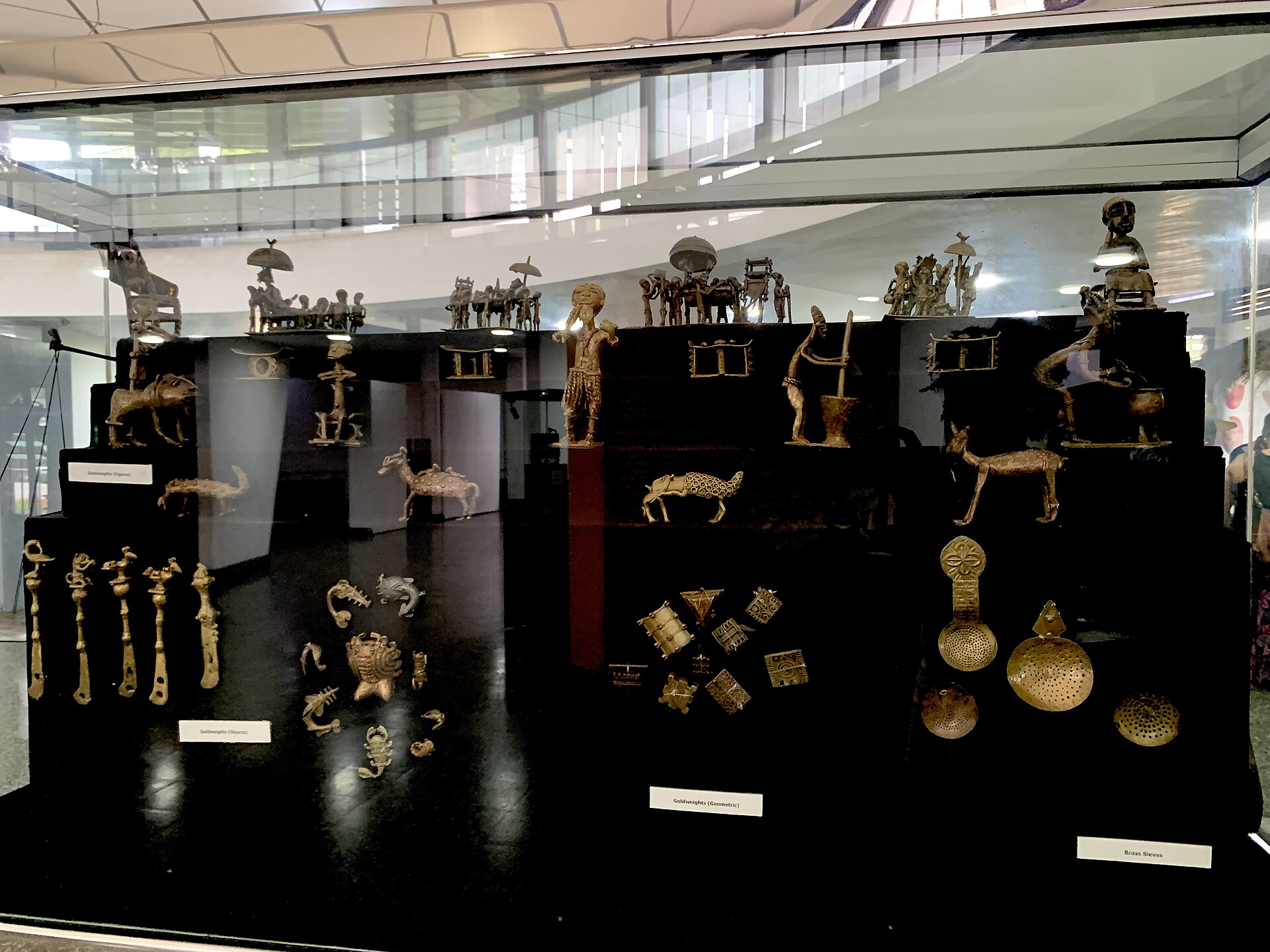
Osei Tutu welded a cluster of rival Akan states into a single empire around 1701, sealing the union with the Golden Stool that his priest Okomfo Anokye is said to have called down from the sky as the soul of the Asante nation. The defeat of the overlord state Denkyira at Feyiase that same year opened the way south toward the coast, the gold, and the Atlantic trade. Asante sat on some of the richest goldfields in West Africa — plentiful enough that Europeans named the shoreline the Gold Coast — and its smiths cast crowns, badges, and regalia by the lost-wax method from the capital at Kumasi. Disciplined armies pushed the empire’s reach across the forest interior, and through the nineteenth century Asante fought Britain in a long run of wars. In the third of them, in 1874, General Garnet Wolseley’s column reached Kumasi, looted the royal treasury, and burned the palace, yet the empire was not finished.
The end came over the Golden Stool itself. In 1896 the British deposed and exiled the Asantehene Prempeh I; in 1900 Governor Frederick Hodgson stood at Kumasi and demanded to sit on the stool. Yaa Asantewaa, Queen Mother of Ejisu, led the last rising, the War of the Golden Stool, with a force of about 5,000; the siege of the British fort failed, she was captured in 1901 and exiled to the Seychelles, and Britain formally annexed Asante on 26 September 1901, folding it into the Gold Coast colony on 1 January 1902. The sovereign empire ended there. The Asante people did not, and neither did the throne: Ghana, independent in 1957, still recognises an Asantehene who reigns from Manhyia Palace in Kumasi over a traditional kingdom — a ceremonial and cultural office, not a state. The Golden Stool survives, never taken. As with the Hawaiian and Zulu kingdoms in this museum, the crown that endures is tradition; the power that ruled is gone.
Worth remembering
- The Golden Stool (Sika Dwa Kofi), by Asante tradition conjured from the sky by the priest Okomfo Anokye, held the soul of the nation; no one, not even the king, could sit on it, and the British never captured it.
- When Governor Frederick Hodgson demanded to sit on the Golden Stool in 1900, Yaa Asantewaa, Queen Mother of Ejisu, led roughly 5,000 warriors in the War of the Golden Stool; captured in 1901, she was exiled to the Seychelles, where she died on 17 October 1921.
Gallery
Sources
- The Asante Empire was founded c. 1701 by Osei Tutu and Okomfo Anokye, unified around the Golden Stool after defeating Denkyira at Feyiase (1701); Britain annexed Asante on 26 September 1901 and the Asantehene became a ceremonial figure within Ghana. Wikipedia
- Asante used their gold wealth to build an empire from the late 17th century; the region's gold was so plentiful it earned the name 'the Gold Coast,' and goldsmiths cast regalia by the lost-wax method. Penn Museum (Expedition Magazine)
- The Golden Stool, said to have descended from heaven and presented to the first Asantehene by the priest Okomfo Anokye, holds the spirits of past kings and cannot be sat upon; Wolseley's troops reached Kumasi on 4 February 1874, looted the royal regalia, and burned the palace. Victoria and Albert Museum
- The 1900 Ashanti Expedition (War of the Golden Stool) was triggered by Governor Frederick Hodgson demanding to sit on the Golden Stool at Kumasi; the rising was suppressed and Britain occupied the whole Asante Empire by 1900–1901. University of Edinburgh, Anatomical Museum
A graveyard tradition: leave a stone to show you came, and remembered.