
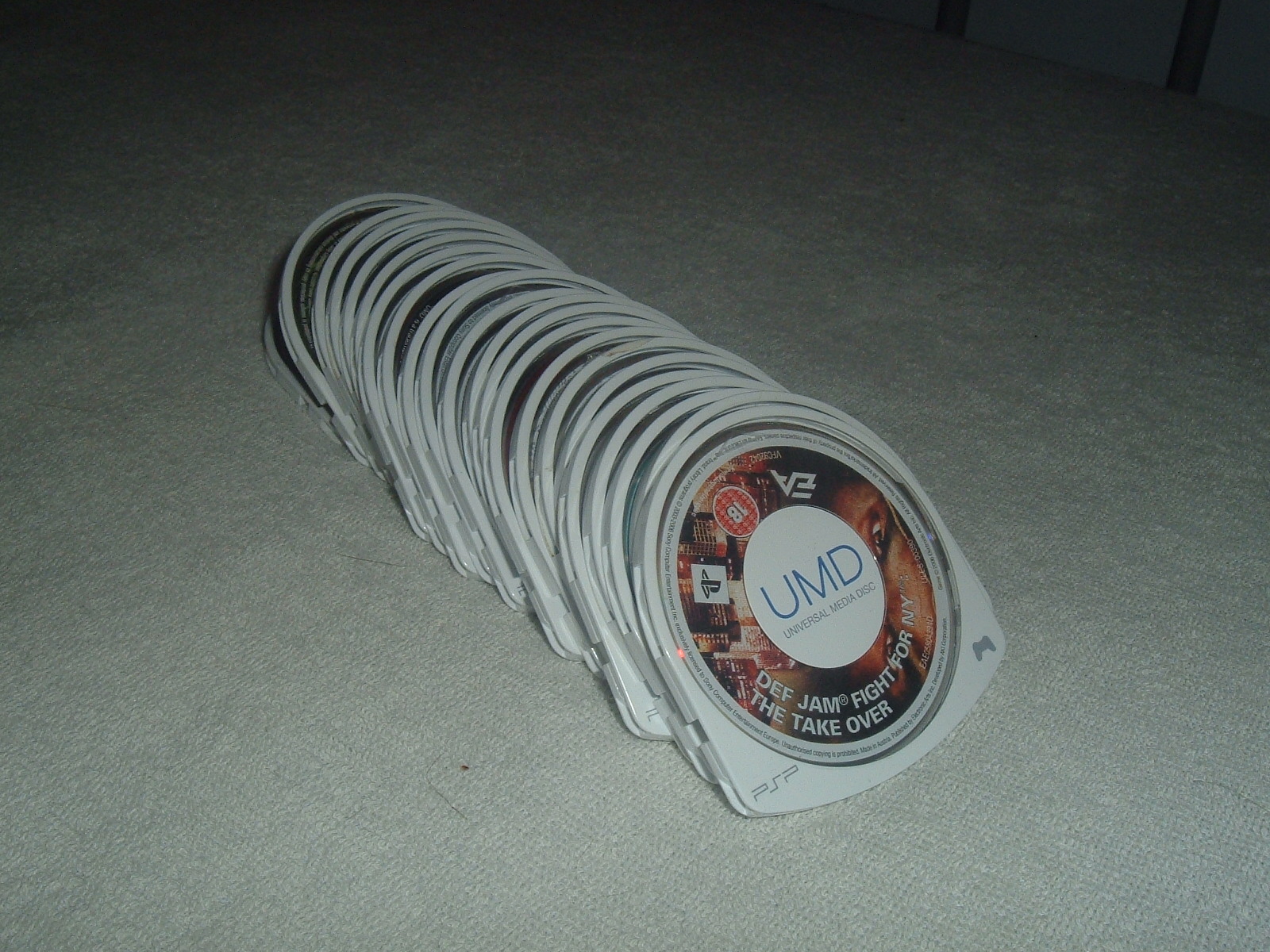
The Universal Media Disc was Sony’s attempt to put an optical disc in your pocket. Introduced in 2004 for the PlayStation Portable, it packed up to 1.80 GB onto a 64 mm dual-layer disc sealed inside a small plastic caddy, so you loaded the cartridge whole and never touched the disc itself. It carried PSP games, and Sony also pushed UMD Video — full-length movies and TV shows pressed for the handheld, launched in tandem with the system. For a stretch in 2005, studios pressed hundreds of films to UMD and stores stocked them next to DVDs. The disc only ever worked in one machine: the PSP, which shipped somewhere around 80 to 82.5 million units across its lifetime. That single-host dependency is the whole story of how it died.
UMD Video broke first. The discs cost about as much as a DVD but carried no extras and played on nothing but a PSP, and buyers ignored them. By March 2006 Universal and Paramount had stopped shipping UMD movie titles, Wal-Mart was pulling shelf space, and the trade press was already calling the movie format dead; film releases trailed off and ended by 2011. Games lasted longer, but the format had no escape route. When Sony built the PSP’s successor, the PlayStation Vita, it announced at GDC 2011 that UMD was gone — replaced by 2 GB and 4 GB flash game cards and digital downloads — and the Vita that launched in December 2011 had no disc drive at all. No later console ever read a UMD; the standard did not carry forward under any name. The last PSP rolled off the line on 26 September 2014, and with the only hardware that could read it discontinued, the disc had nowhere left to spin.
Worth remembering
- Capacity 1.80 GB dual-layer (900 MB single-layer) on a 64 mm disc, permanently sealed in a plastic caddy so the bare disc was never handled.
- The PSP, the only hardware that ever read UMDs, shipped roughly 80–82.5 million units over its 2004–2014 run; UMD Video launched alongside it but collapsed fast, with Universal and Paramount halting titles by early 2006.
Gallery
Sources
- UMD held up to 1.80 GB (dual-layer), 900 MB single-layer, on a 64 mm read-only optical disc inside a sealed cartridge; released 12 Dec 2004; the PS Vita did not include UMD support and it was never added. Wikipedia
- By March 2006 Universal and Paramount had stopped shipping UMD movie titles and Wal-Mart began cutting shelf space, with reports declaring UMD movies close to failure. Digital Trends
- At GDC 2011 Sony announced the PSP successor (Vita) would drop the UMD format for 2 GB / 4 GB flash game cards; the Vita launched in Japan 17 Dec 2011 with no UMD drive. Wikipedia
- Sony discontinued the PSP after roughly 10 years; final manufacturing ended 26 Sep 2014, with PSP lifetime production around 82.5 million units. GameSpot
A graveyard tradition: leave a stone to show you came, and remembered.