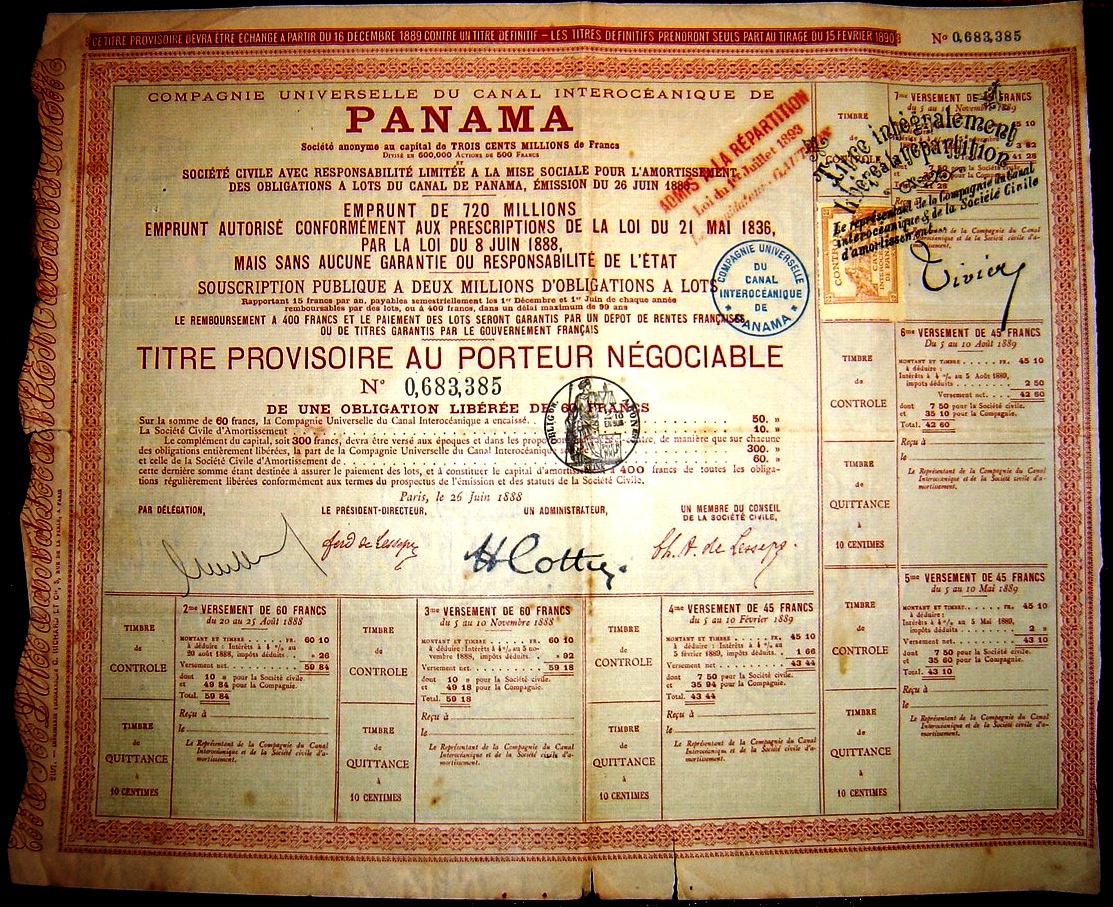
Riding the prestige of Suez, Ferdinand de Lesseps founded the Compagnie Universelle in 1879 to cut a sea-level canal through Panama, and ordinary France believed in him. Some 800,000 small investors put up around one and a half billion francs — the largest private undertaking of the nineteenth century — on the word of the man who had joined two seas at Suez. Digging began in 1881.
Panama was not Egypt. A sea-level canal through mountains and jungle was beyond the era’s engineering, and the isthmus killed the workforce faster than it could be replaced: by 1889 roughly twenty-two thousand were dead of yellow fever and malaria, a toll the company quietly understated. The money ran out against the rock, and in February 1889 a Paris court ordered the company into liquidation, wiping out the savers. The wreck then turned into one of the Third Republic’s great corruption scandals: company funds, it emerged, had bribed more than a hundred deputies to keep the failing venture alive. De Lesseps, his son, and Gustave Eiffel were convicted in 1893. A salvage company carried the concession a while longer and sold what was left to the United States in 1904 — which, with mosquito control the French never had, finished the canal the French company died attempting.
Worth remembering
- In 1893 de Lesseps, his son Charles, and the engineer Gustave Eiffel were convicted of fraud; the trial revealed that company money had bribed more than a hundred members of the Chamber of Deputies to keep the failing venture afloat and the press quiet.
- By 1889 roughly 22,000 workers had died on the isthmus, overwhelmingly from yellow fever and malaria — deaths the company under-reported, because the sick avoided its hospitals whenever they could.
Gallery
Sources
- A Paris court placed the Compagnie Universelle into liquidation in February 1889; the failure became the Panama Scandal, in which company money was found to have bribed scores of members of the Chamber of Deputies Encyclopaedia Britannica
- The company's collapse ruined roughly 800,000 private French investors; the United States later purchased the remaining assets of the successor Compagnie Nouvelle for $40 million in 1904 PBS American Experience
- The Compagnie Universelle du Canal Interocéanique was organized in August 1879 and dissolved by its shareholders in early 1889; the Compagnie Nouvelle was organized in October 1894 to preserve the concession Autoridad del Canal de Panamá (Panama Canal Authority)
A graveyard tradition: leave a stone to show you came, and remembered.