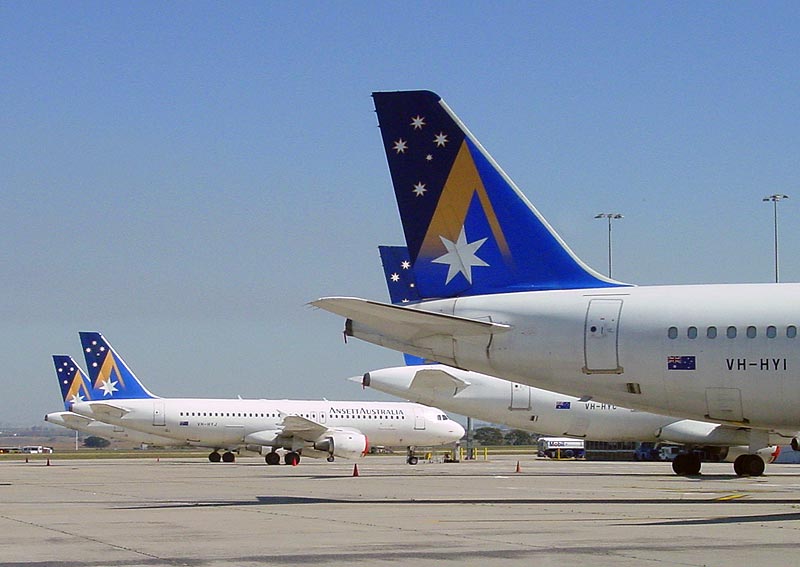
Ansett was born in 1935 out of spite: refused a licence to run a road-haulage business, Reginald Ansett started flying passengers instead. For the next sixty years it was one half of Australian aviation. Under the “two-airline policy” that protected a cosy domestic duopoly, Ansett and the government carrier carved up the country between them, and by the mid-1990s Ansett held about half the domestic market with a fleet of 134 aircraft reaching 88 destinations. It was the airline of ordinary Australian travel, woven into the timetable of national life.
Two slower forces killed it, and a third made it sudden. Bought by Air New Zealand, Ansett was starved of the capital its ageing fleet needed — an ownership overreach that left it carrying high costs into a deregulated market. There the low-cost upstart Virgin Blue flew the same routes at roughly half the cost per seat-kilometre, and Ansett’s legacy model was simply obsolete against it. Then came September 2001: aircraft values collapsed worldwide the same week, and on 14 September the fleet was grounded. Administration came on the 12th, the last flight on 5 March 2002, and full liquidation after — unsecured creditors recovered nothing on around three billion dollars. The brand resurfaced in 2025 on an unrelated travel app; the airline that half the country once flew was already two decades gone.
Worth remembering
- When the fleet was grounded on 14 September 2001, about 16,500 employees lost their jobs overnight and another 60,000 supplier jobs were put at risk — the largest single corporate collapse of jobs in Australia to that point.
- Its cost to fly one seat one kilometre was roughly double Virgin Blue's — a structural gap that made survival close to arithmetically impossible, with or without the shock of September 11.
Gallery
Sources
- Reginald Ansett registered Ansett Airways in 1935 after Victoria's Transport Regulation Board refused him a road-haulage licence, flying his first service Hamilton–Melbourne in February 1936 Australian Dictionary of Biography, Australian National University
- Air New Zealand's loss on Ansett reached NZ$1.425 billion — the largest in New Zealand corporate history; unsecured creditors ultimately received nothing and employee entitlements owed ran to hundreds of millions World of Aviation
- Ansett's domestic market share fell from about 50% in the mid-1990s to 39% by 2001, and Qantas held roughly 77% of the domestic market after Ansett's exit AirlineRatings.com
A graveyard tradition: leave a stone to show you came, and remembered.