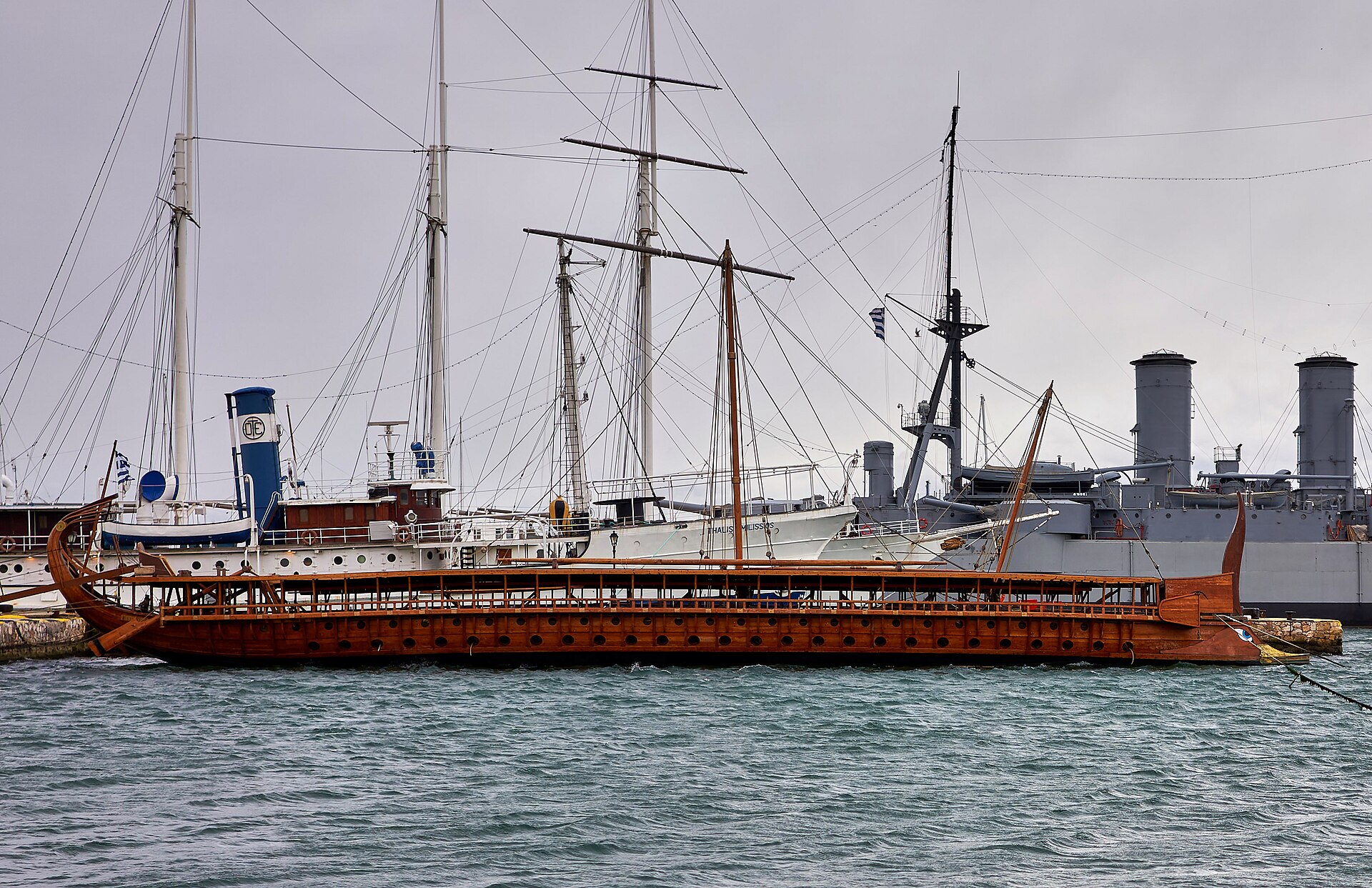
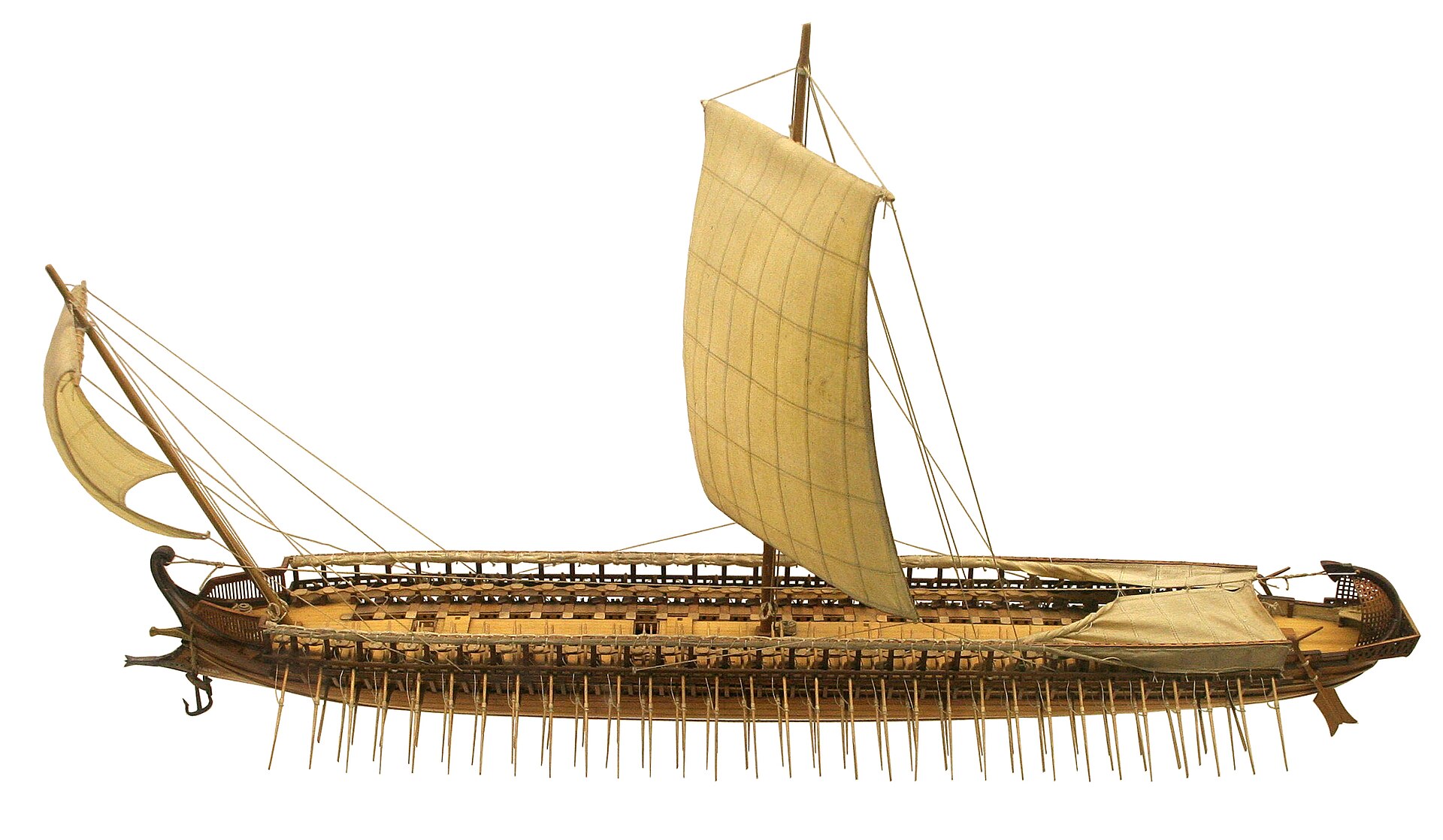
The trireme was not the first oared Mediterranean warship, but it was the one that turned naval power into a form of state power. Corinth adopted the design from earlier Phoenician models around 700 BCE, and Athens perfected it: a 37-meter hull carrying 170 oarsmen stacked in three tiers — thranitai on top, zygitai in the middle, thalamitai below, each bank timed to a different stroke length in the same hull — driving a bronze ram at the bow. Themistocles talked Athens into spending its silver-mine windfall on 200 of them in 483 BCE, and two years later that fleet met the Persian navy in the narrows at Salamis and broke it. For the next century and a half, a city-state’s trireme count was its foreign policy. Athens’ shipsheds at Piraeus could berth over 300 of them at the empire’s height, and the fleet that built and lost that empire — through the Delian League, the Peloponnesian War, and its final surrender in 404 BCE — was built entirely from this one hull form.
What ended it was not a better trireme. It was a bigger ship built on a different principle. Late in the 4th century BCE, first under Philip II and then more aggressively under the Hellenistic successor kingdoms, navies started building quadriremes and quinqueremes — ships that put multiple rowers on a single oar instead of one rower per oar across three cramped banks. The polyremes were slower and less agile, but they had thicker hulls, bigger crews, and enough deck space to carry marines, archers, and siege engines for the kind of sustained sieges and troop landings that Alexander’s successors actually needed. The trireme’s advantage — a fast, precise ram in the hands of a lean crew — mattered less than a hull that could take a hit and keep fighting. By the 3rd century BCE the quinquereme was the Mediterranean’s standard capital ship, and the trireme’s role had shrunk to scouting and patrol.
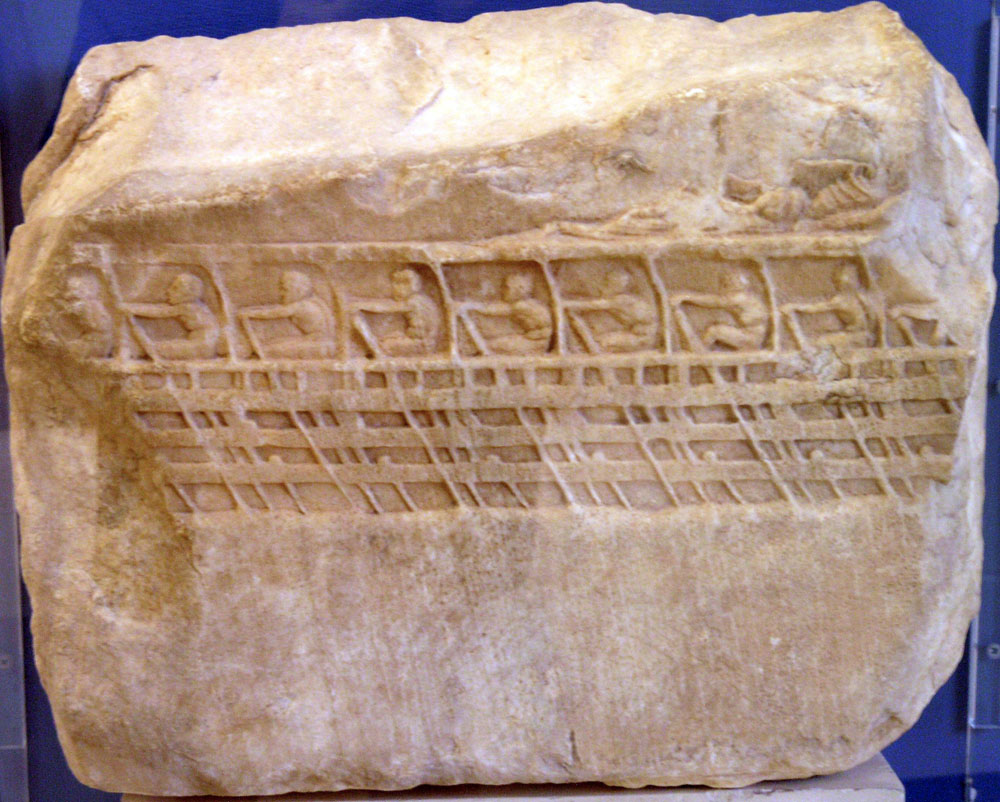
The ship itself was easy enough to remember. What was lost was the specific mechanical knowledge of how 170 oarsmen in three superimposed banks actually rowed without the top tier’s oars fouling the ones below — an arrangement so implausible on paper that by the 20th century most naval historians assumed it couldn’t have worked as described. Settling it took more than argument: in 1982 the historian John Morrison, naval architect John Coates, and writer Frank Welsh founded the Trireme Trust to build a full-scale, functioning replica from scratch, using ancient shipsheds, vase paintings, and the Lenormant Relief as their only blueprints. Olympias launched in 1987, and sea trials with 170 volunteer rowers through 1994 got her to 9 knots and a 180-degree turn inside two and a half ship-lengths — proof the three-bank design could work at all. It also could not fully recover what it set out to prove: Olympias has never matched the ram-charge speed ancient sources describe, historians still argue over the exact oar geometry the trust chose, and the ship today sits in a dry dock in Palaio Faliro as a museum piece, not a warship anyone builds twice. Two centuries of naval supremacy, and the fleet that won Salamis had to be reverse-engineered by a committee two and a half thousand years later, from a stone carving and a guess.
Worth remembering
- At Salamis in 480 BCE, an outnumbered Athenian-led fleet of triremes used the strait's narrow waters to neutralize the Persian fleet's numbers, ramming and disabling ships that had no room to maneuver — the battle that broke the Persian invasion of Greece and set the trireme as the era's decisive weapon of state power.
- A trireme carried 170 oarsmen stacked in three tiers so tight that the top-bank thranitai rowed almost directly above the heads of the thalamitai below — a rowing arrangement so mechanically implausible on paper that when naval historians tried to resolve the debate in the 1980s, the only way to settle it was to build one and put 170 people in the seats.
Gallery
Sources
- Thucydides records that the Corinthians were the first on the Greek mainland to adopt the trireme, around 700 BCE, though the design is generally credited to earlier Phoenician shipbuilders; the type reached its highest development in 5th-century BCE Athens Wikipedia
- The classical Athenian trireme measured roughly 37 meters long and 6 meters wide, carried a crew of about 200 including 170 oarsmen arranged in three tiers (62 thranitai, 54 zygitai, 54 thalamitai), plus marines, and could sustain roughly 6 knots under oar over open water Wikipedia
- Athens built a fleet of 200 triremes under Themistocles in 483/2 BCE and used it to win the decisive naval victory over Persia at the Battle of Salamis in 480 BCE, establishing Athenian naval supremacy in the Aegean through the end of the Peloponnesian War in 404 BCE Wikipedia
- By the late 4th century BCE, quadriremes and quinqueremes — which used multiple rowers per oar rather than one rower per oar across three banks — began displacing the trireme as the Mediterranean's standard capital warship; these heavier ships traded the trireme's speed and agility for thicker hulls, larger crews, and greater capacity for marines and siege equipment, and by the 3rd century BCE the quinquereme was the standard warship across the Mediterranean Ancient War History
- The Trireme Trust was founded in 1982 by historian John Morrison, naval architect John Coates, and writer Frank Welsh specifically to resolve a long-standing scholarly controversy over how the trireme's three-tier oar system actually worked; almost universal academic opinion at the time held that a genuine three-level oar arrangement was physically impracticable The Trireme Trust
- The full-scale reconstruction Olympias, built 1985-87 in Piraeus and commissioned by the Hellenic Navy in August 1987, was rowed by 170 volunteers in sea trials that reached 9 knots and executed 180-degree turns in under a minute within an arc of two and a half ship-lengths — trials repeated in 1990, 1992, and 1994 that demonstrated the three-bank design was seaworthy after all, though the ship's true ancient ramming speed (estimated above 16 knots) has never been matched, and disputes over the exact oar-length and nesting geometry persist among the historians who built her Wikipedia
A graveyard tradition: leave a stone to show you came, and remembered.