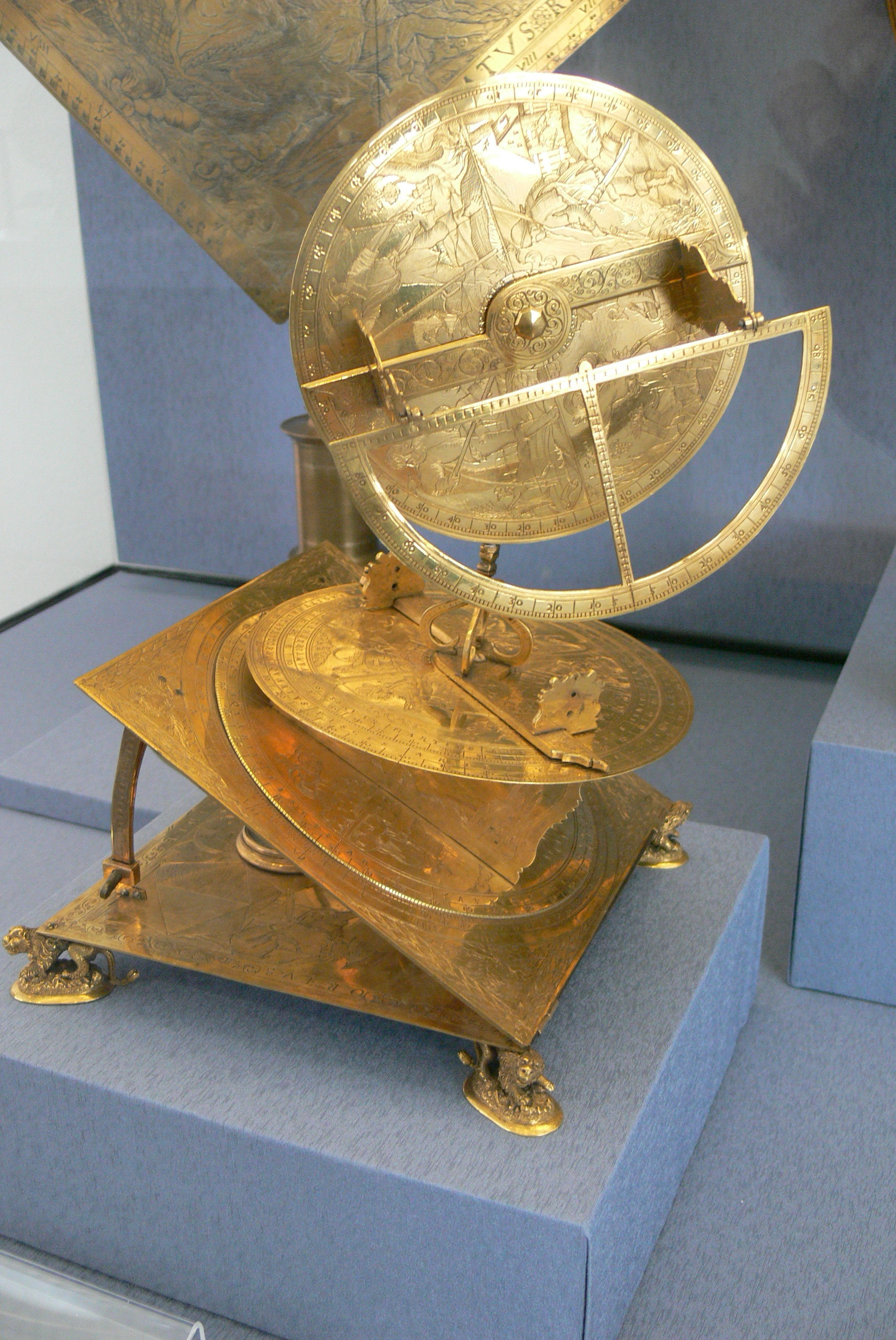
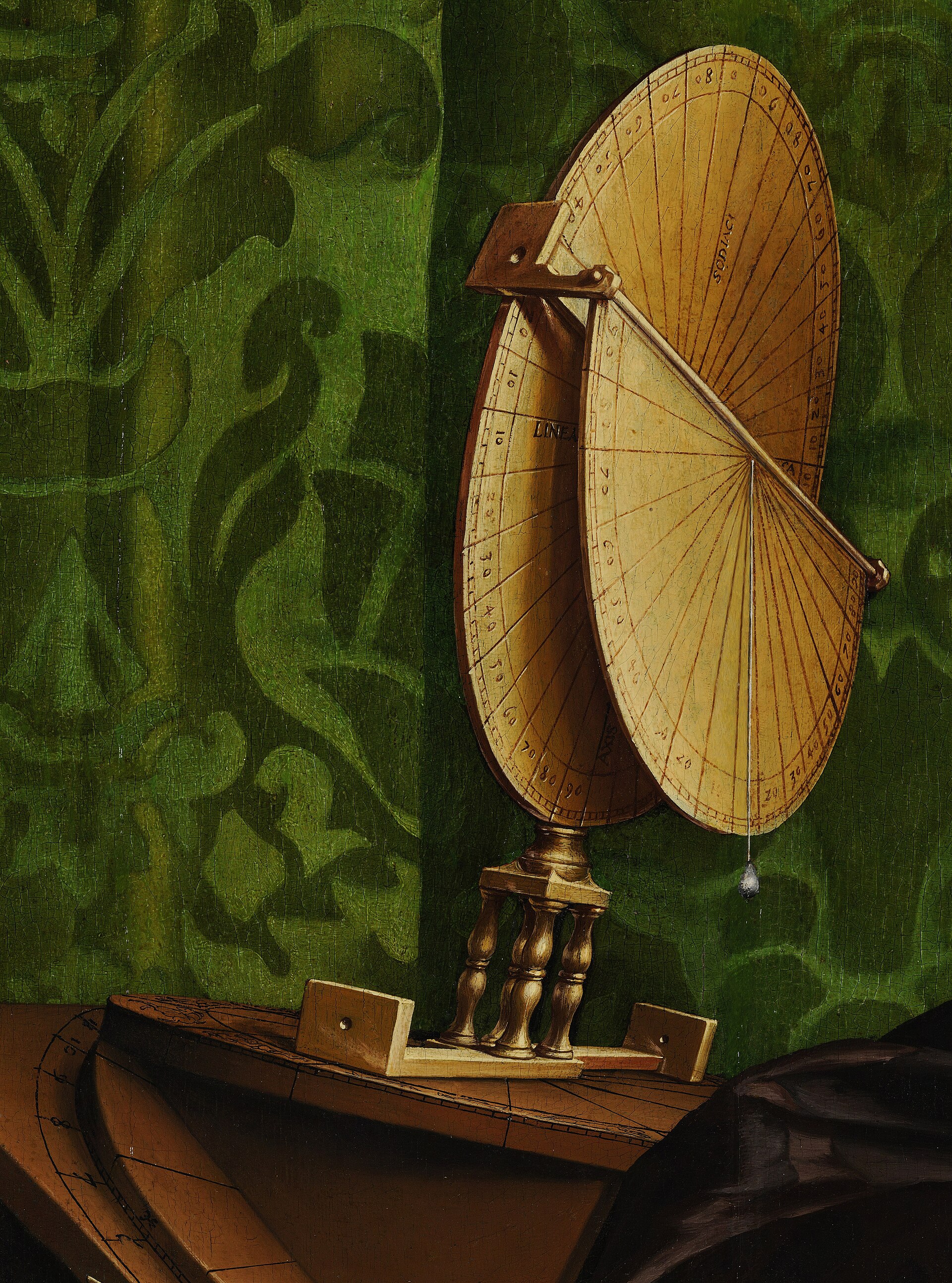
The torquetum was a brass-and-wood analog computer for the sky. Where an astrolabe flattened the heavens onto a single disc, the torquetum stacked the three coordinate systems astronomers actually used — horizon, equatorial, and ecliptic — onto hinged plates set at the observer’s latitude and the 23.5° tilt of the ecliptic. Sight a star through it and you could read its position in one system and, by turning to the next graduated circle, read the same star’s coordinates in another, without trigonometry. Bernard of Verdun and Franco of Poland described how to build one in the 13th century, Franco’s “Modus construendi torquetum” carrying the date 1284; Regiomontanus traced the idea back further, to the Andalusi astronomer Jabir ibn Aflah. By the Renaissance it had become shorthand for mathematical sophistication itself, which is why Holbein set one on the upper shelf of “The Ambassadors” in 1533 and why Peter Apian engraved it into his luxury astronomy books a few years later.
It was also expensive, fragile, and only as accurate as the eye reading its small graduations — and that combination did not survive contact with better instruments. Tycho Brahe got far finer positions in the 1580s from large, rigidly built mural quadrants and armillaries that did one job precisely rather than three jobs adequately, and after 1609 the telescope began resolving positions the naked-eye torquetum could never reach. The coordinate conversions it performed mechanically were taken over by tables and then by direct computation on equatorial mounts that simply slewed to the right place. No torquetum is known to survive from before the 16th century, and by the 17th the instrument had quietly fallen out of use; only a handful of Renaissance examples, like Praetorius’s 1568 piece in Nuremberg, remained — as objects to keep, not to use. The sky kept being measured. The torquetum did not.
Worth remembering
- Built three coordinate planes into one hinged frame — laid flat it read horizon coordinates, its base tilted to the observer's co-latitude gave equatorial coordinates, and its upper disc set at the 23.5° obliquity gave ecliptic coordinates — so a position could be read directly and converted mechanically.
- Depicted in Holbein's 'The Ambassadors' (1533) as a marker of learning; the best surviving documentation comes from Peter Apian's woodcuts of the 1530s–1540s, and a physical example built by Johannes Praetorius in Nuremberg in 1568 survives in the Germanisches Nationalmuseum.
Gallery
Sources
- The torquetum was an analog instrument that took and interconverted celestial measurements across three coordinate systems — horizon, equatorial and ecliptic — without calculation; the only surviving examples date from the 16th century. Wikipedia
- The instrument's construction was described by Franco of Poland (Franco de Polonia, fl. 1284) in his treatise 'Modus construendi torquetum'. Bodleian Libraries, University of Oxford
- A torquetum is depicted on the table in Hans Holbein the Younger's 1533 painting 'The Ambassadors'; Petrus Apianus illustrated the instrument in the 1530s–1540s (Astronomicum Caesareum, 1540). Wikimedia Commons / National Gallery, London
A graveyard tradition: leave a stone to show you came, and remembered.