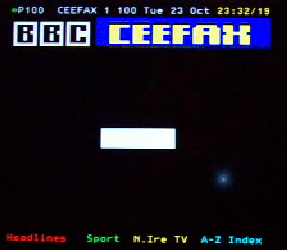
Teletext worked by encoding text and simple graphics into unused scan lines in a standard television broadcast signal — the vertical blanking interval that appeared as a black bar when a TV rolled. A decoder chip in the television captured these data streams and displayed numbered pages on request. BBC’s Ceefax launched in September 1974; ITV’s ORACLE followed. By 1982 two million UK households had teletext TVs; by the mid-1980s it was standard equipment on nearly every European set. Pages covered news headlines, sports results, weather, TV schedules, and financial data — functions that the web would later perform, but available with no internet connection and essentially zero latency once a page loaded.
The World Wide Web began eroding teletext’s purpose from the late 1990s. News organisations migrated online; younger viewers went to the web for the same information faster and with more depth. Teletext lingered because it remained free with a TV licence and required no separate subscription or hardware — but as analogue broadcasting was switched off across Europe, the platform disappeared with it. BBC Ceefax went dark in October 2012 after 38 years. Ireland’s Aertel outlasted it by a decade, finally closing in October 2023. The format never took hold in North America, where cable made the broadcast bandwidth less scarce and the technical investment was never made.
Worth remembering
- Teletext pages were broadcast on a continuous cycle — selecting a page number meant waiting for it to rotate back around, sometimes 20–30 seconds — a design constraint that shaped the entire editorial format toward short, scannable updates.
- BBC Ceefax page 301 (sport) and page 302 (football results) were some of the most-watched pages in British broadcasting during the 1980s and 1990s, checked at halftime and full-time by viewers who could not wait for the evening news.
Gallery
Watch
Sources
- BBC Ceefax launched September 23, 1974; two million teletext sets in the UK by 1982; Ceefax closed in 2012 Wikipedia
- The World Wide Web began to take over some of the functions of teletext from the late 1990s; teletext was available as an option on almost every European TV set by the mid-1980s Wikipedia
- Teletext uses the vertical blanking interval to send text and simple graphic information; widely adopted in Europe, relatively obscure in North America Encyclopaedia Britannica
A graveyard tradition: leave a stone to show you came, and remembered.