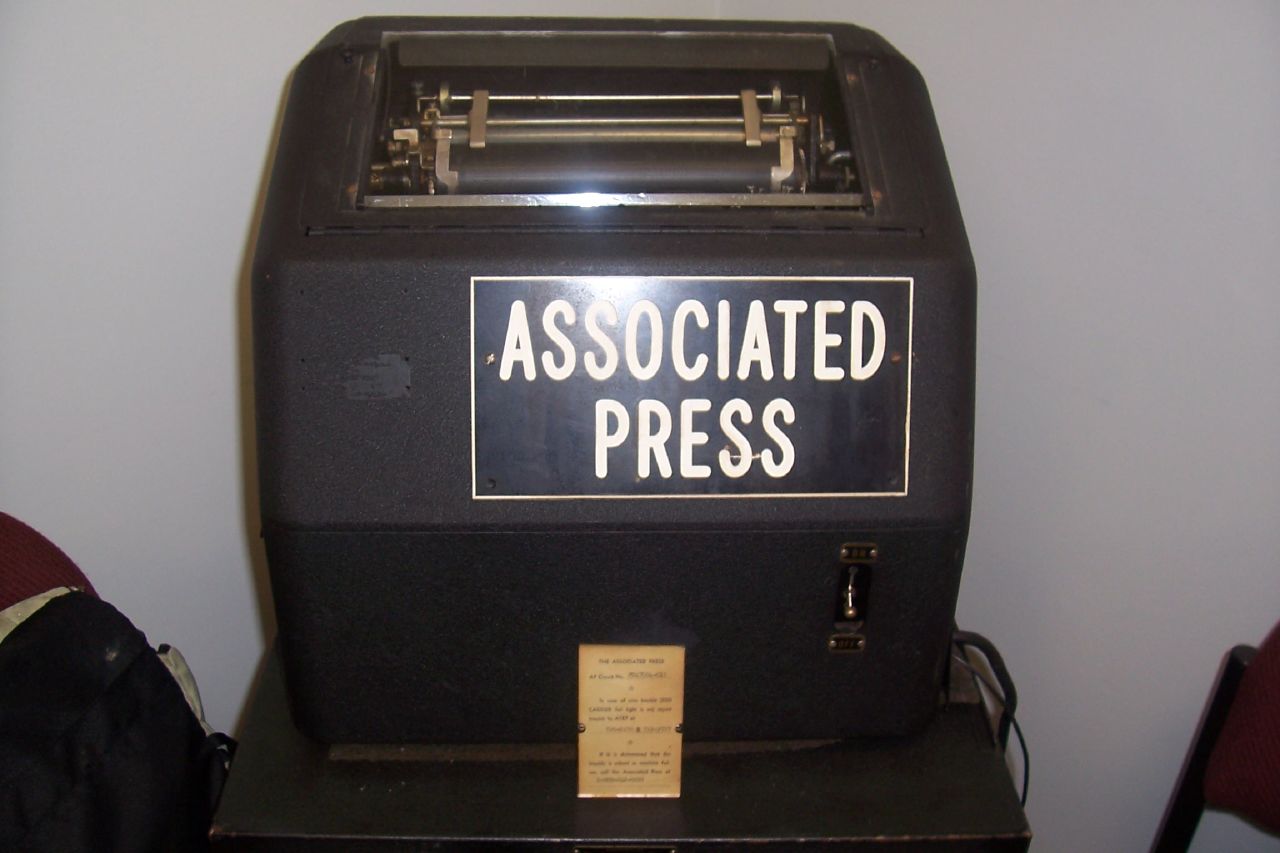
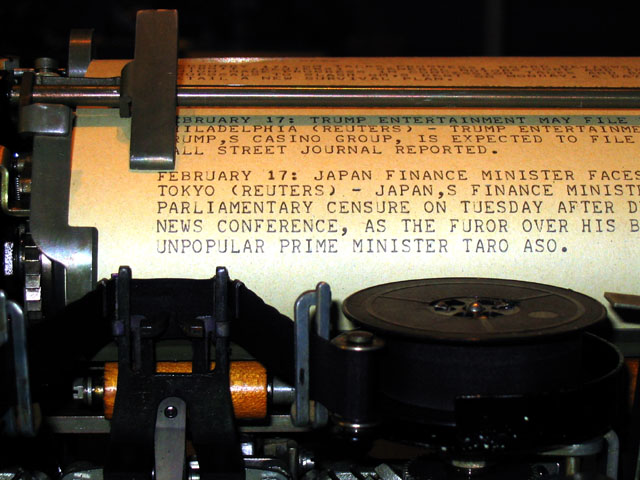
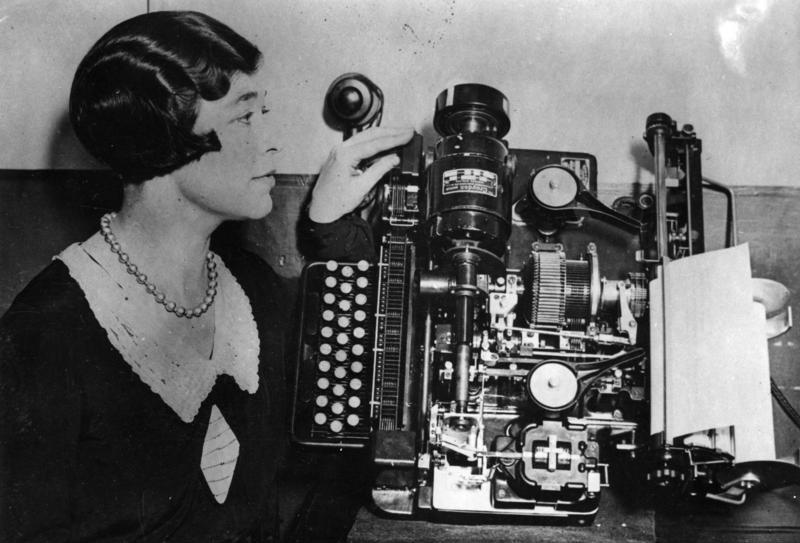
The teleprinter was the machine, not the network: a typewriter wired to print, automatically and instantly, whatever was typed on a matching machine somewhere else. Émile Baudot’s five-unit code from the 1870s made the character set possible, but it was Donald Murray, a New Zealand-born engineer, who in 1901 made the machine usable — swapping Baudot’s synchronized, multi-operator keyboards for a keyboard perforator that punched paper tape at each operator’s own pace. The Morkrum Company built the first commercial installation on that lineage between Boston and New York in 1910, and the Associated Press put a Morkrum printing telegraph into newsroom service in 1914. From there the teleprinter became the workhorse behind the wire services — AP, Reuters, UPI — clattering out bulletins onto rolls of paper, with bells built into the machine itself to flag a story’s urgency before an editor read a word: three for an advisory, five for a bulletin, and on AP’s machines twelve straight bells for a flash, the rarest and most urgent classification on the wire. The same underlying technology, stripped down to a keyboard, a printer, and a modem-like coupler, also gave the deaf a way to hold a real-time conversation over an ordinary phone line, as a Telecommunications Device for the Deaf (TDD) — a use that outlived the machine’s newsroom career by a decade or more.
Telex, the switched public network launched in Germany in 1933, rented teleprinters to subscribers and connected them number-to-number the way the phone system connected voices; the teleprinter itself is older than that network and outlasted it in specialized settings the network never served. Newsrooms were the first to let it go: United Press International and then the Associated Press replaced their last mechanical Teletypes with electronic high-speed printers by mid-September 1986, as wire copy moved onto video display terminals and, later, newsroom computers. TDD units for the deaf held on longer, since no equally simple alternative existed yet, until internet relay services and telecommunications relay systems absorbed that role through the 1990s. The bell that once stopped a newsroom cold went quiet machine by machine, replaced by a screen that made no sound at all.
Worth remembering
- Donald Murray's 1901 system replaced Émile Baudot's synchronized multi-operator keyboards with a keyboard perforator punching paper tape, letting each operator type at their own rhythm instead of in lockstep.
- On wire-service machines, bells rang to flag a story's urgency before anyone read a word of it — five bells for a bulletin, twelve on AP's machines (ten on UPI's) for a flash, loud enough to stop a newsroom cold.
Gallery
Sources
- Donald Murray patented an automatic five-unit telegraph system with a typewriter-like keyboard and paper-tape perforator in 1901, an ancestor of the teleprinter Wikipedia
- The Morkrum Company made its first commercial teleprinter installation between Boston and New York in 1910; the Associated Press adopted the Morkrum printing telegraph in 1914 Wikipedia
- Wire-service teleprinters rang bells to flag a story's urgency — flashes were signaled by twelve bells on AP machines and ten on UPI's, 'and they could stop the whole nation in its tracks' Poynter
- The Associated Press announced it expected to replace the last of its old Teletype machines with modern high-speed printers by mid-September 1986, after UPI had already done so Poynter
- Teleprinters, including Telecommunications Devices for the Deaf, became functionally obsolete as fax machines, personal computers, email, and the internet took over their roles from the 1980s onward Wikipedia
A graveyard tradition: leave a stone to show you came, and remembered.