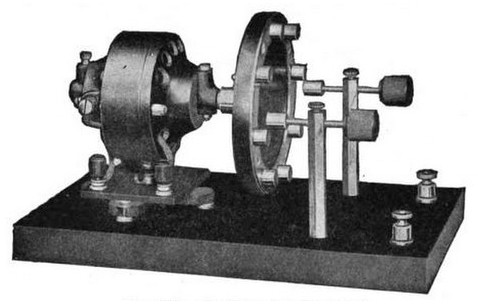
For the first quarter-century of radio there was essentially one kind of transmitter, and it worked by making a spark. A bank of capacitors charged up and discharged across a gap in a violent spark, shock-exciting a tuned circuit into a brief burst of oscillation that died away as the energy bled out — a “damped wave.” Heinrich Hertz used a spark gap to prove radio waves existed in 1887; Marconi turned the principle into a business from the mid-1890s. By the 1900s every coastal station, every naval set, and every ship’s wireless room ran on spark. When the Titanic sank in 1912, the distress calls that brought the Carpathia were spark transmissions tapped out in Morse.
The technology had two deep faults baked into its physics. It could not carry a voice — the damped pulse was good only for keying Morse on and off — and it was filthy across the spectrum. Because each spark rang out a quick, decaying burst rather than a steady tone, the signal spread over a wide band of frequencies, so a single spark station occupied the room that dozens of clean transmitters would later share. As the airwaves filled up after the First World War, that spectrum-hogging noise became intolerable.
The vacuum tube ended it. De Forest’s triode and the feedback-oscillator circuits that followed could generate a steady, narrow continuous wave — cleaner, longer-ranged, capable of carrying speech, and far less interfering. Spark was commercially obsolete by about 1920, but it did not just fade: the 1927 international radiotelegraph convention set out to stamp it out, barring new spark installations and then forbidding damped-wave emission outright, so that by the mid-1930s spark radio was illegal for ordinary use. Shipowners fought to slow the ban — they had a fleet full of working spark sets and no wish to rip them out — but the rules held. It is one of the few technologies in this museum that was not merely replaced but prohibited, because the way it worked made the airwaves worse for everyone.
Worth remembering
- It could only send Morse code, never a voice. A high-voltage spark shock-excited a tuned circuit into a quick, dying burst of radio energy — a 'damped wave' — so the output was a smear of frequencies rather than a single clean tone. Reginald Fessenden needed an entirely different transmitter to broadcast speech.
- When the Titanic went down in 1912, her operators were sending CQD and SOS from a rotary spark set; the disaster drove new rules mandating round-the-clock wireless watch on passenger ships, which kept spark installations bolted into the merchant fleet for another decade after they were technically obsolete.
Gallery
Sources
- Spark-gap transmitters produced 'damped waves' with very large bandwidth that caused electromagnetic interference; they were superseded by vacuum-tube continuous-wave transmitters by around 1920, and damped-wave emission has been prohibited by international regulation since the mid-1930s Wikipedia
- The 1927 Washington International Radiotelegraph Convention (effective 1929) barred new spark land-station installations and progressively forbade damped-wave emissions; shipping interests lobbied to delay the ban given the cost of replacing legacy marine sets Wikipedia / ITU regulatory history
A graveyard tradition: leave a stone to show you came, and remembered.