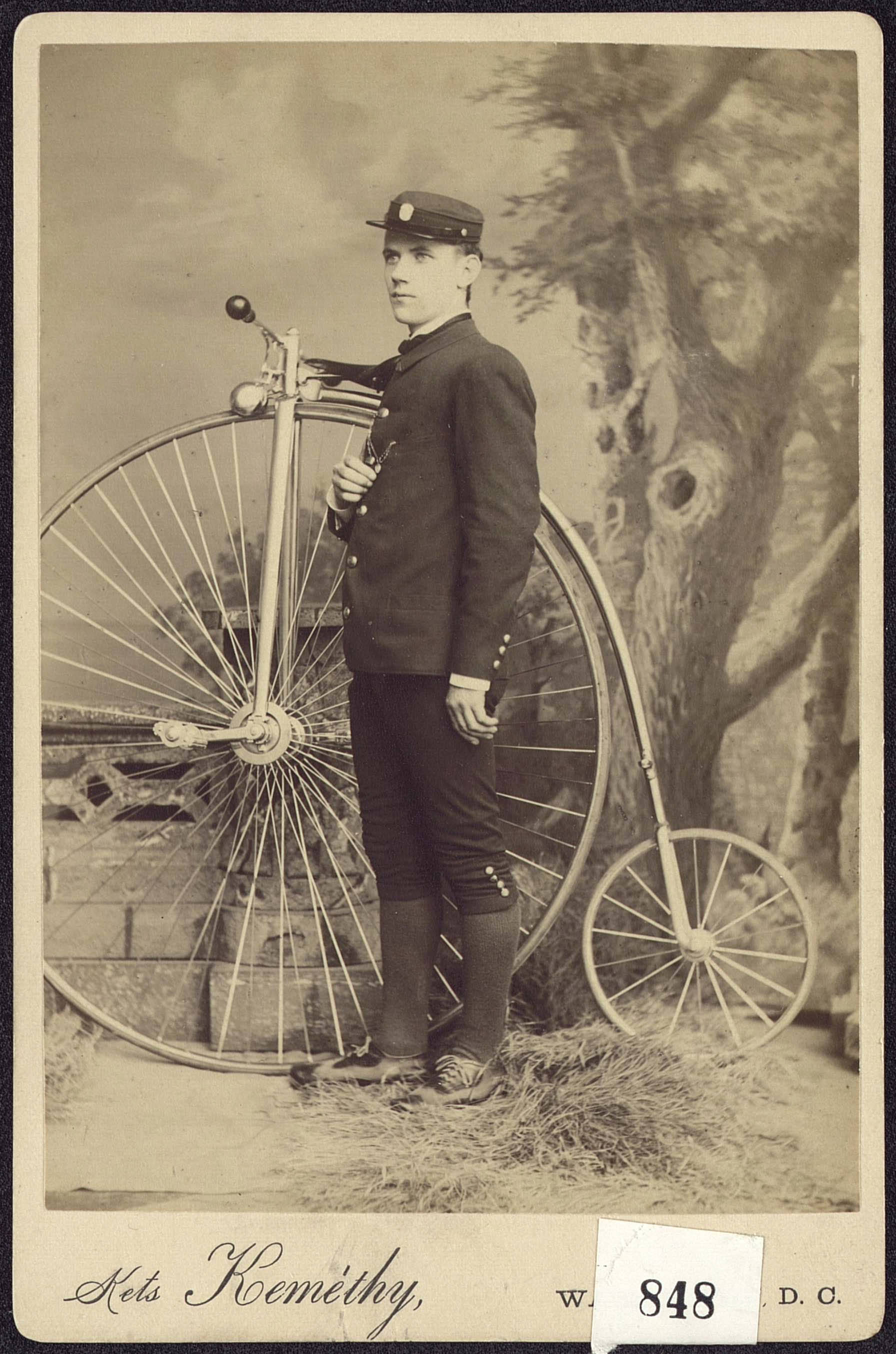
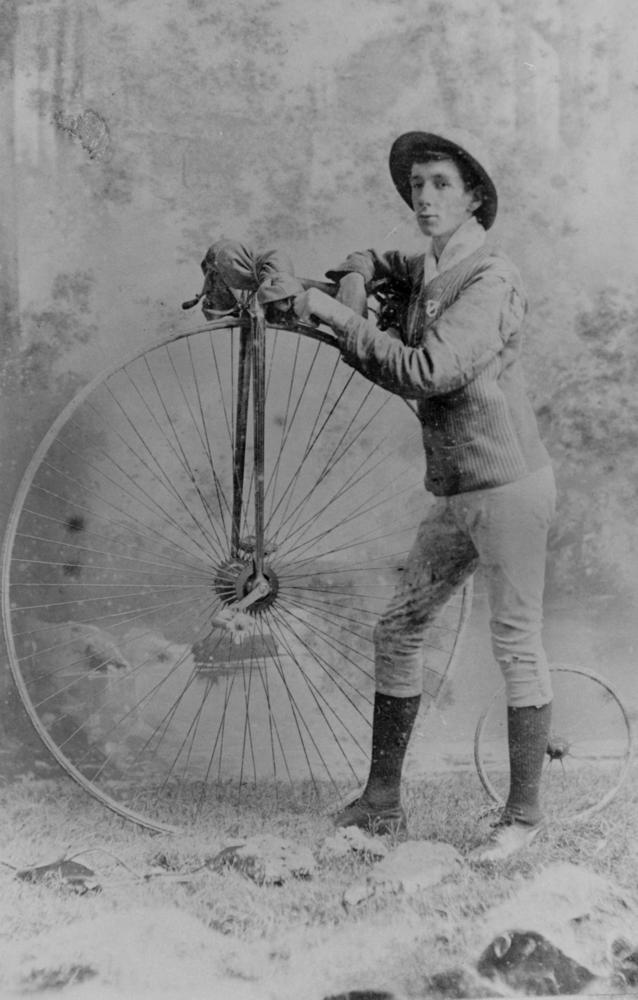
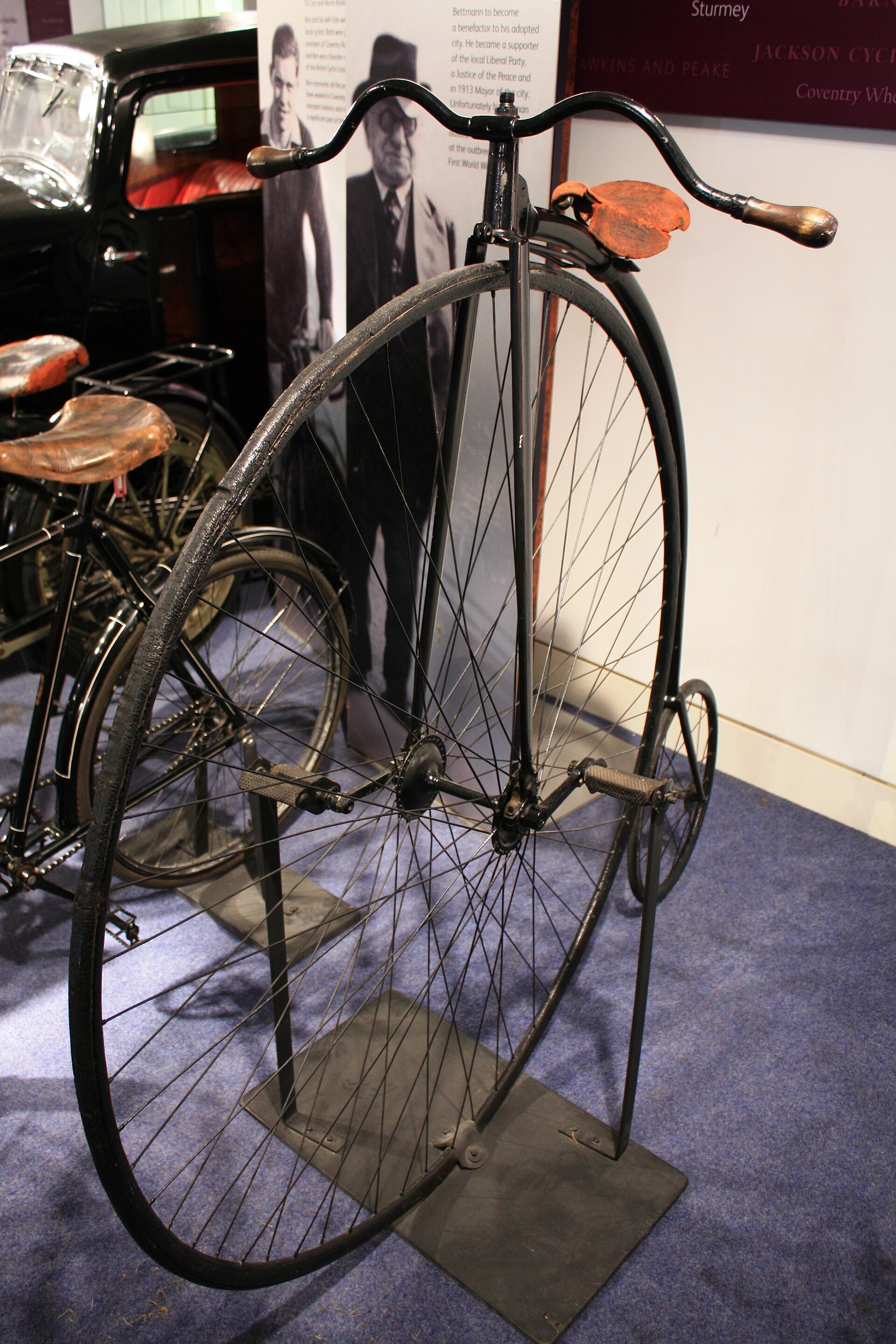
The penny-farthing was the first vehicle the public actually called a “bicycle,” and its absurd silhouette was a piece of engineering logic. In the early 1870s there was no chain drive, so the pedals were fixed straight to the front wheel’s axle — one revolution of the legs moved the machine exactly one turn of the wheel. The only way to cover more ground per stroke, and so go faster, was to make the driven wheel bigger. James Starley’s “Ariel” of 1870–71 did just that, and the design settled into the familiar shape: a front wheel as tall as the rider’s legs allowed, up to five feet, and a tiny trailing wheel just for balance. The name came later, from the big penny and the little farthing of British coinage.
For about a decade it was the machine. It was fast for its day, it was the height of fashion, and it created the social world of cycling — the first clubs with their uniforms and club colours, the first track racing, the first cyclists as a recognisable type on the road. It was also genuinely dangerous. The rider sat high and far forward, and any sudden stop pitched him over the handlebars onto his head; the “header” was a standard hazard, and the reason the eventual replacement was marketed as the “safety” bicycle.
That replacement arrived from the same family that built the high-wheeler: John Kemp Starley’s Rover of 1885 put the rider low between two equal wheels and drove the rear wheel by chain, so speed no longer depended on wheel size. Dunlop’s pneumatic tyre, in 1888, gave the small-wheeled machine the smooth ride that had been the high-wheeler’s last advantage. Between them they made the penny-farthing pointless, and within five years almost no one was building them. It survives now only as a heritage curiosity wheeled out for parades — the elegant, perilous answer to a problem that the chain drive simply erased.
Worth remembering
- There was no chain and no gearing: the pedals turned the front axle directly, so one push moved the bike exactly one wheel-circumference. The only way to go faster was a bigger wheel, and the rider's leg length set the limit — up to about 60 inches across.
- Sitting five feet up and right over the front axle, a rider who hit a stone or stopped short was flung straight over the bars — a crash called 'taking a header.' Going downhill, experienced riders hooked their legs over the handlebars to shift their weight back.
Gallery
Sources
- James Starley's 'Ariel' (patent filed August 1870, production from December 1870) was the first penny-farthing and set the direct-drive high-wheel form Online Bicycle Museum
- The Rover safety bicycle (1885) and Dunlop's pneumatic tyre (1888) displaced the penny-farthing, whose front wheel ran 48–60 inches; high-wheel production had slowed to a halt by 1893 BikeTips
A graveyard tradition: leave a stone to show you came, and remembered.