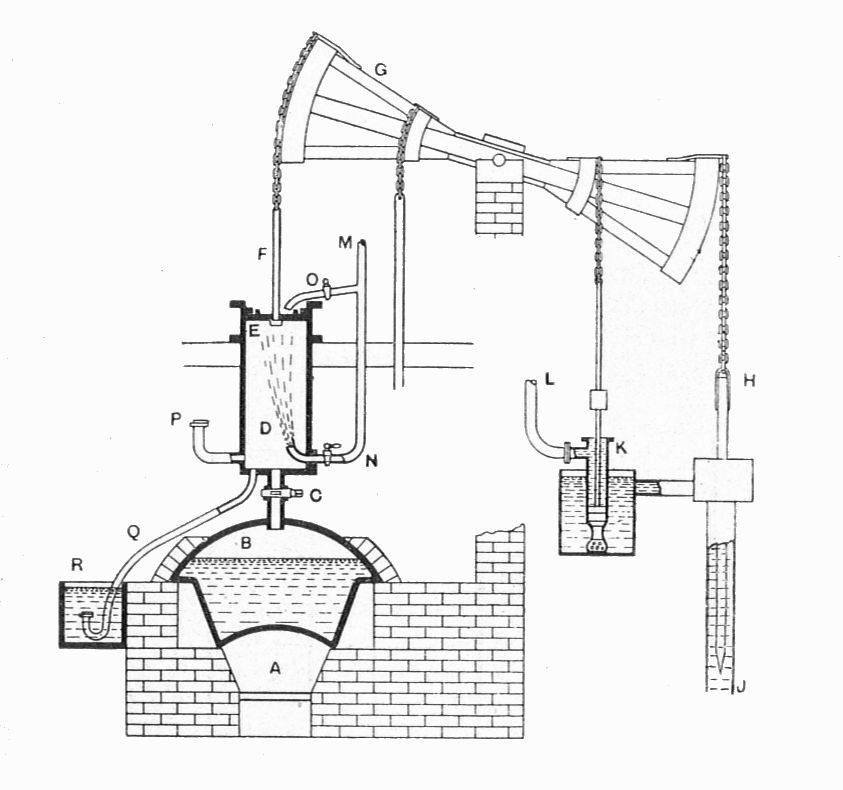
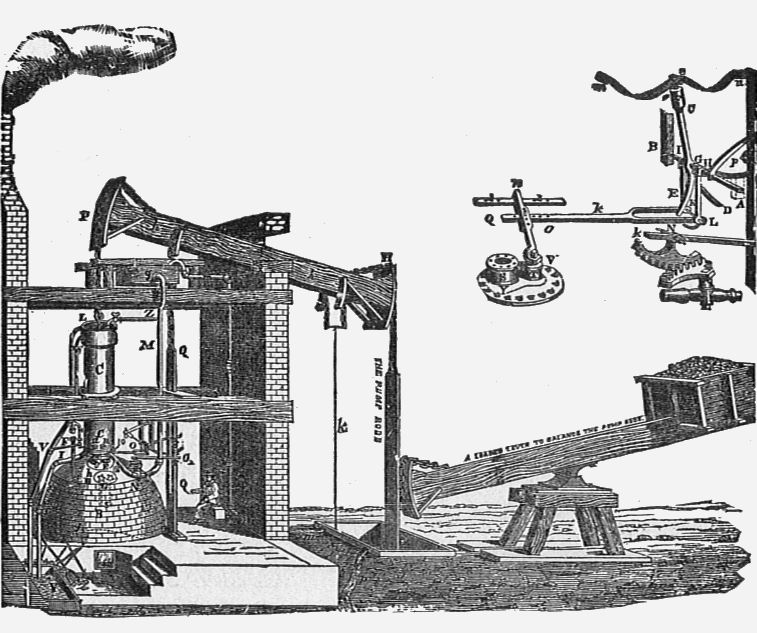
Thomas Newcomen’s engine of 1712 was the first machine that turned heat into reliable mechanical work, and for that it has a fair claim to be the machine that started the Industrial Revolution. It was an ungainly thing: a coal-fired boiler, a tall brick engine-house, a single enormous cylinder, and a rocking timber beam linked to pump rods that reached down into a mine. Its trick was the vacuum. Steam was let into the cylinder and then killed by a spray of cold water, which condensed it and left a partial vacuum; the ordinary pressure of the atmosphere then shoved the piston down into that void, hauling the beam over and lifting water out of the mine. It was not powered by steam so much as by the weight of the air, and it ran, stroke after stroke, for as long as the coal held out.
That last point was its undoing. Because the cylinder had to be heated and then chilled on every single stroke, the Newcomen engine threw away almost all the energy in its fuel — useful only where coal was practically free, at the pithead of a colliery. When the young instrument-maker James Watt, repairing a model of one in 1765, realised he could condense the steam in a separate vessel and keep the cylinder permanently hot, he cut the coal needed by roughly three-quarters. Watt’s engine, commercial from the 1770s, simply did the same job far more cheaply, and no one built new Newcomen engines for industry after about 1800. A few of the old beam engines pumped on for decades out of sheer durability — the last, at Elsecar in Yorkshire, ran until 1923 — but as a living technology the engine that began the steam age was finished within a century of starting it.
Worth remembering
- It did not run on steam pressure but on the vacuum left when steam condensed: cold water sprayed into the cylinder collapsed the steam, and the weight of the atmosphere pushed the piston down, rocking a great beam that worked the pump rods sunk into the flooded mine below.
- It made deep mining possible for the first time — pumping water out of coal and tin pits that had been drowning — and so the engine that began the steam age existed to dig up the coal that the steam age would run on.
Gallery
Sources
- The Newcomen engine, first erected in 1712 to pump mine water, was superseded after 1769 by Watt's separate-condenser engine, which cut fuel costs by about 75% Encyclopaedia Britannica
- The Newcomen engine converted only about 1% of the steam's thermal energy to work; Watt's 1769 modification reduced fuel consumption to a quarter or less of the Newcomen engine's National High Magnetic Field Laboratory
A graveyard tradition: leave a stone to show you came, and remembered.