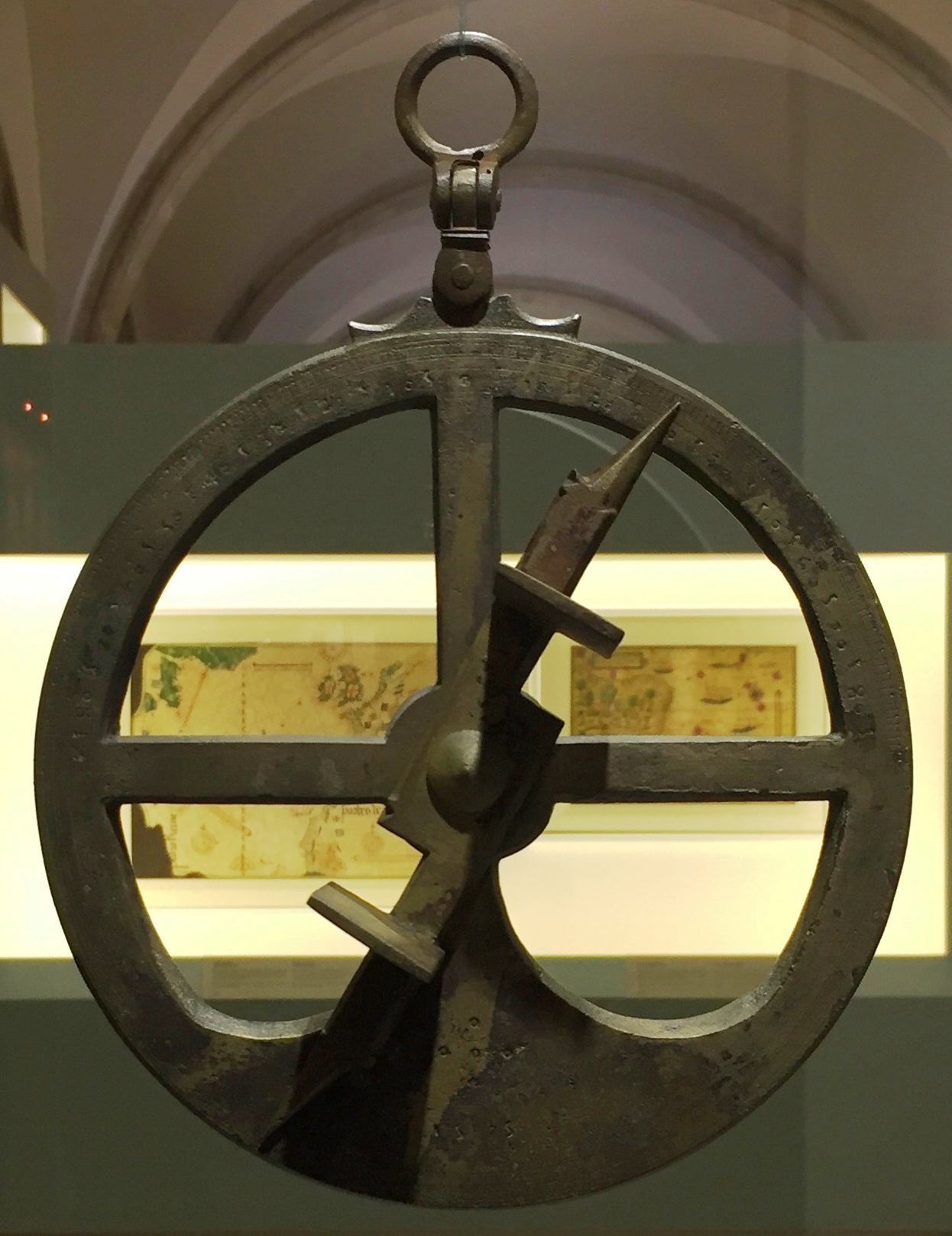
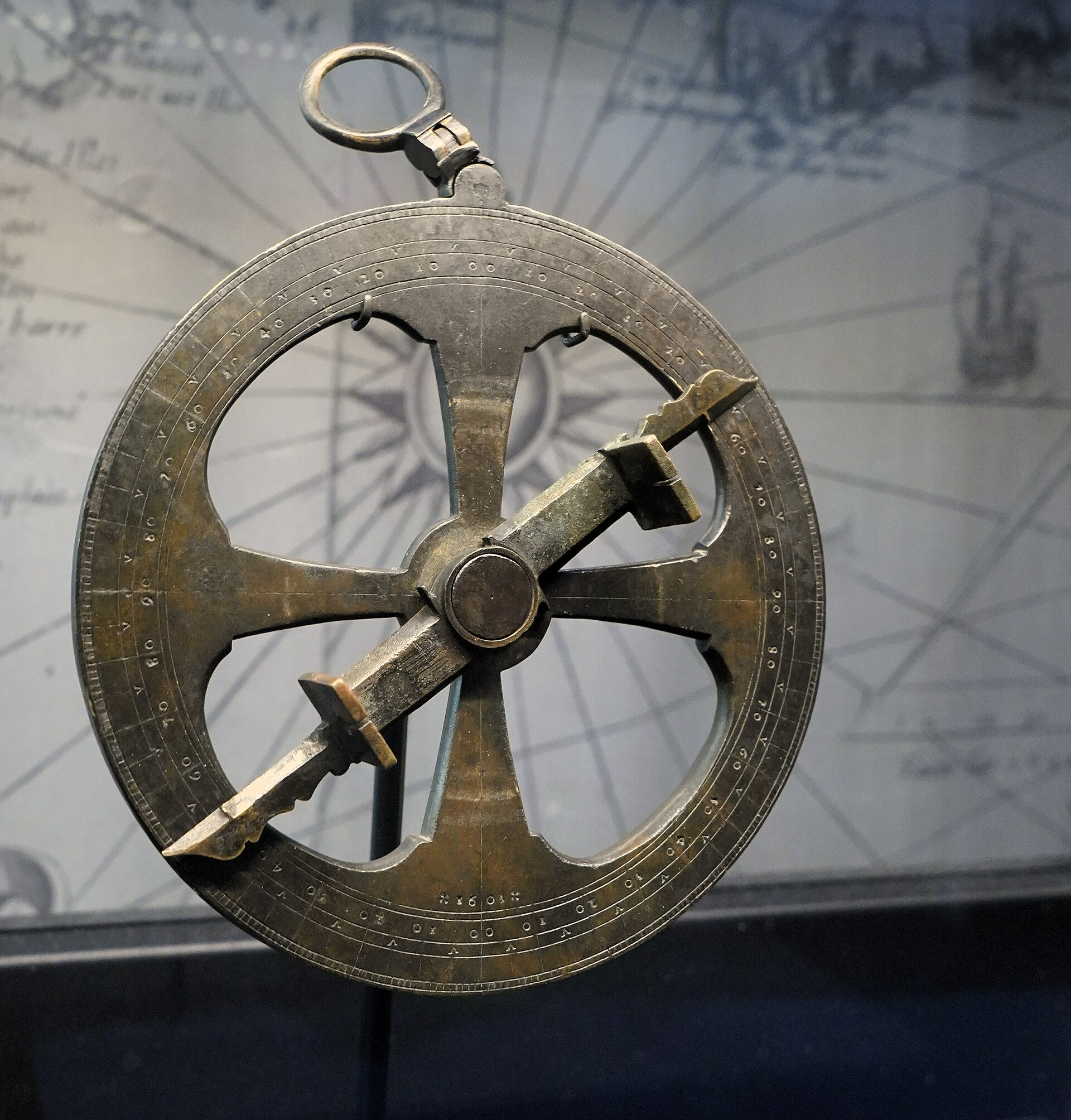
The astrolabe as an astronomical instrument goes back to the Hellenistic world, but the version that mattered to the great voyages was a deliberately crude descendant of it. Portuguese navigators pushing down the African coast in the late 15th century needed something that would survive a heaving deck and a salt wind, so they threw away the elegant engraved disc and kept only what fixed latitude: a heavy bronze ring, an altitude scale around its rim, and a pivoting bar with two pinhole sights. Hung from a thumb at local noon, it told the pilot how high the sun stood, and from that — against printed declination tables — how far north or south the ship had come.
For two centuries it was the instrument of the open ocean. Columbus carried one, the pilots of Vasco da Gama and Magellan carried them, and roughly a third of the surviving examples were made in Portugal, the country that perfected the thing. It was never precise — a degree of latitude is sixty nautical miles, and a good reading on a rolling deck was lucky to be that close — but it was the best a navigator had for finding his line across an empty sea.
It was beaten by instruments that did the same job without making the navigator stare into the sun. John Davis’s backstaff (1594) let him keep the sun at his back and read its shadow; then John Hadley’s octant (1731) used mirrors to bring sun and horizon together in one view, working in any weather on any heavenly body. Against those the astrolabe had no answer, and by the early 1700s it was finished. Only about 108 genuine sea astrolabes are known to exist today, and most of them were not handed down — they were pulled up from the wrecks of the ships that carried them down. The oldest of all, the Sodré astrolabe of about 1496–1501, came off a wreck of Vasco da Gama’s fleet off Oman, and was certified by Guinness World Records in 2019 as the earliest known mariner’s astrolabe.
Worth remembering
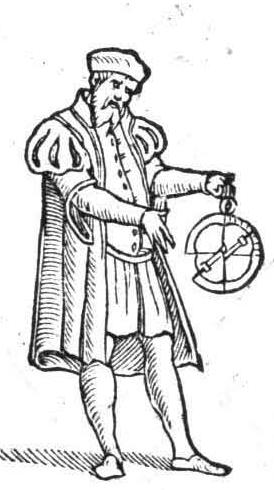
- The navigator hung the instrument by a ring so it swung vertical, turned the sighting vane until the noon sun shone through both pinholes, and read the altitude off the scale — which, with a table of the sun's declination, gave the ship's latitude to within a degree or so on a calm sea.
- Its heavy open-frame body was the whole point: the mass steadied it against the roll of the deck, and the cut-out spaces let the wind blow through instead of swinging it around — the difference between the sea astrolabe and the solid disc astronomers used on land.
Gallery
Sources
- Only about 108 genuine mariner's astrolabes are known to survive; the oldest, the Sodré astrolabe (1496–1501), was recovered from a wreck of Vasco da Gama's fleet off Oman Wikipedia
- The Sodré astrolabe was certified by Guinness World Records in 2019 as the oldest known; the mariner's astrolabe was first used at sea on a Portuguese West Africa voyage in 1481 Phys.org (reporting Mearns et al., IJNA 2019)
A graveyard tradition: leave a stone to show you came, and remembered.