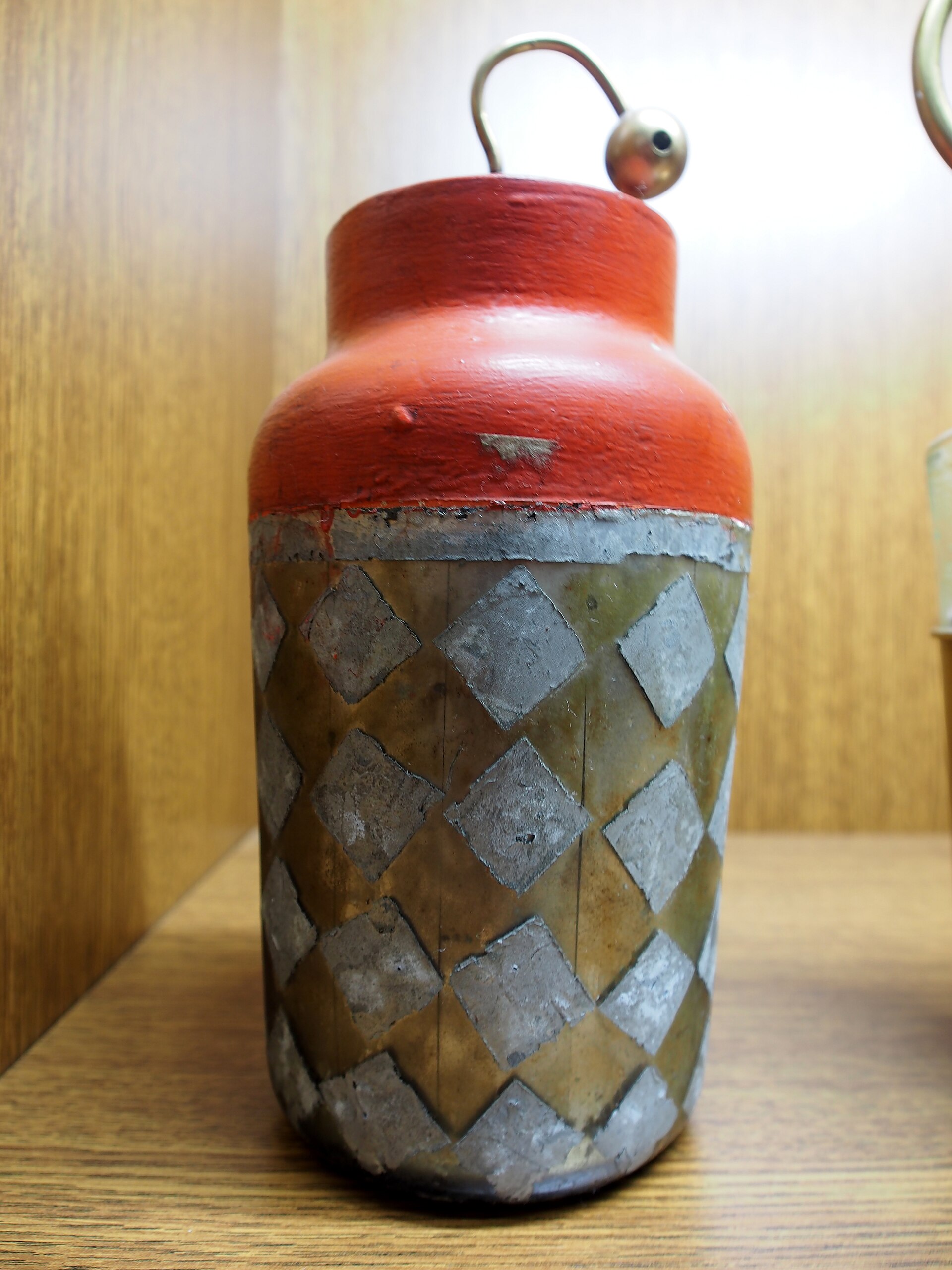
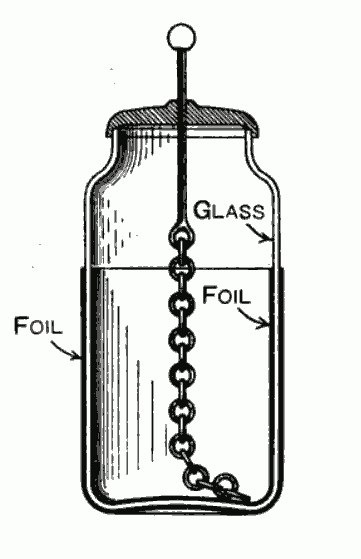
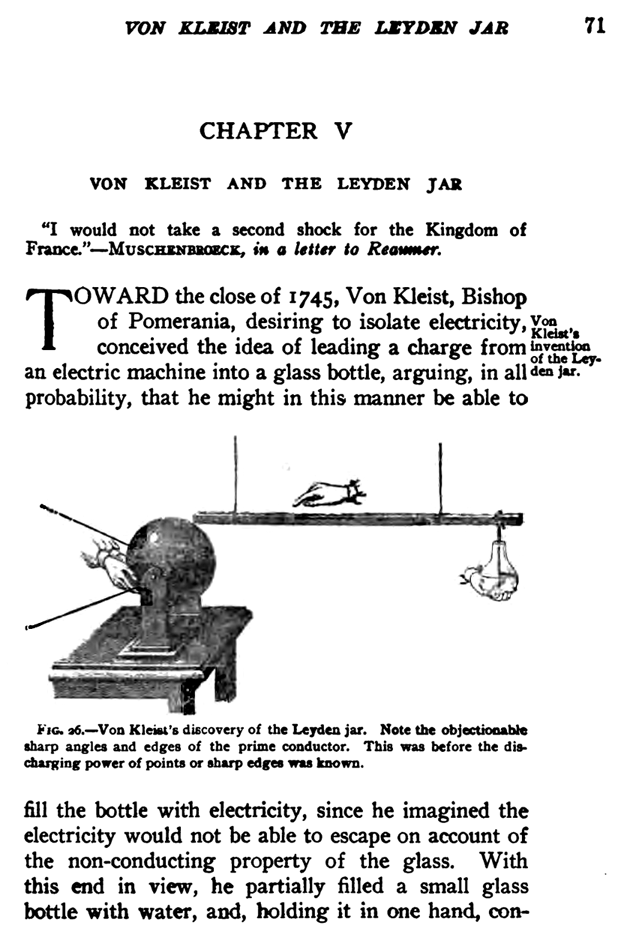
The Leyden jar was a glass vessel coated with metal foil on the inside and the outside, with a brass rod and chain reaching through the cork stopper to touch the inner foil. Charge an electrostatic generator against that rod while the outer foil is grounded — through a hand or a tabletop — and the two foil surfaces hold opposite charges across the glass, which acts as the dielectric. Ewald Georg von Kleist stumbled on the effect on 11 October 1745 with a nail stuck through the cork of a medicine bottle; Pieter van Musschenbroek and Andreas Cunaeus reproduced it independently at Leiden within months, Cunaeus discovering that gripping the jar by hand while charging it delivered a violent shock. For the first time electricity could be stored and carried, not just generated on the spot. The jar became the standard tool of 18th-century electrical research, and the prop in its theatrical demonstrations: in 1746 Abbé Nollet discharged one through about 180 of the king’s guards and through a circle of roughly 200 Carthusian monks linked by iron wires, all of whom convulsed at the same instant.
The principle the jar pioneered never died — every capacitor in a phone, radio, or power supply still stores charge across a dielectric between two conductors, and Franklin’s flattened “Franklin square” already pointed at the parallel-plate form that would dominate. What died was the device. A foil-lined glass bottle holds tiny capacitance for its bulk, breaks if dropped, and self-discharges across its damp surface; it cannot be wound, stacked, or printed. As radio and electrical engineering scaled up in the early 1900s, mica, paper-foil, and later ceramic and film capacitors replaced it — units that pack far more capacitance into a fraction of the volume and survive being soldered into a circuit. The jar held its place as the only practical capacitor for over a century and a half, then vanished from working hardware entirely. It survives now where it started: on a demonstration bench, charged up to make a spark jump and remind a room that it once shocked a line of monks.
Worth remembering
- In 1746 Nollet discharged a single jar through a chain of ~200 Carthusian monks holding iron wires — a circuit roughly 1.6 km around — and all jerked at once, a result he read as conduction of 'unlimited rapidity.'
- Benjamin Franklin's dissectible-jar experiment led him to argue the charge lived in the glass itself, and his flattened 'Franklin square' reframed the jar as two plates separated by a dielectric — the parallel-plate capacitor.
Gallery
Sources
- Invented independently by von Kleist (discovery 11 Oct 1745) and by Musschenbroek/Cunaeus at Leiden 1745–46; a glass jar with metal foil coating inner and outer surfaces, the original form of the capacitor. Wikipedia
- In 1746 Abbé Jean-Antoine Nollet discharged a Leyden jar through ~180 royal guardsmen and a line of Carthusian monks for Louis XV; the monks reacted simultaneously, suggesting near-instant conduction. Wikipedia
- Von Kleist accidentally produced it by running an electrostatic generator to a nail through the cork of a medicine bottle; the device let experimenters store and carry charge, and is still used to demonstrate electrostatics. EBSCO Research Starters
A graveyard tradition: leave a stone to show you came, and remembered.