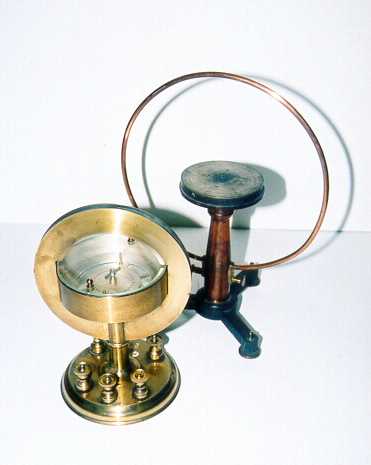
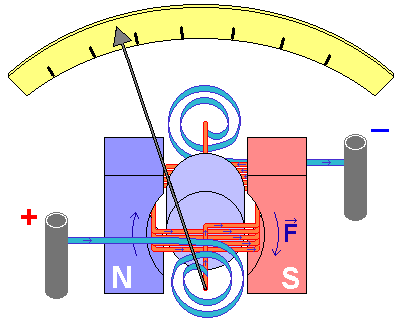
Hans Christian Ørsted noticed in July 1820 that a wire carrying current made a nearby compass needle swing — the first evidence that electricity and magnetism were the same force wearing different clothes. Within two months Johann Schweigger had turned that twitch into an instrument: wind the wire in loops around the needle instead of laying it straight past, and every loop adds its push, so a current too weak to nudge a bare needle could now swing one wrapped in copper. André-Marie Ampère reached the same idea independently that year. For the next sixty years the “multiplier” or galvanometer was the only way to see a current — no numbers, just a needle rotating against a scale, its swing proportional to whatever charge or current was pushing it. William Thomson refined the trick for the transatlantic cable, gluing a mirror to the needle and bouncing a beam of light off it, so a signal too faint to move a pointer could still throw a spot of light across a wall. In 1882 Jacques-Arsène d’Arsonval and Marcel Deprez flipped the geometry — a coil suspended in a fixed magnet’s field, rather than a needle in the earth’s — and that moving-coil design became the guts of nearly every analog ammeter, voltmeter, and ohmmeter built afterward.
None of that mechanism survives in a modern meter. A digital multimeter measures current by dropping it across a precision shunt resistor or reading a Hall-effect sensor, converts the voltage with an analog-to-digital chip, and prints a number on a liquid-crystal display — no needle, no coil, no magnet, nothing that swings or settles. Fluke’s first handheld digital multimeter shipped in 1977, and through the following decade it did to the panel meter what the calculator did to the slide rule: same job, no moving parts, better precision, and readable at a glance instead of interpreted against a scale. Field technicians dropped the analog meter first, since a jarred needle instrument reads wrong until recalibrated and a digital one doesn’t; laboratories held on longer, since the moving-coil meter’s smooth analog sweep is still easier to eyeball for a trend than a scrolling digital readout, but that holdout thinned to teaching demonstrations and instrument collections by the 1980s. Current measurement as a task never went anywhere — it’s in every phone charger and lab bench today — but the specific idea of doing it by watching a needle get shoved by a magnetic field is now something you see in a museum case or a physics classroom, not on a bench.
Worth remembering
- Ballistic galvanometers, calibrated to measure the total charge in a brief current pulse from the swing of the needle, were standard 19th-century instruments for testing submarine telegraph cable insulation and capacitor discharge.
- William Thomson (Lord Kelvin) built a highly sensitive mirror galvanometer in the 1850s-60s, reflecting a light beam off a tiny mirror attached to the needle to read transatlantic telegraph cable signals too faint to move a pointer directly.
Gallery
Sources
- Hans Christian Ørsted's July 1820 experiment showed an electric current deflects a nearby compass needle, the discovery of electromagnetism that made current detection by magnetic needle possible. Wikipedia
- Johann Schweigger built the first 'multiplier' in September 1820, wrapping the current-carrying wire in loops around a compass needle so each turn added to the deflecting force, making weak currents measurable. Wikipedia
- In 1882 Jacques-Arsène d'Arsonval (with Marcel Deprez) devised the moving-coil galvanometer, suspending a current-carrying coil in a fixed magnetic field instead of moving a needle in the earth's field — the design basis for most analog panel meters into the 20th century. Wikipedia
- Fluke released the first handheld digital multimeter in 1977, bringing solid-state, direct-numeric current and voltage measurement to a portable instrument and displacing analog meter movements from routine test work. Wikipedia
A graveyard tradition: leave a stone to show you came, and remembered.