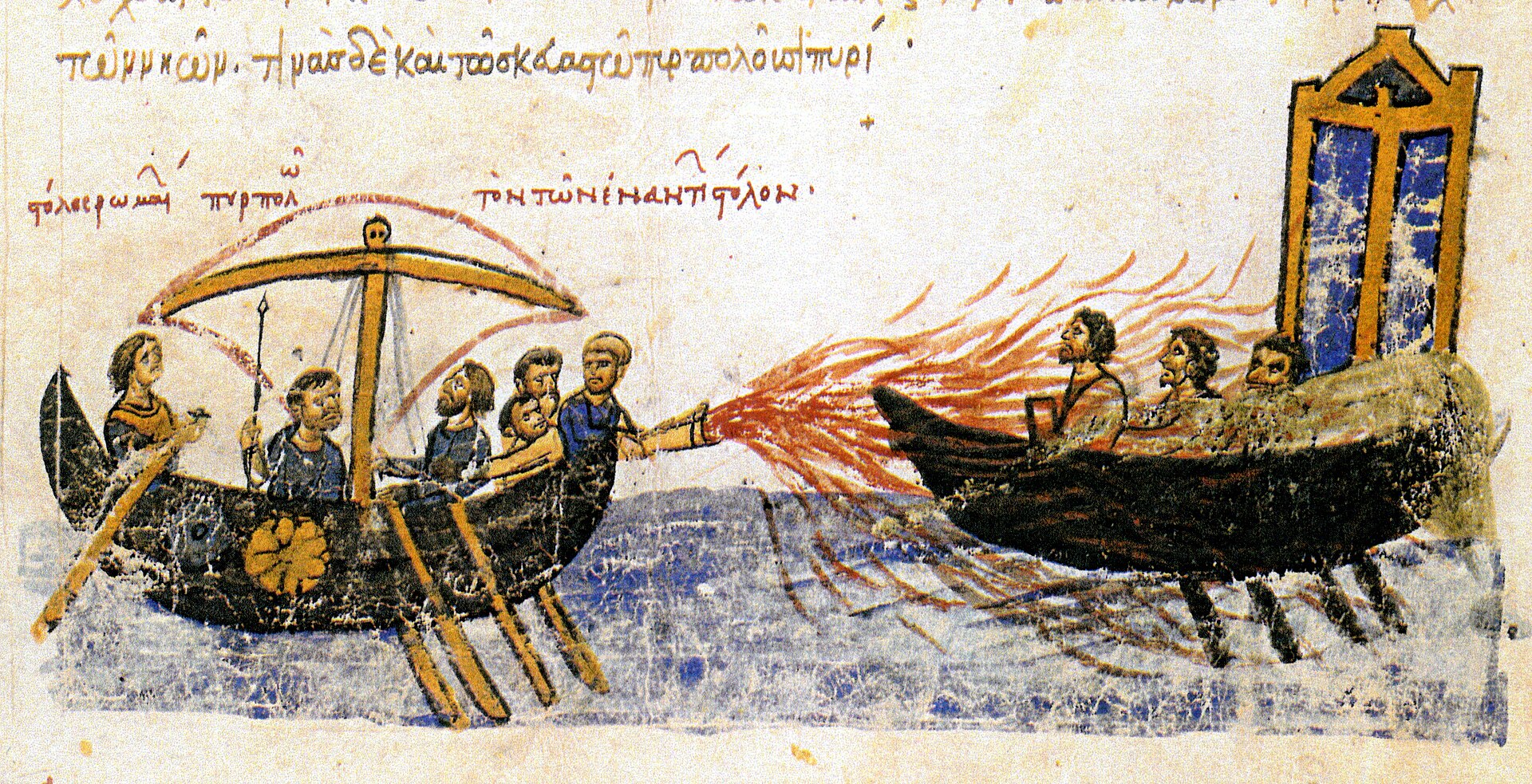
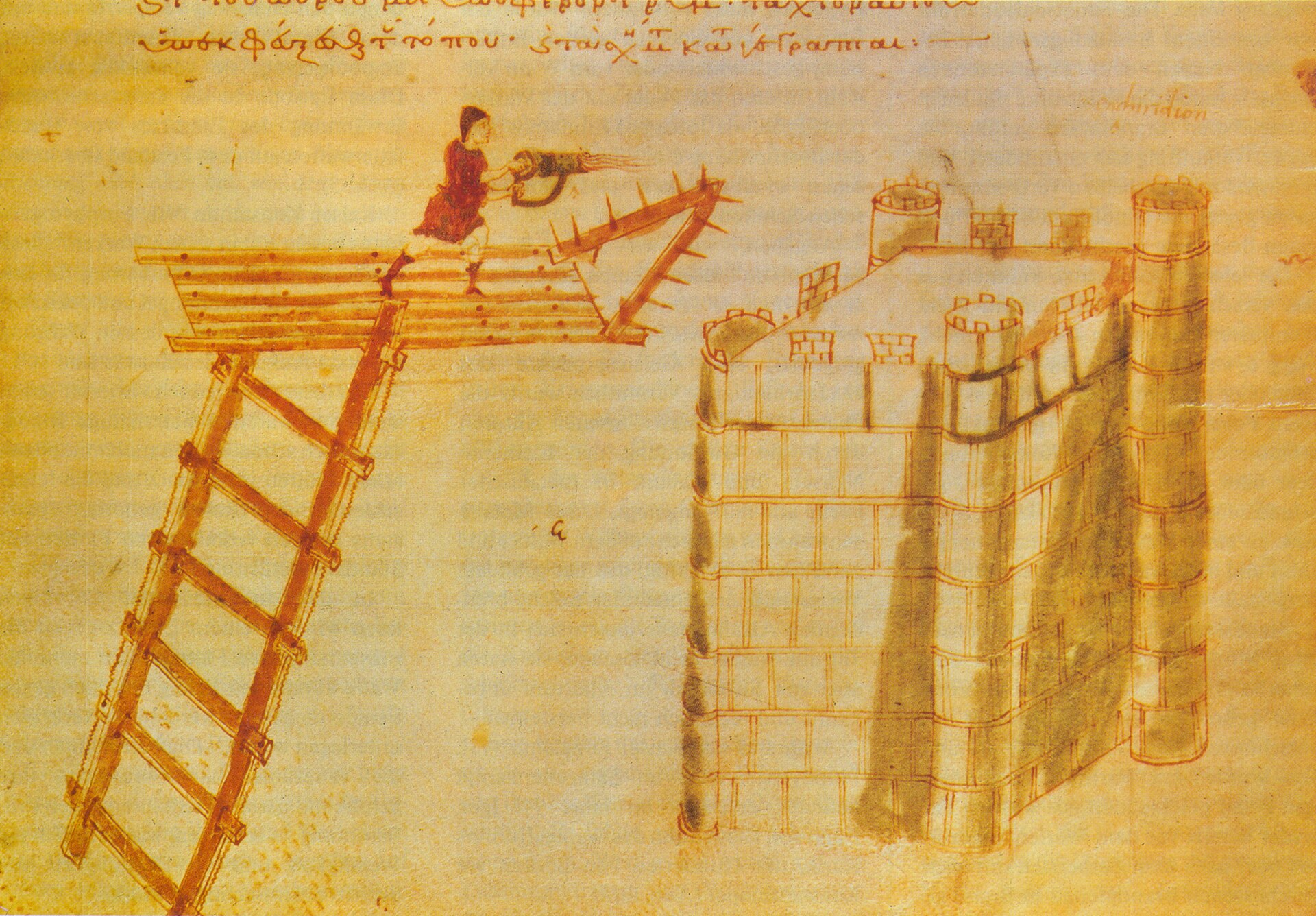
Greek fire was first deployed at the Battle of Cyzicus in 672 CE, when a Syrian engineer named Callinicus brought the weapon to Emperor Constantine IV. It reportedly ignited on contact with water, burned on the sea’s surface, could not be doused with water, and could be hurled in ceramic grenades or projected as a stream through bronze siphons mounted on the bows of warships. Twice within fifty years it broke Arab sieges that might otherwise have ended the Byzantine Empire.
The formula was the most jealously guarded secret in the medieval world. Byzantine sources say it was transmitted within a narrow circle and never written down in a recoverable form. It was stored under lock and key in the imperial palace. The penalty for divulging it was death. Enemies captured the hardware repeatedly — the siphons, the fire-ships, the crews — and could never reverse-engineer the substance inside. Arab, Bulgar, and later Crusader forces developed their own incendiaries, but none matched the described properties: spontaneous ignition, water-resistance, and the ability to be pumped under pressure.
Modern chemists have proposed formulas involving petroleum distillates, quicklime, sulfur, and various resins. Some produce igniting liquids. None has reproduced all the properties described in Byzantine primary sources. The point at which the knowledge died is the Fourth Crusade’s sack of Constantinople in 1204, which shredded the institutional fabric that had preserved it — the workshops, the hereditary specialists, the imperial administration. The weapon had been used for over five centuries and feared from the North Sea to the Indian Ocean. Then it was simply gone — forgotten so completely that we cannot be certain what it was.
Worth remembering
- At the naval battle of 718 CE, during the second Arab siege of Constantinople, Greek fire destroyed the Arab fleet so completely that the siege collapsed; the weapon effectively saved the Empire — and arguably the Byzantine shield over eastern Christianity — at its most exposed moment.
- Enemies captured fire-ships, bronze siphons, and even entire crews multiple times. None of them ever reproduced the weapon. The most militarily valuable secret of the medieval world was looted again and again without being cracked.
Gallery
Sources
- Greek fire was first used by the Byzantine fleet at the Battle of Cyzicus in 672 CE; the formula was a closely guarded state secret; enemies who captured the siphons and fire-ships were never able to reproduce the weapon Wikipedia
- Greek fire burned on the surface of water and could not be extinguished by it; its precise composition remains unknown despite many modern attempts to reconstruct it Encyclopaedia Britannica
A graveyard tradition: leave a stone to show you came, and remembered.