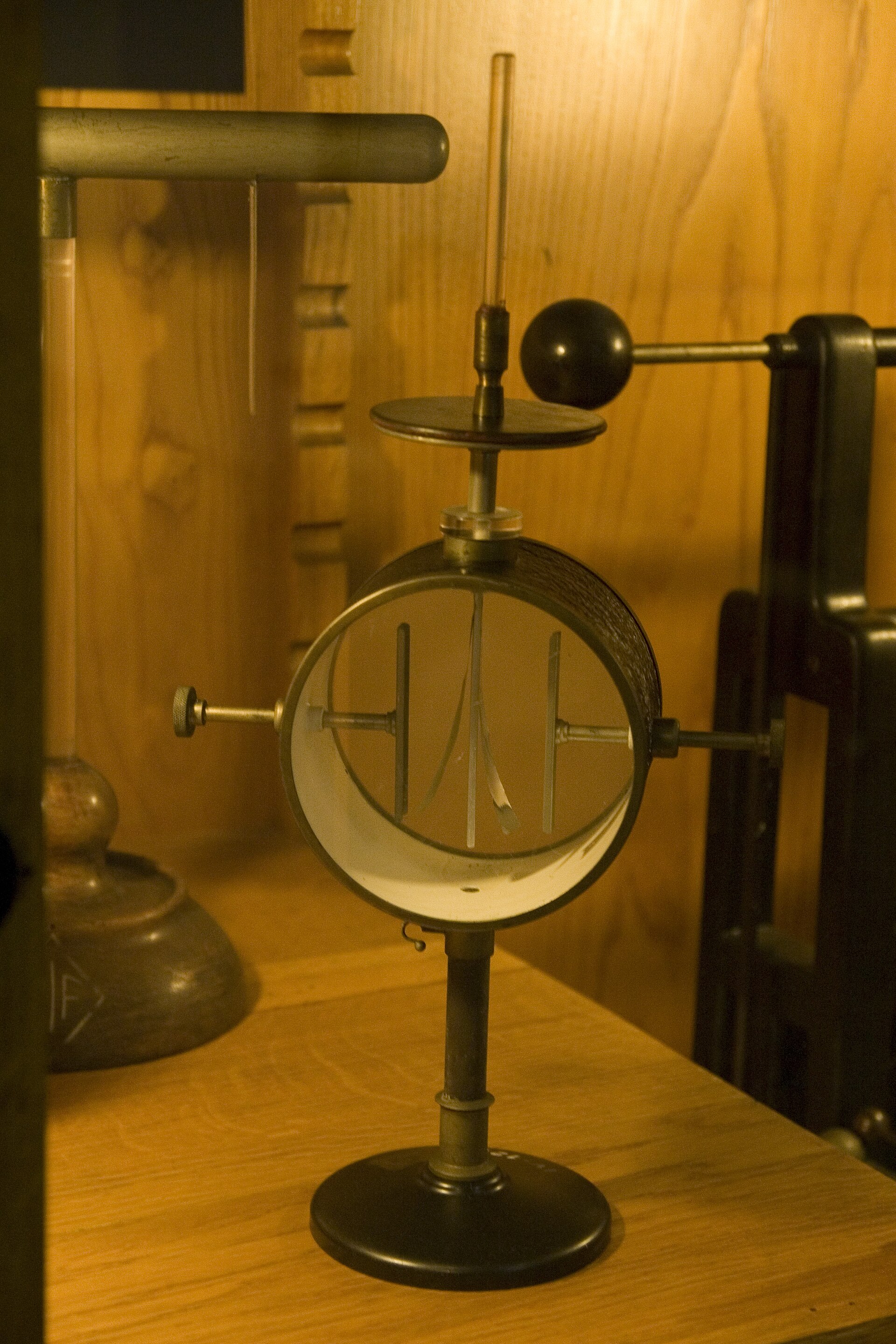
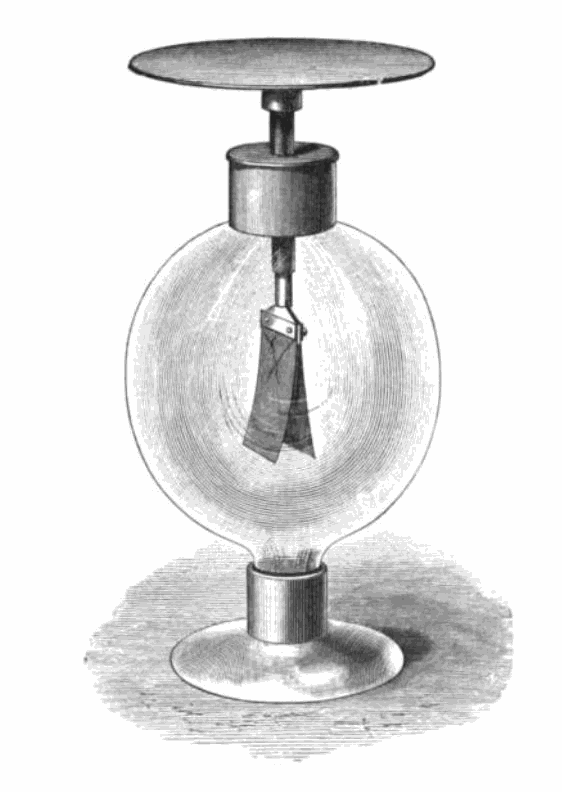
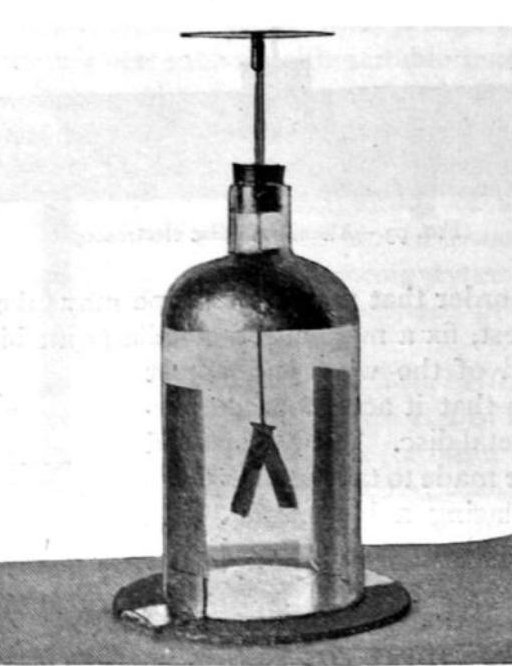
The gold-leaf electroscope detects charge; it does not store it, and that distinction is the whole point of the device. A brass rod runs down from an external terminal — a disk or ball — into a sealed glass bottle, and two thin strips of gold leaf hang from the rod’s lower end. Touch the terminal with a charged object and the charge spreads down the rod into both leaves; since like charges repel, the two strips push apart, and the angle of divergence gives a rough read of how much charge arrived and which sign it carried, depending on which pre-charged reference the leaves are tested against. Abraham Bennet, an English clergyman, built the design in 1786–87 and published it in 1789, improving on the coarser pith-ball and straw-blade electroscopes that preceded it; Volta named Bennet’s instrument as an influence on his own electrometer. For over a century it was the most sensitive charge detector available, standard equipment in any laboratory doing electrostatics.
Its second life came from a property nobody designed into it: ionizing radiation ionizes the air around a charged electroscope and lets the charge leak away, so the rate at which the leaves fell back together became a way to measure radiation intensity. Following Röntgen’s X-rays (1895) and Becquerel’s radioactivity (1896), the gold-leaf electroscope was one of the principal tools both men used to take measurements, and Rutherford used it — charged to 200–300 volts, leaves watched through a telescope and scale — to time the discharge from radium salt passed through brass plates, sorting the radiation into alpha (stopped by the plates) and beta (which passed through) by how each changed the leak rate. The U.S. National Bureau of Standards built a refined version in 1927, reading a 10-micrometer quartz fiber at 100x magnification to calibrate radium samples against Marie Curie’s own standard. What killed it was the same limit that had always been there: a human eye reading an angle through a telescope, one measurement at a time, no permanent record. Vacuum-tube electrometers gave an amplified, continuous electrical readout instead of a leaf angle, and the Geiger-Müller counter, commercialized from the late 1920s, turned radiation into an audible click and a countable pulse — quantitative, automatic, and usable by someone who had never learned to read a leaf scale. By mid-century the gold-leaf electroscope had left serious laboratory and radiation-monitoring work behind and settled into the role it still holds: a classroom prop that shows a student static electricity is real, right before the electronics that replaced it take over the actual counting.
Worth remembering
- Bennet's 1789 design was sensitive enough to register charge from a single spark or a person walking across a rug — a leap in sensitivity over the pith-ball and straw electroscopes it replaced, and Volta credited it as an influence on his own electrometer.
- At the U.S. National Bureau of Standards, a gold-leaf electroscope built around a 10-micrometer quartz fiber and read through 100x magnification measured radium gamma intensity against Marie Curie's international radium standard — samples had to sit sealed for at least 20 days first, to let short-lived radon daughters reach secular equilibrium.
Gallery
Sources
- Abraham Bennet, an English clergyman and physicist, invented the gold-leaf electroscope in 1787, improving on pith-ball and straw electroscopes by suspending two strips of gold leaf from a brass rod inside a glass bottle. Wikipedia
- Bennet detailed the instrument in his 1789 book on electrical experiments; Alessandro Volta cited Bennet's design as a key influence on his own electrometer work. Wikipedia
- Charged to 200–300 volts and viewed through a telescope fitted with a scale, the gold-leaf electroscope was discharged by ionizing radiation; Rutherford used it to time the discharge rate from radium salt passed through brass plates, distinguishing alpha rays (stopped by the plates) from beta rays (which passed through) by charge and penetration. Oak Ridge Associated Universities Health Physics Museum
- The electroscope was one of the principal instruments used by Wilhelm Röntgen and Henri Becquerel in their measurements following the discovery of X-rays (1895) and radioactivity (1896); a refined gold-leaf design built at the U.S. National Bureau of Standards in 1927 measured gamma intensity from radium samples against Marie Curie's radium standard, using a 10-micrometer quartz fiber read at 100x magnification. NIST
A graveyard tradition: leave a stone to show you came, and remembered.