
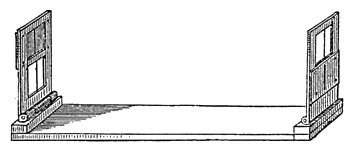
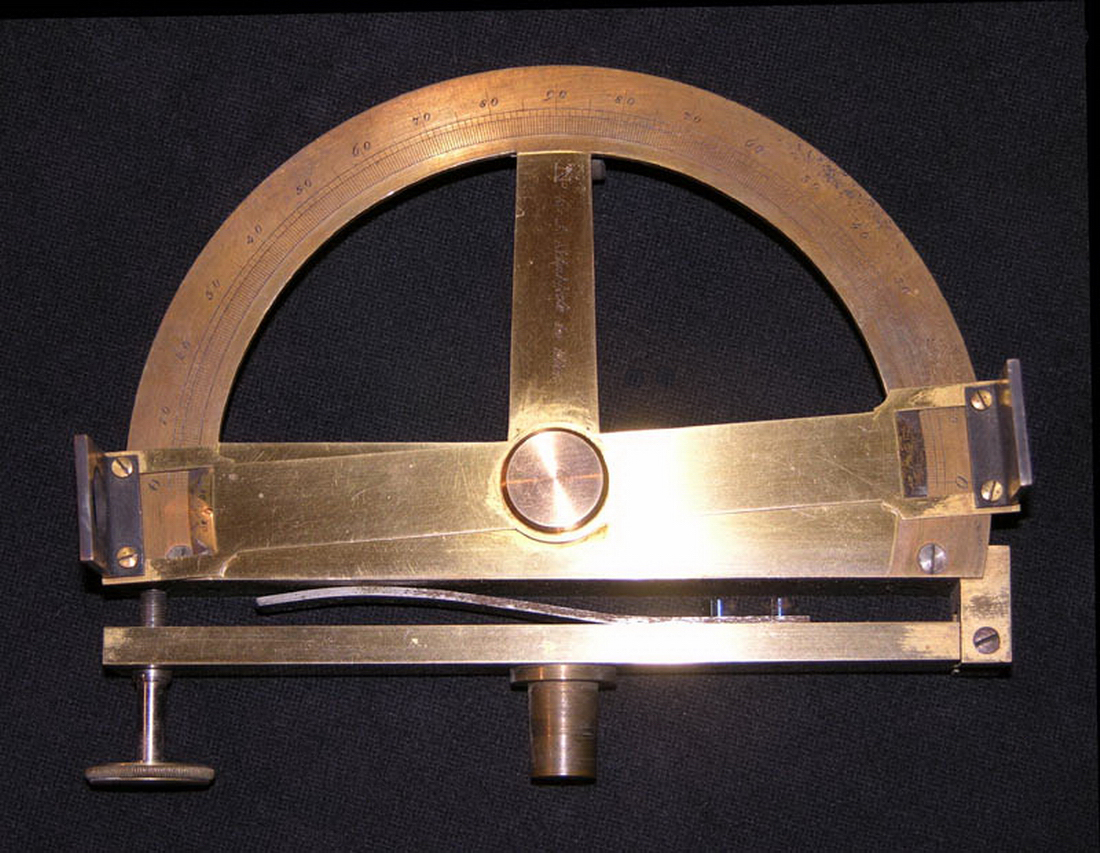
The dioptra was the Greek and Roman answer to a single hard question: what is the angle between two lines of sight? In its surveying form it was a sighting tube or bar carrying a pair of sights, mounted on a stand with screw adjustments and, in Hero of Alexandria’s elaborated version, a toothed horizontal disc turned by a worm gear and a vertical semicircular scale for reading angles. Set level, it measured the slope of the ground; this is how engineers laid out aqueduct gradients of a few inches per mile and drove tunnels toward each other from opposite hillsides. Hero’s 1st-century-CE treatise “On the Dioptra” is the fullest description that survives, but the instrument is older — Hellenistic writers refer to it by the 3rd century BCE, and Hipparchus had already adapted the idea to the sky, using a four-cubit rod with a fixed pinhole and a sliding pinnule that he edged along until it exactly eclipsed the disk of the Sun or Moon, reading the body’s apparent diameter off the geometry.
The job the dioptra did never went away; the dioptra did. Measuring angles for surveying passed, in the 16th century, to the theodolite — a graduated instrument with its own sighting line, later a mounted telescope, that read horizontal and vertical angles together with a precision the open-sight rod could not match. Astronomy left it behind even more thoroughly, moving to the graduated astrolabe, the sextant, and eventually the telescope. What remains of the dioptra is mostly description and reconstruction: no securely identified ancient example is on display, and the instrument is known from Hero’s text, scattered references, and the modern drawings made to picture what those words describe. The function — turning a sight line into a number — outlived every piece of bronze that once performed it.
Worth remembering
- On aqueduct works the dioptra set gradients so shallow they are hard to imagine being eyeballed — the Roman line at Nîmes drops about 1 in 3,000 over its length. Hero's 'On the Dioptra' devotes worked problems to running a tunnel toward a target from both ends at once.
- Turned to the sky, Hipparchus mounted a sliding pinnule on a four-cubit rod and pushed it along until it just hid the Moon; from the geometry he read off the Moon's changing angular diameter through its orbit, and found the Sun's diameter showed no measurable variation.
Gallery
Sources
- The dioptra is a classical astronomical and surveying instrument dating from the 3rd century BC; an entire book on its construction and surveying use is credited to Hero of Alexandria, and it was replaced as a surveying instrument by the theodolite. Wikipedia
- Hipparchus measured the apparent diameters of the Sun and Moon with his dioptra — a four-cubit grooved rod with a fixed sighting pinhole and a sliding pinnule moved until it exactly covered the disk of the Sun or Moon, the angle following from the ratio of pinnule width to its distance from the eye. Wikipedia
- The dioptra functioned as a sighting tube or rod fitted with sights on a stable stand with screw turns for precise calibration; Hero's 'Dioptra' describes a toothed horizontal base driven by a worm gear and a vertical semicircular scale for angular readings. Museo Galileo
A graveyard tradition: leave a stone to show you came, and remembered.