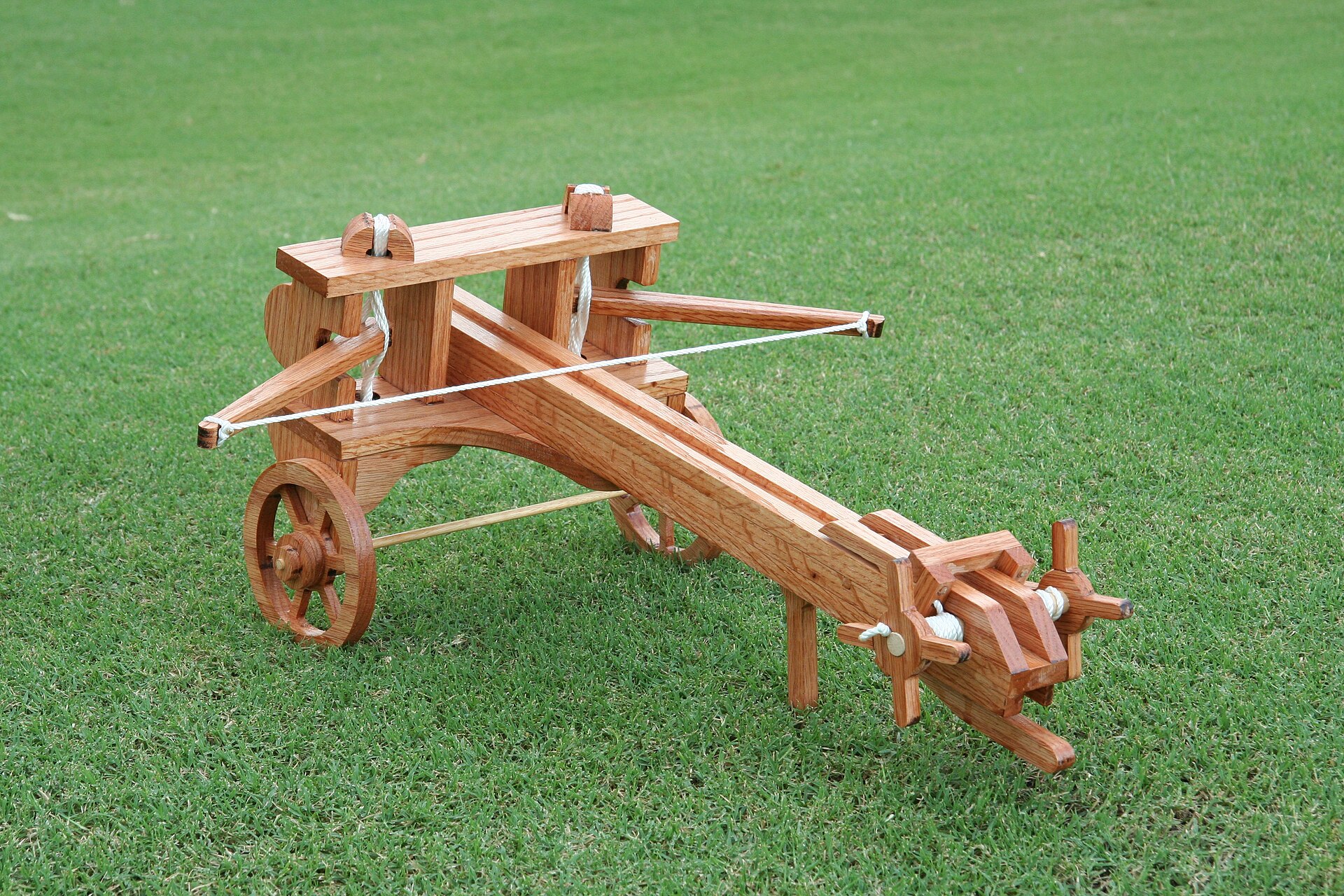
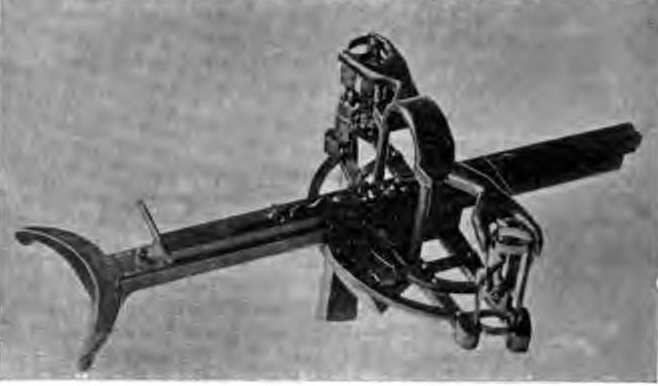
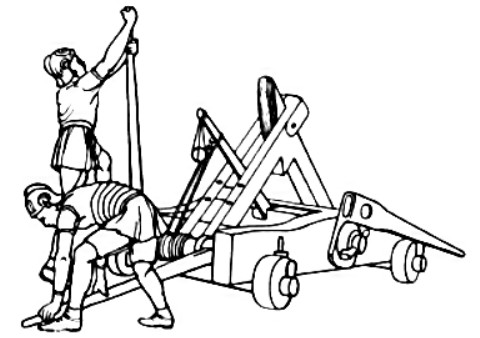
The catapult, in its ballista and onager forms, was not one weapon but a family: tension and torsion machines that stored energy in a drawn bowstring or a twisted skein of sinew and horsehair, then released it in a single violent snap. It is a different mechanism entirely from the trebuchet, which arrived centuries later and swings a counterweight rather than untwisting a spring — a separate lineage that deserves its own reckoning. The line begins with the gastraphetes, a “belly bow” that let one soldier brace a crossbow against his stomach to draw it, and hardens into true torsion artillery under engineers working for Dionysius I of Syracuse, whose katapeltikon saw combat at Motya in 397 BCE. Rome inherited and industrialized the design: the two-armed ballista threw bolts and stones with the accuracy to pick off individual men on a wall, while the later, cruder onager — one arm, one twisted rope skein, first named in Ammianus Marcellinus’s account of 353 CE — traded precision for the brute ability to lob stones weighing up to 45 kilograms into a fortification. At Alesia, at Jerusalem, wherever a Roman siege train made camp, these machines did the work siege ladders and rams could not: killing and terrifying at range, methodically, before the infantry ever closed.
What killed them was not a better bowstring. It was a different physics. Gunpowder artillery does not store mechanical energy in a stretched material and release it — it burns a chemical propellant and rides the expanding gas, a mechanism with no analogue in the torsion or tension family at all. England had cannon in the field by 1327 and used them at Crécy in 1346; by the 15th century, bombards and cannon had taken over the siege trains of Europe and the Mediterranean, doing to masonry walls in hours what a bank of onagers had done in weeks, and doing it with a machine that scaled — bigger powder charge, bigger gun, more range — in a way no amount of twisted sinew ever could. The torsion catapult had run for roughly eighteen centuries as the most sophisticated mechanical device most armies would ever field. Gunpowder did not out-torque it. It made torque irrelevant.
Worth remembering
- At the siege of Jerusalem in 70 CE, Roman ballistae threw stones with enough force and consistency that Josephus's eyewitness account of their positions and ranges has since been reconstructed and confirmed by computer modeling of the ballista stones themselves, recovered in 2022 excavations at the Russian Compound.
- A standard Roman ballista bolt carried over 500 yards, and fourth-century sources describe the largest examples throwing a dart past 1,200 yards — range and penetrating force that made trained ballistarii capable of picking off individual soldiers on a wall, a precision weapon two thousand years before the word existed.
Gallery
Sources
- The historian Diodorus Siculus records a mechanical arrow-firing catapult (katapeltikon) built by a Greek engineering team for Dionysius I of Syracuse in 399 BCE and used against Motya in 397 BCE — the earliest recorded deployment of the class Wikipedia
- Roman ballistae fired bolts and stones; standard versions reached over 500 yards and the largest fourth-century engines threw a dart more than 1,200 yards; Julius Caesar deployed ballistae in siege towers during the siege of Alesia in 52 BCE Wikipedia
- The onager, a single-armed torsion stone-thrower distinct from the two-armed ballista, is first documented by Ammianus Marcellinus in 353 CE and remained in use into the 6th century, when the mangonel replaced it; historical accounts describe stone projectiles up to 45 kg (100 lb) Wikipedia
- Computer modeling of Roman ballista stones excavated near Jerusalem's Russian Compound confirmed Josephus's account of the siege of 70 CE, showing bolt-throwing machines effective to distances of 100–400 meters The Times of Israel
- Torsion siege engines remained in use through the Middle Ages until the development of gunpowder artillery in the 14th century rendered them mostly obsolete Wikipedia
A graveyard tradition: leave a stone to show you came, and remembered.