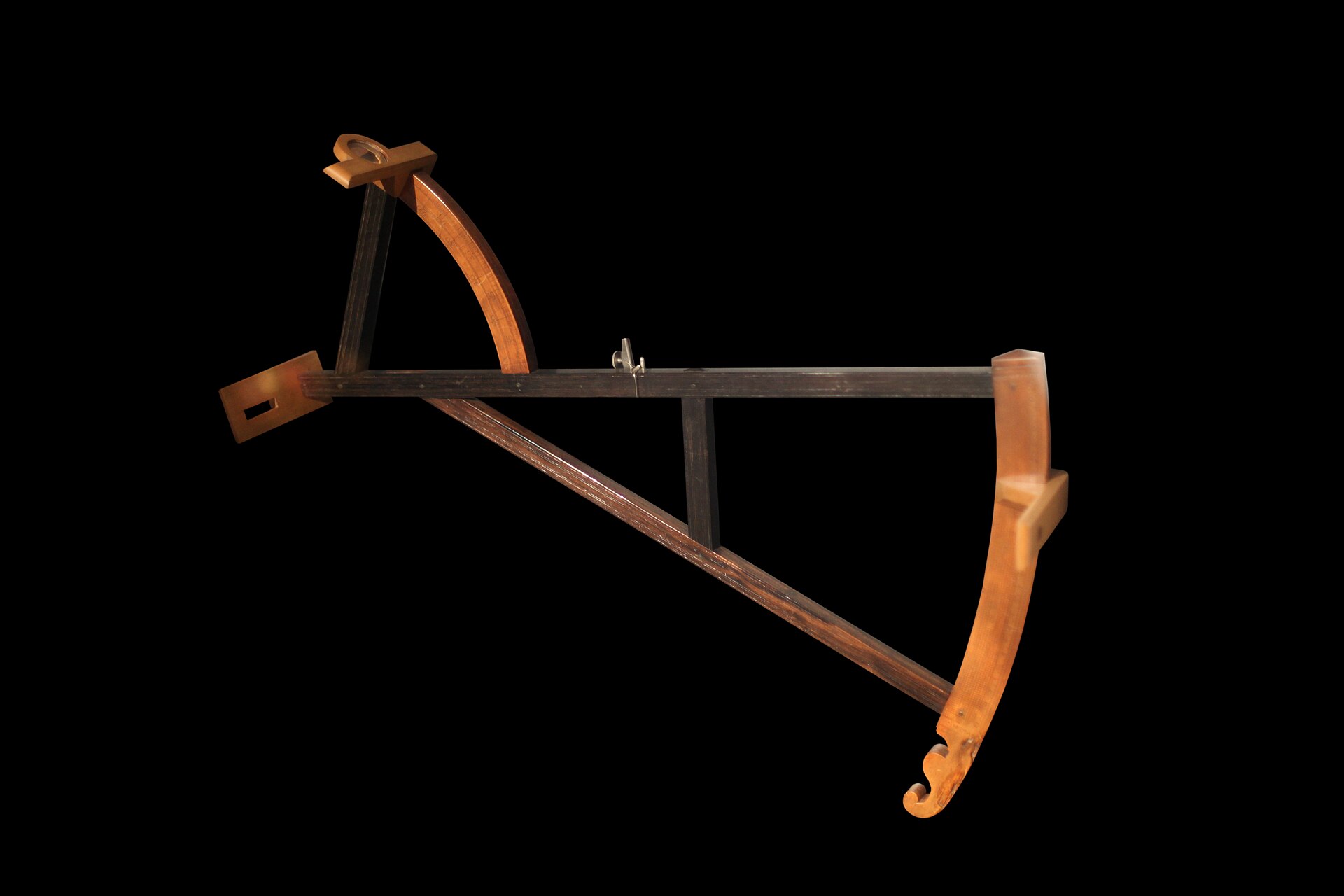
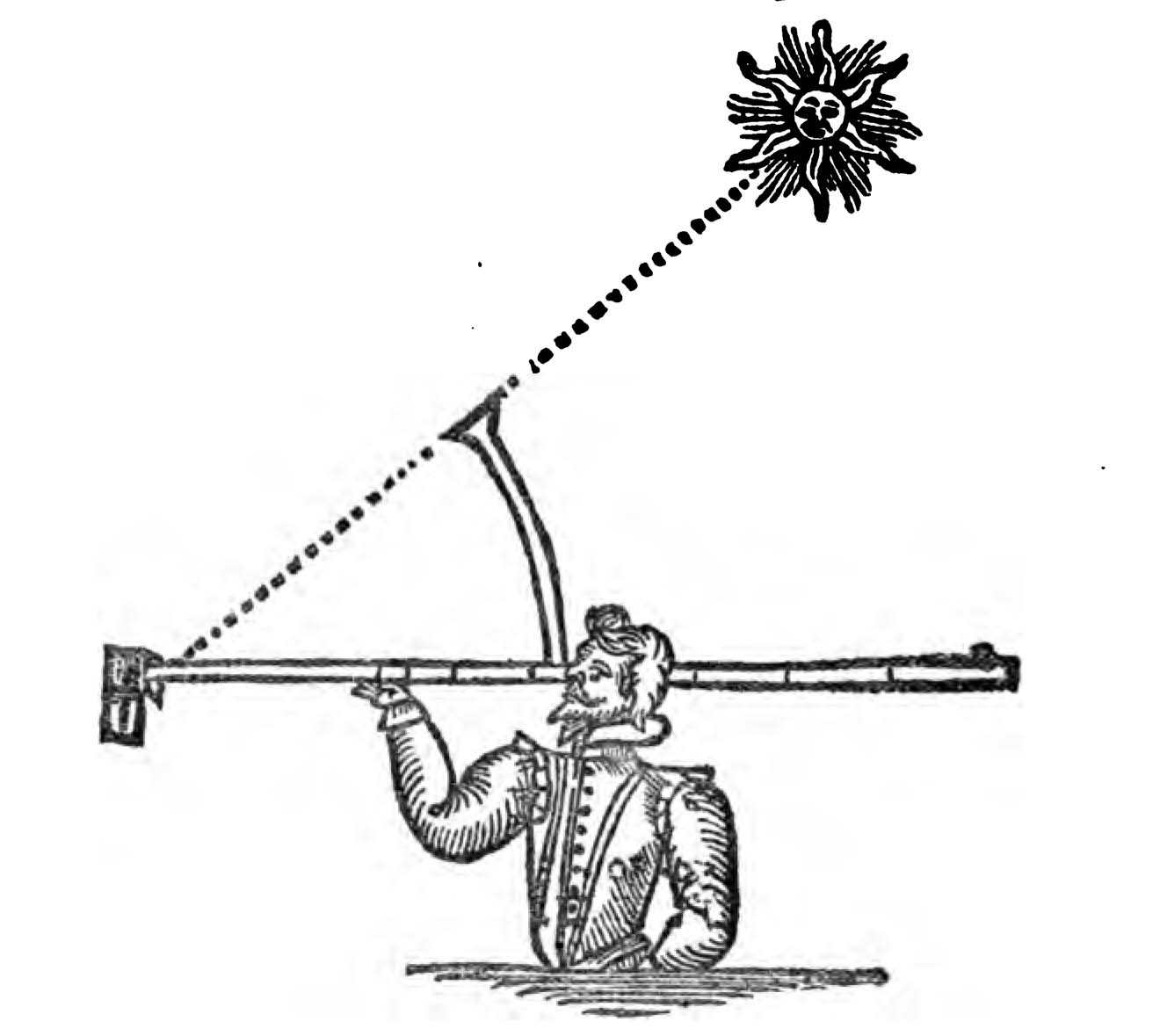
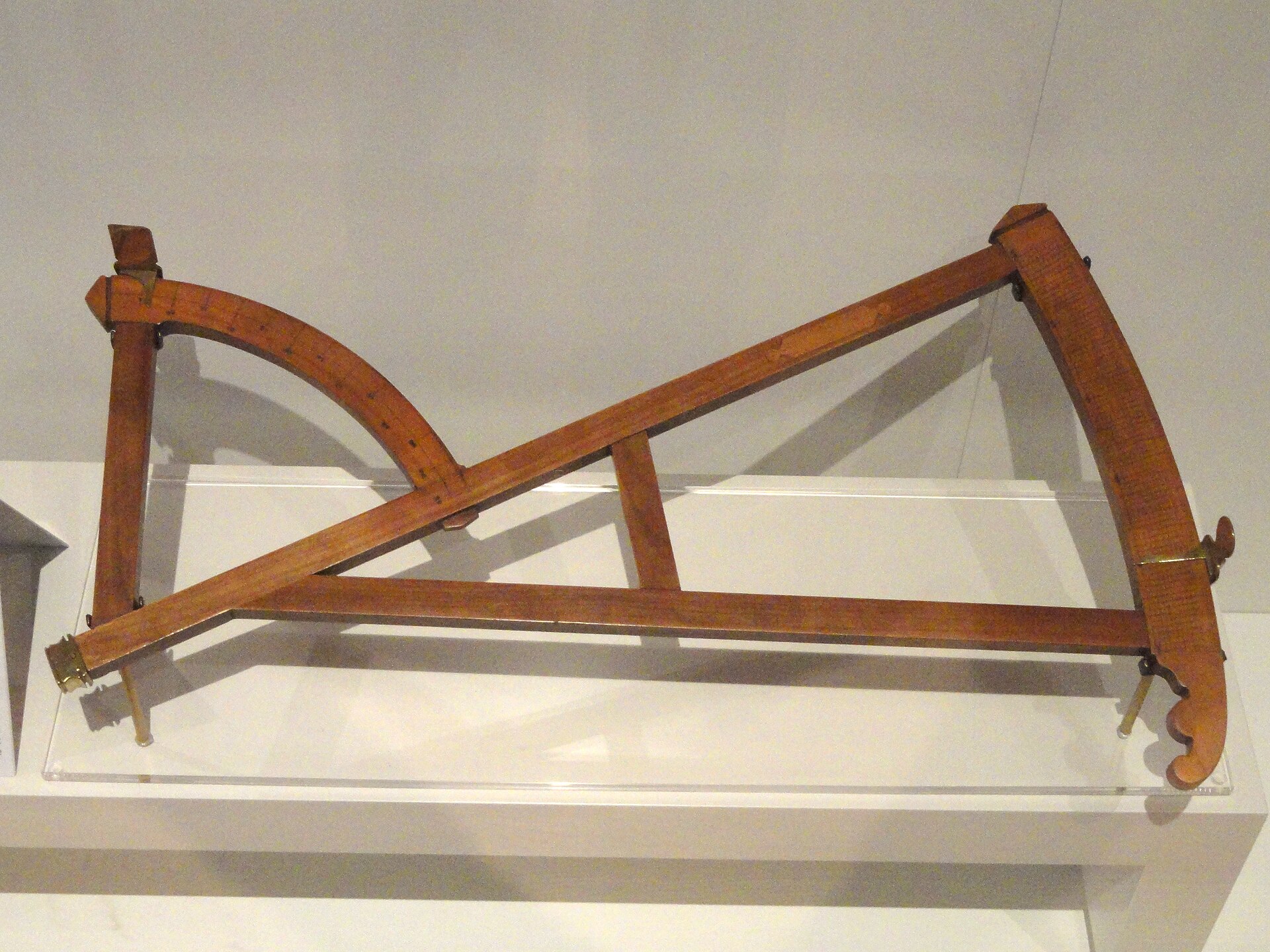
Before the backstaff, taking the sun’s height at sea meant looking straight at it. The cross-staff and forestaff required the navigator to sight along a rod toward the sun itself, and decades of doing it left ocean pilots with damaged eyes. John Davis — the Elizabethan explorer who gave his name to the strait between Greenland and Baffin Island — published the fix in 1594. His instrument turned the navigator around: you faced away from the sun and read the shadow its altitude cast onto a horizon vane, adding the figures off two graduated arcs to get the angle. No glare, no slow blindness.
For the long 17th century it was the ocean-going instrument, made across England, the Netherlands, and the American colonies in ebony, rosewood, and boxwood. English and Dutch fleets carried it on every trade route; it replaced the astrolabe and the cross-staff as the practical way to find latitude at noon. The design even improved late in life, gaining a small lens to sharpen the shadow on hazy days.
What it could never do was work in the dark or through cloud, because it depended on the sun casting a shadow. John Hadley’s octant, demonstrated in 1731, used two mirrors to bring any celestial body down to the horizon in a single view — the sun, a star, the moon, by day or night, on a pitching deck. It was simply a better tool for the same job, and the navigators voted with their lockers. By 1800 the backstaff was a thing in collections, not on ships; period engravings of the changeover even show the artist quietly swapping the backstaff in an old print for an octant in the reissue.
Worth remembering
- You stood with your back to the sun and let the shadow of an upper vane fall on a slit; through that same slit you lined up the horizon, and the sum of the readings off two arcs — one of 60°, one of 30° — gave the sun's altitude. No staring into the light, which is how generations of navigators had ruined their eyes with the cross-staff.
- Its one fatal limit: it only worked on the sun, and only when the sun was out. It could not take a star or the moon, so a cloudy noon meant no fix — exactly the gap the octant's mirrors closed.
Gallery
Sources
- The backstaff (Davis quadrant) was the standard ocean-navigation instrument of the 17th and early 18th centuries, replaced by the octant and sextant by the late 18th century The Mariners' Museum & Park
- John Davis described the back-staff in 'The Seaman's Secrets'; the instrument let the navigator avoid looking at the sun, and was made obsolete by the octant from the 1730s The American Surveyor
A graveyard tradition: leave a stone to show you came, and remembered.