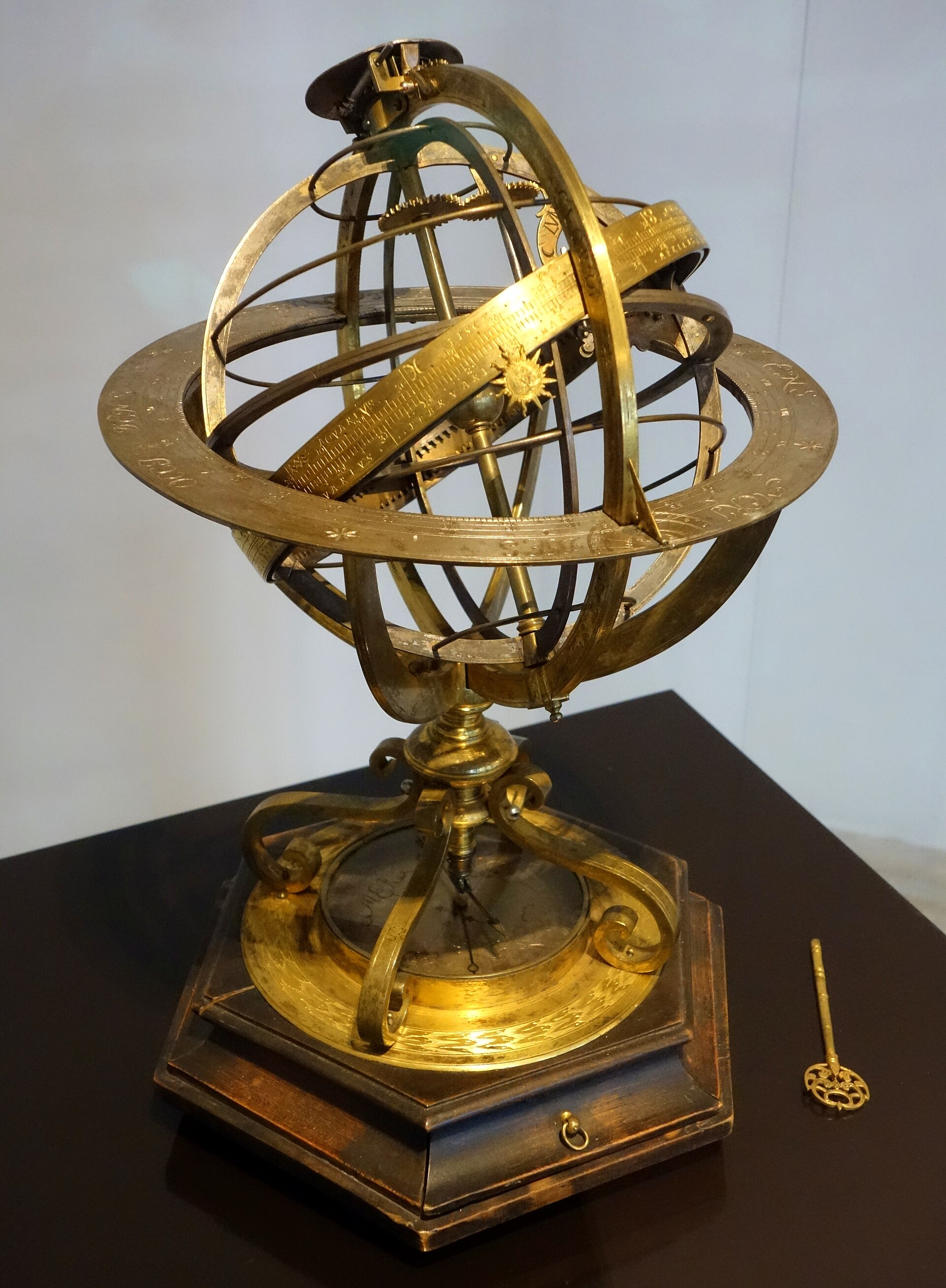
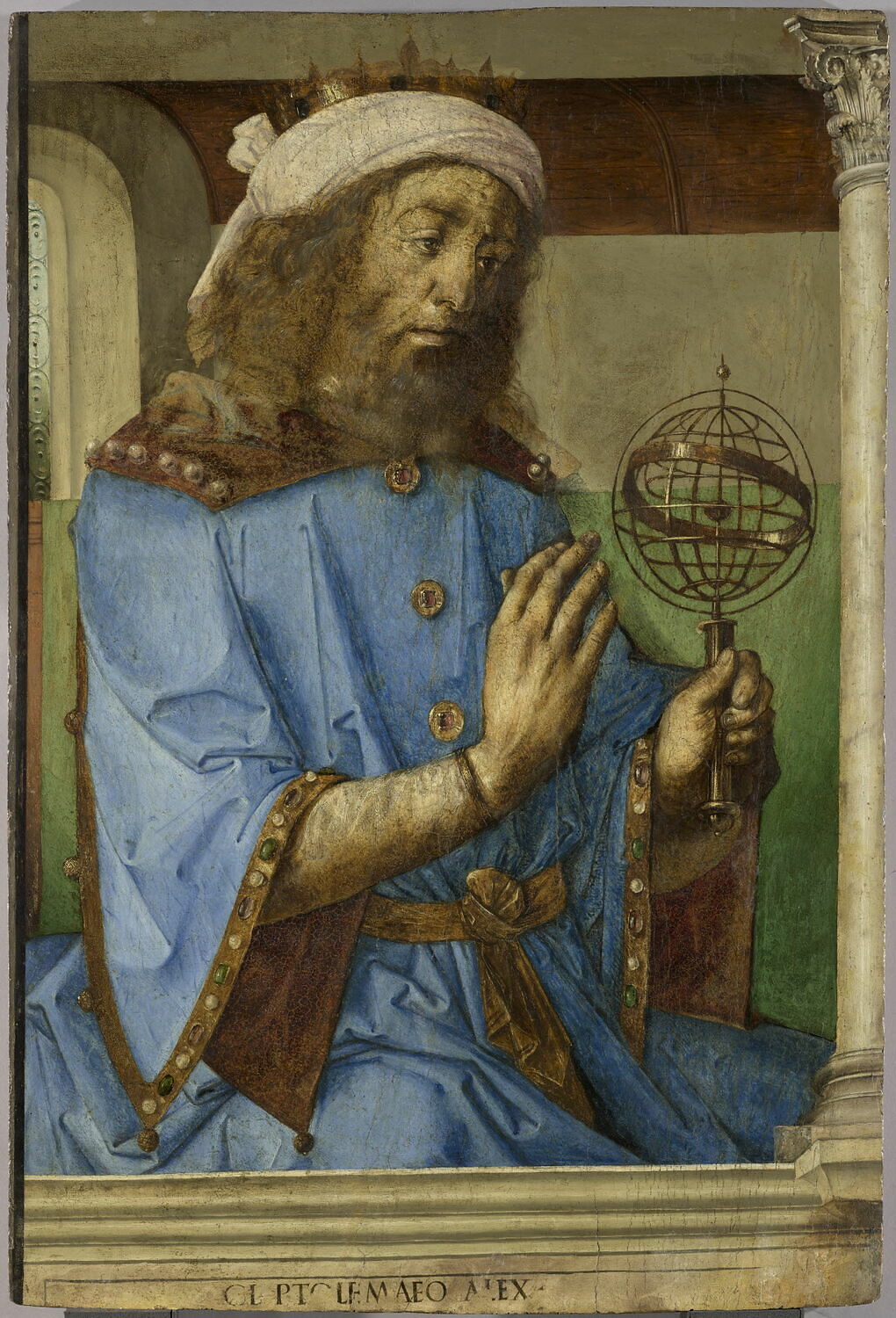
An armillary sphere is a birdcage built to model a coordinate system: nested and pivoting rings for the celestial equator, the ecliptic, the meridian and the tropics, sometimes with a small globe of Earth or the Sun caged at the center. Hipparchus credited Eratosthenes with an early version around 255 BCE, used to pin down the tilt of the ecliptic against the equator — a single-purpose ring rather than the full sky-cage the design became. China arrived at the same idea without any contact with Greek astronomy: Zhang Heng had a bronze sphere turning under its own water-clock power by 125 CE, a lineage that ran forward through Yi Xing, Su Song, and Guo Shoujing. Ptolemy described a ring instrument for taking celestial coordinates directly in the Almagest, and the design carried through Islamic astronomy — al-Battani and others refined it — into medieval Europe, where Sacrobosco’s “De Sphaera” made it the standard prop for teaching spherical astronomy in university lecture halls for three centuries. It did two jobs at once: as an observing instrument, sighted through a bore or tube fixed to one ring, it let an astronomer read a star’s position directly off graduated scales; as a teaching model, it let a student watch the whole apparatus of celestial motion turn in their hands.
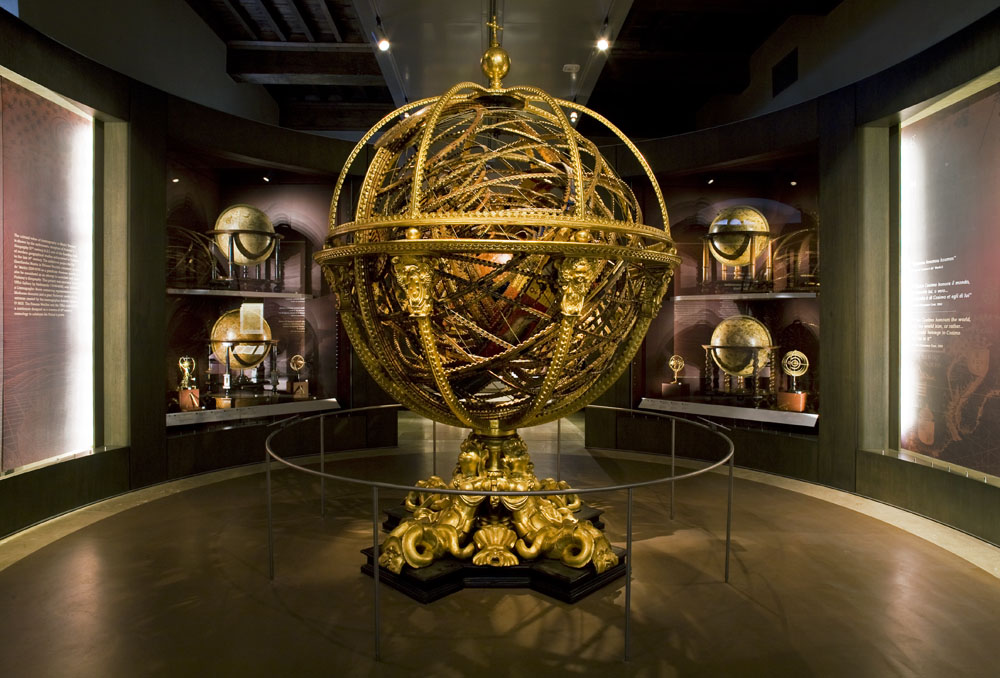
The observing job ran out of room first. Tycho Brahe pushed the design to its physical limit at Uraniborg in the 1580s, building armillary spheres up to 2.7 meters across specifically because bigger rings meant finer graduations and smaller reading error — and by the account in his own 1598 “Astronomiae Instauratae Mechanica,” it worked: he compiled the best naked-eye stellar and planetary positions ever recorded. It wasn’t enough. The telescope reached observational use around 1609, and telescopic sights bolted onto graduated quadrants through the following decades did to angular measurement what no amount of brass and scale-cutting could: they resolved positions past what any human eye, however well trained, could read off a ring. Observatories retired their armillary spheres for sighted and eventually telescopic instruments over the following decades, a quiet trade rather than a single break. What didn’t die was the teaching half — Santucci’s gilded Ptolemaic sphere in Florence, finished in 1593, was already built more as a representation of the cosmos than a working tool, and that use case, the sphere as a demonstration of how the sky is put together rather than an instrument for measuring it, survived the telescope by centuries, showing up in classrooms and frontispieces long after no working astronomer would have trusted one for actual data. Dominance is not eternal: the instrument that once was the only way to fix a star’s place in the sky became, within a couple of generations, a thing you kept around to explain the idea of the sky to someone who hadn’t seen it done properly yet.
Worth remembering
- Eratosthenes' solstitial armilla, credited to him by Hipparchus and used around 255 BCE, is among the earliest ring instruments on record — built to fix the obliquity of the ecliptic rather than to model the whole sky, a task the fully developed sphere would later take on.
- Zhang Heng completed a bronze armillary sphere in China by 125 CE that turned on its own power, driven by an inflow water clock — an independent Chinese design tradition that ran through Yi Xing, Su Song, and Guo Shoujing without contact with the Greek line that produced Ptolemy's ring instruments.
Gallery
Sources
- An armillary sphere is a model of the celestial sphere built from graduated metal rings representing the equator, ecliptic, meridians and tropics; Hipparchus attributed its invention to Eratosthenes around 255 BCE, who used a solstitial armilla to measure the obliquity of the ecliptic. Wikipedia
- Zhang Heng (78–139 CE) built a bronze armillary sphere driven by an inflow clepsydra water clock, completed by 125 CE — the first known application of hydraulic power to rotate such an instrument, developed independently of the Greek tradition and influencing later Chinese astronomers including Yi Xing, Zhang Sixun, Su Song and Guo Shoujing. Wikipedia
- Tycho Brahe built armillary spheres of 1.5 m and a great equatorial armillary of 2.7 m radius at his Uraniborg observatory, documented in his 1598 treatise 'Astronomiae Instauratae Mechanica'; he was the last major astronomer to compile precision positional data entirely by naked eye, working in the decades immediately before the telescope's invention in 1608. Amusing Planet
- Antonio Santucci's large Ptolemaic armillary sphere, built in Florence for Ferdinand I de' Medici between 1588 and 1593, survives in the Museo Galileo and is described as the largest such instrument in existence — built as a representational 'universal machine' of the Ptolemaic cosmos rather than a working observational tool. Museo Galileo, Florence
A graveyard tradition: leave a stone to show you came, and remembered.