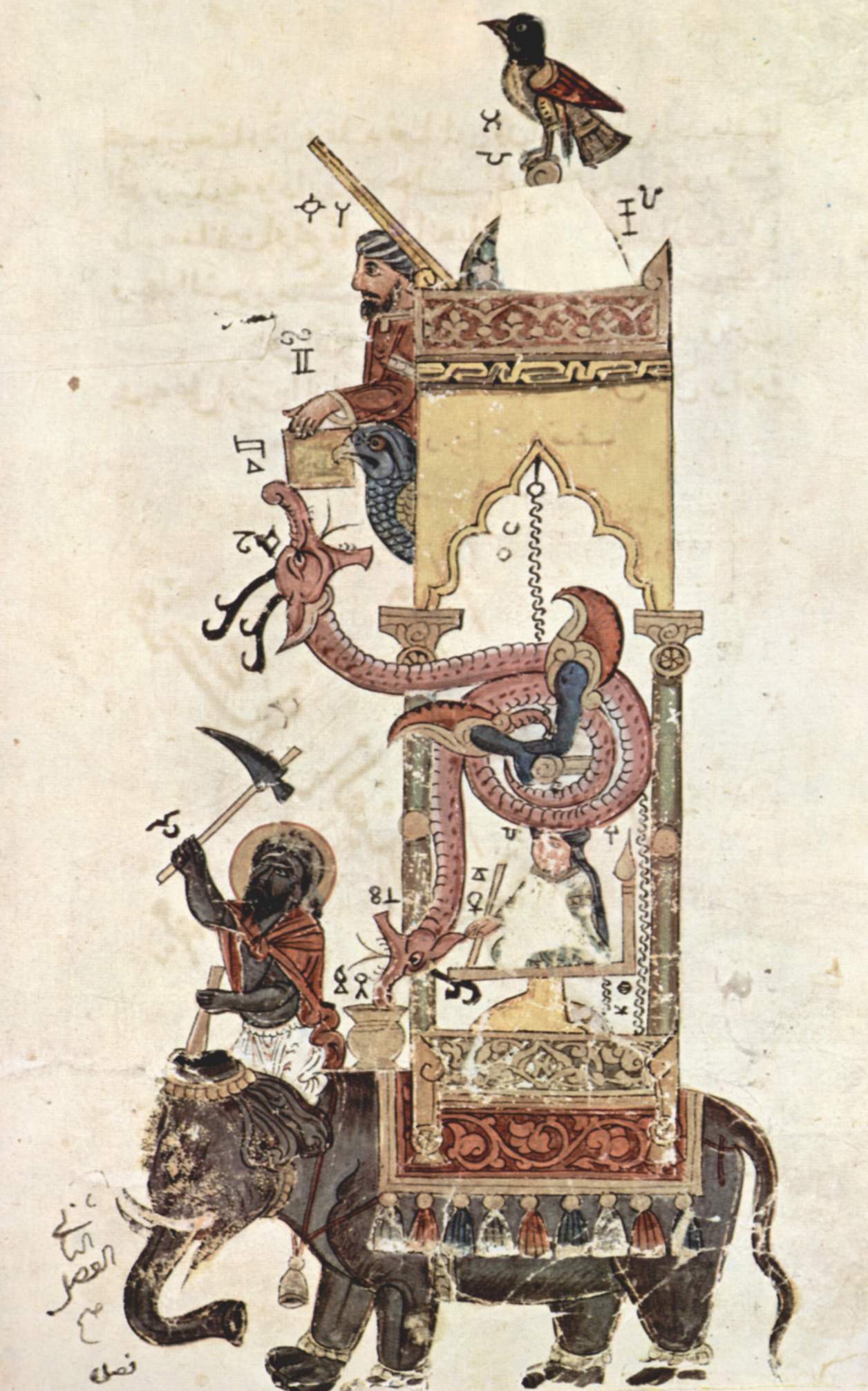
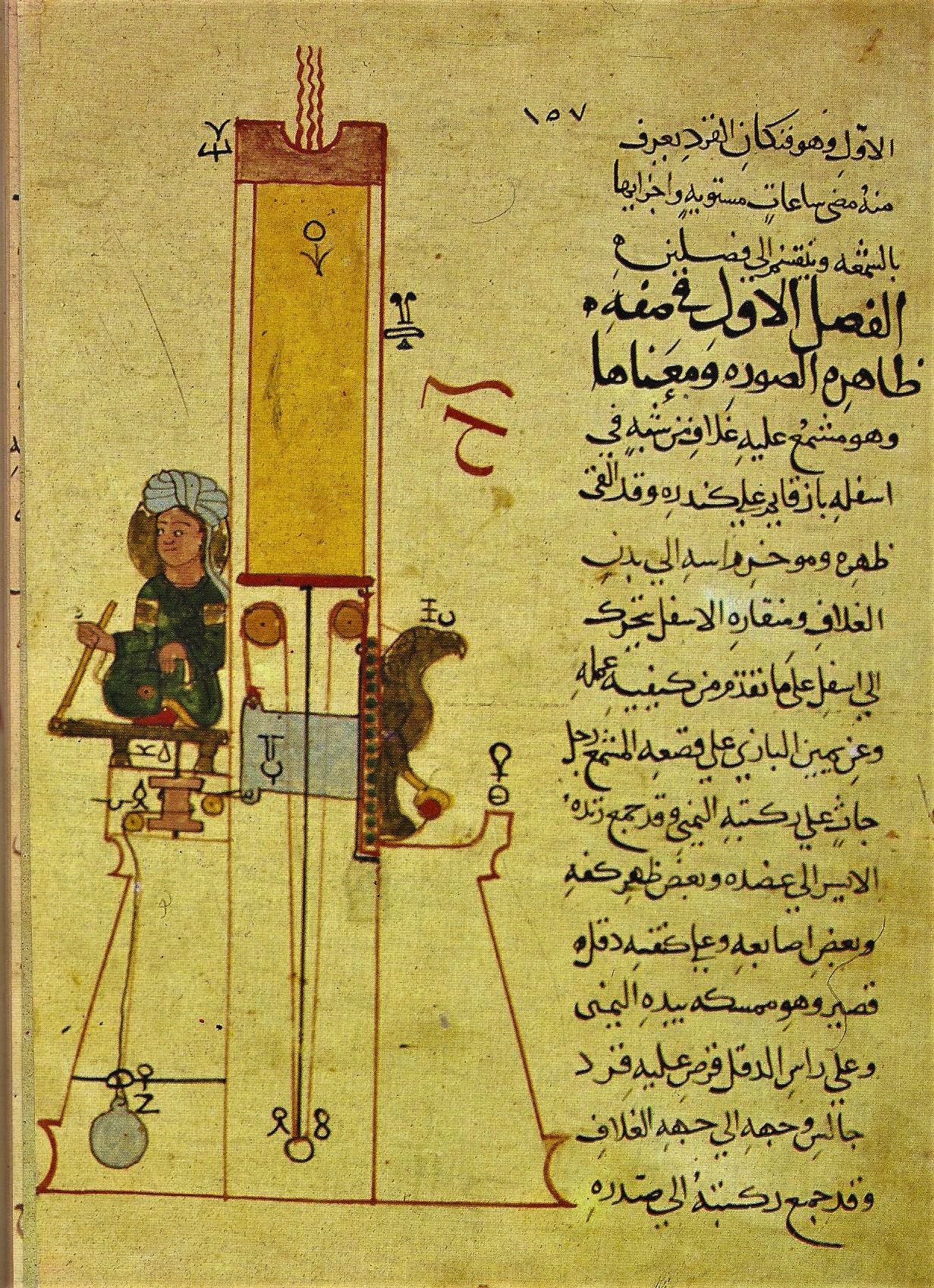
In 1206, at the Artuqid court in Diyarbakır, the engineer Ismail al-Jazari finished a book describing fifty machines — and most of them were the kind of thing the world would not see again for centuries. His Elephant Clock told the time through a performance: inside a model elephant a bowl slowly sank in a tank of water, and at each half hour it released a ball that rattled through serpents and falcons and figures until a little mahout struck a drum. He built a humanoid automaton that poured water for hand-washing, peacocks that offered soap and a towel, and a band of mechanical musicians on a boat whose rhythm could be altered by moving pegs around a drum — a programmable machine, set down in ink eight hundred years before anyone called it that.
None of it survived. The medieval Islamic tradition of grand programmable water-clocks had no successor of its own: from the late thirteenth century, weight-driven mechanical clocks spread through European towns, simpler and more accurate, and by the time later engineers returned to clockwork they built in that European idiom rather than al-Jazari’s. His actual machines, made of wood and brass and water, were not preserved; what remains is the book, copied and recopied, its bright diagrams the only evidence that any of it ran. The replicas in museums and shopping malls today are reconstructions from those pages — built from the manual of a technology that left no living descendants.
Worth remembering
- Every half hour the Elephant Clock performed: a sinking bowl in the elephant's belly tripped a sequence in which a falcon dropped a ball into a serpent's mouth, a figure struck a cymbal, and the mahout beat the elephant — a chain of automated theatre powered by a single timed float.
- Al-Jazari also designed a hand-washing automaton that offered water and a towel, and a boat of mechanical musicians whose drumbeats could be reprogrammed by repositioning pegs on a rotating drum — arguably the first programmable machine, described eight centuries before the word existed.
Gallery
Sources
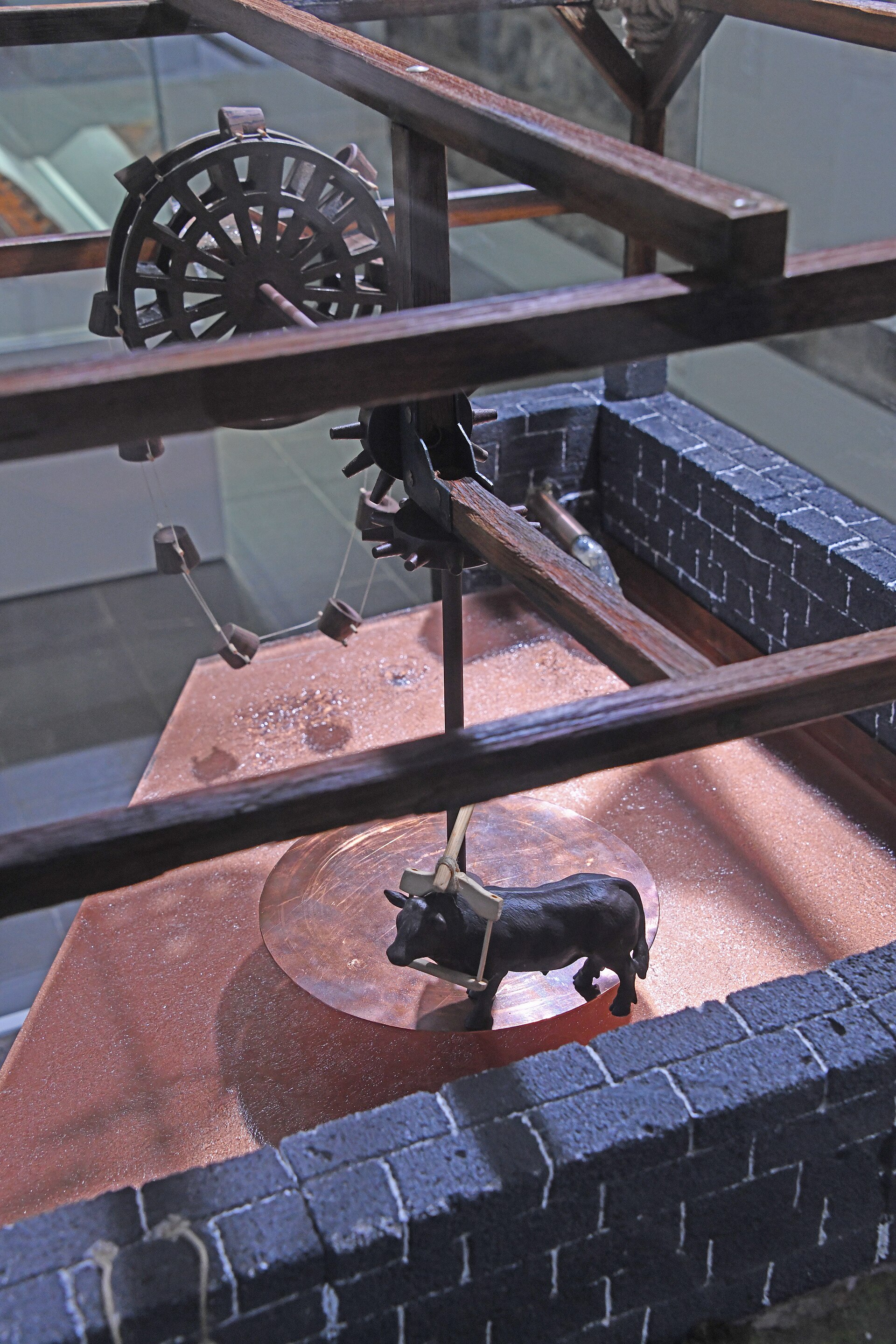
- Al-Jazari described some fifty devices in his 1206 treatise, including programmable humanoid automata; the Elephant Clock deliberately combined Indian, Chinese, Egyptian, Greek and Arabian elements. Muslim Heritage (Foundation for Science, Technology and Civilisation)
- Al-Jazari's programmable drum machine used pegs (cams) on a rotating drum to change its rhythms; no original of his machines survives, and the knowledge persists only in manuscript copies. National Geographic
- Mechanical clocks are documented in Europe from the 1280s and were common across Europe within decades — the technology that structurally displaced the water-clock traditions. Encyclopedia.com (Gale)
A graveyard tradition: leave a stone to show you came, and remembered.