
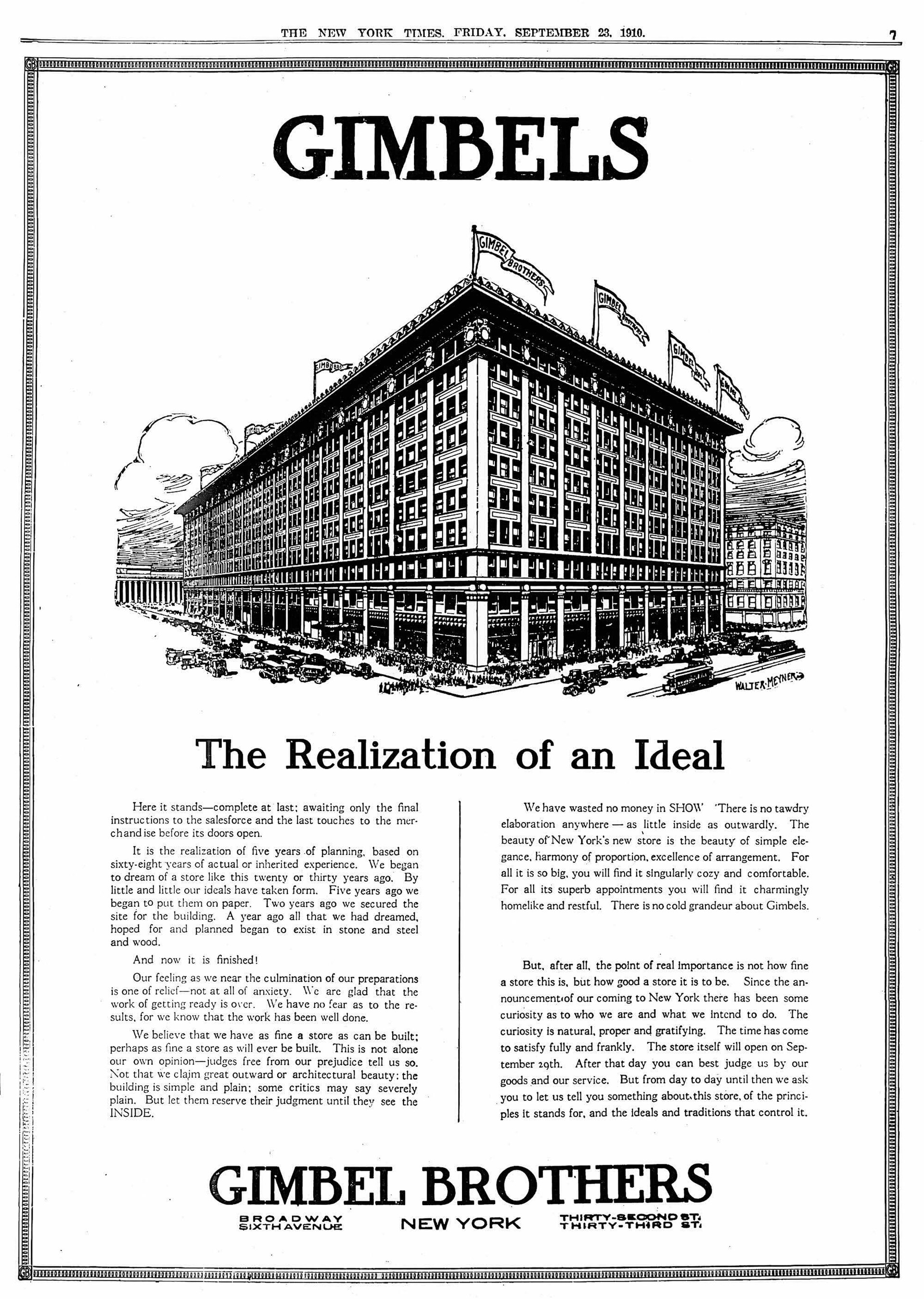
Gimbels was a department-store empire that lasted 145 years. Adam Gimbel opened a frontier general store in Vincennes, Indiana in 1842, and his descendants turned it into Gimbel Brothers, with stores in Milwaukee, Philadelphia and New York. By the 1920s it was the largest department-store retailer in America by sales, peaking at 53 stores by 1965, and its Manhattan flagship stood directly across from Macy’s — one of American retail’s defining rivalries.
By 1973 the company had declined enough that British American Tobacco’s retail arm, BATUS, acquired it and ran it alongside Saks Fifth Avenue. BATUS saw no path to reviving a brand that had lost its identity in the era of malls and discounters, and decided in 1986 that Gimbels was a marginal performer. All remaining stores closed by the end of 1987. Saks, the more prestigious sibling, survived.
Worth remembering
- Gimbels launched an early department-store Thanksgiving parade in Philadelphia in 1920, predating Macy's New York parade by four years.
- The Macy's-Gimbels rivalry was so embedded in culture that Miracle on 34th Street (1947) made a Macy's Santa sending shoppers to Gimbels a central plot point.
Gallery
Sources
- BATUS decided in 1986 to close its Gimbels division and sell the properties; all remaining stores were shuttered by 1987. Wikipedia
- By the 1920s Gimbel Brothers was the largest department-store retailer in America, expanding to a peak of 53 stores by 1965. American Business History Center
- The Macy's-Gimbels rivalry was immortalised in the 1947 film Miracle on 34th Street. Encyclopaedia Britannica
A graveyard tradition: leave a stone to show you came, and remembered.