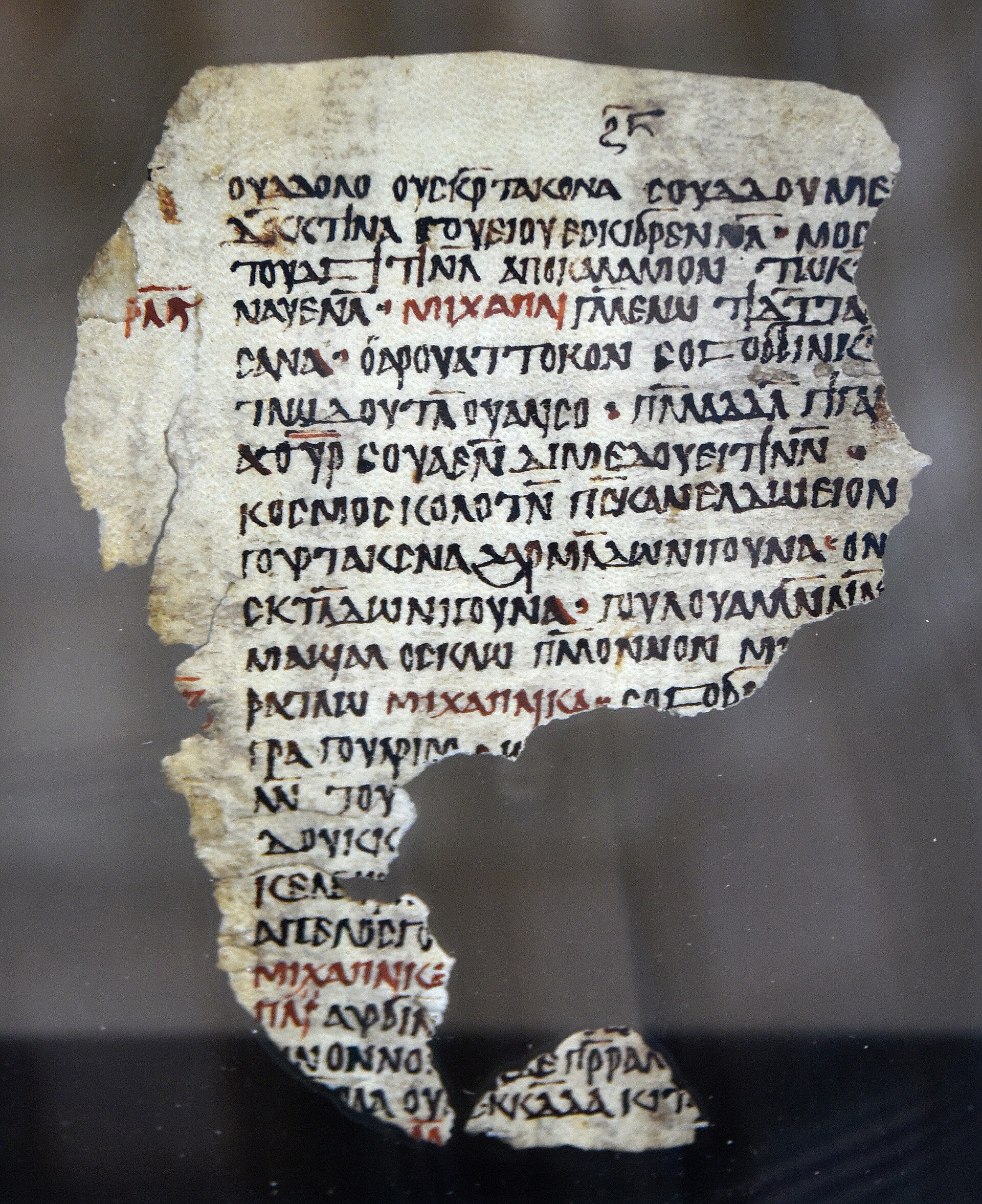
Old Nubian was the language of Christian Nubia, the string of kingdoms — Nobatia, Makuria, Alodia — that held the middle Nile in what is now northern Sudan and southern Egypt for the better part of a millennium. Converted to Christianity in the sixth century, these kingdoms developed Old Nubian as a written language, using an alphabet adapted from Coptic (and so, at one remove, from Greek) with a few extra letters carried over from Nubia’s older Meroitic script. In it they wrote out their scriptures, their sermons, their land deeds and letters — one of the best-documented written languages of medieval Africa, most of it recovered from the bone-dry archaeological mound of Qasr Ibrim.
Its death came with the slow fall of Christian Nubia. From the fourteenth century the kingdoms were worn down by Arab pressure and the spread of Islam; Makuria’s capital fell, and the language of administration and worship began to give way to Arabic. The last Christian Nubian state, a small kingdom called Dotawo, left the final dated document written in the language in the year 1484. After that the written record of Old Nubian simply stops; when Ottoman power reached the region in the next century, no organised Nubian church or Christian kingdom was left to find. The language did not vanish entirely — its living relatives, Nobiin and Dongolawi, are still spoken on the Nile today — but Old Nubian itself, the literary tongue of the Christian kingdoms, was finished.
Worth remembering
- It was written in an uncial Coptic alphabet — itself descended from Greek — with three extra letters borrowed from the older Meroitic script of Nubia, to spell the sounds Greek and Coptic letters could not.
- Most of what survives was dug out of the dry mound of Qasr Ibrim on the Nile: over a hundred pages of homilies, biblical translations, legal deeds, and letters, the largest body of writing in any medieval African language outside Egypt and Ethiopia.
Gallery
Sources
- The last document relating to the kingdom of Dotawo, written in the Nubian language, bears the date 1484, after which the historical record falls silent Penn Museum, Expedition Magazine (William Y. Adams, 1993)
- Old Nubian was written in an alphabet derived from Coptic with extra letters, and was the language of Christian Makuria from the 8th to 15th centuries, used for religious, legal, and administrative texts Mnamon, Scuola Normale Superiore
A graveyard tradition: leave a stone to show you came, and remembered.