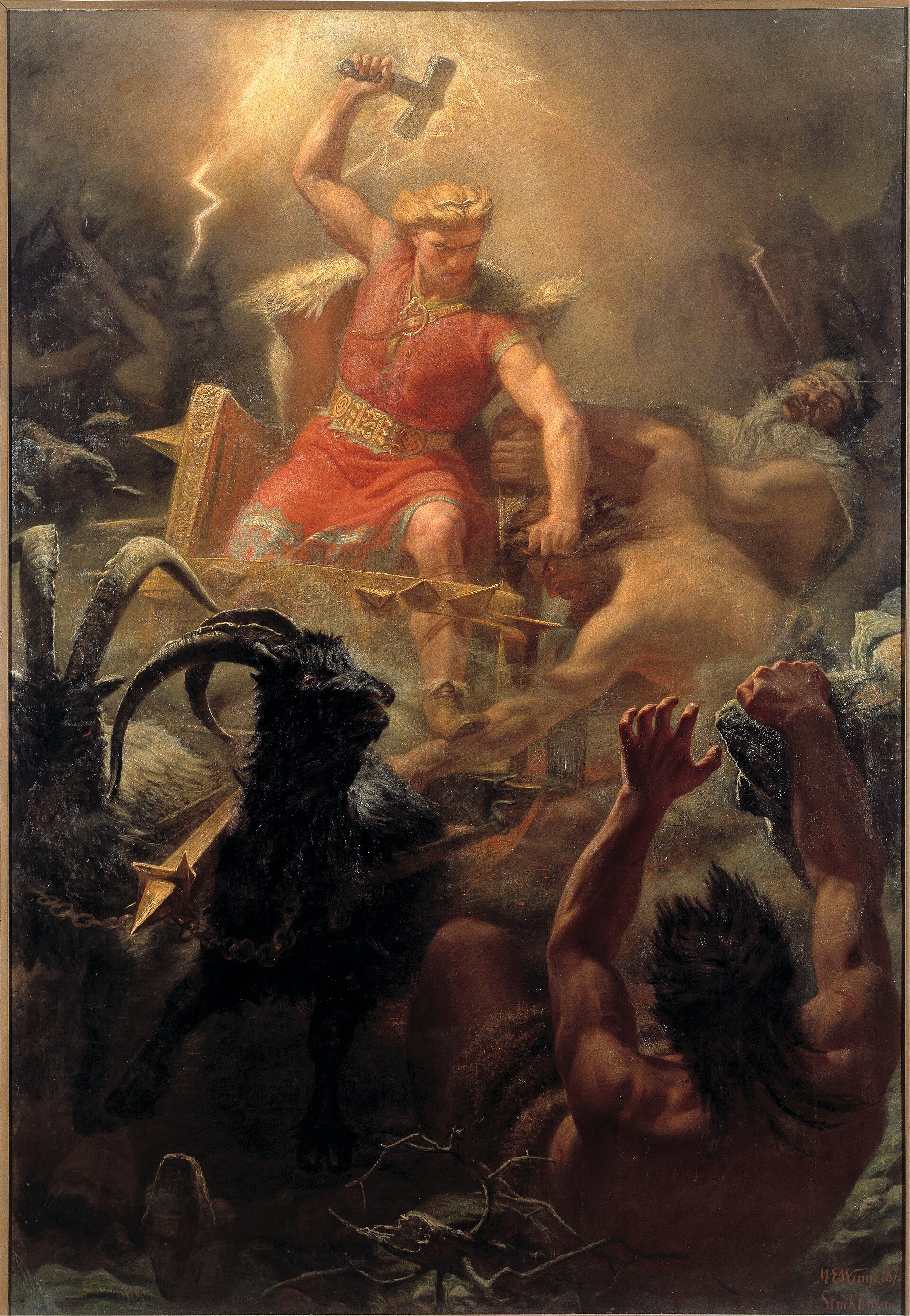
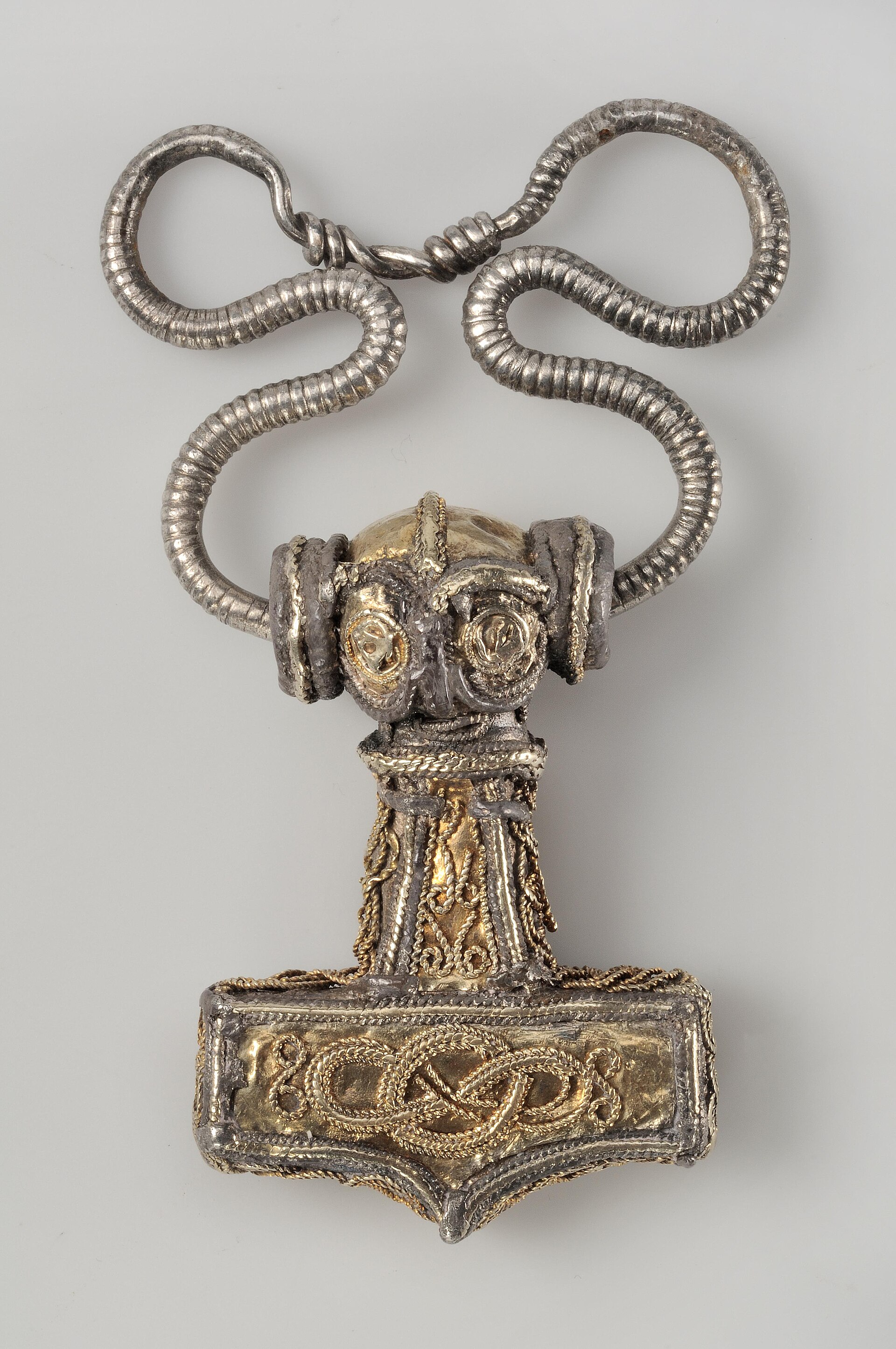
Thor was the god the Vikings actually carried. The hammer Mjölnir, hung on a cord in silver or bronze, was the single most common pagan symbol of the age; more of these amulets survive from the 10th and 11th centuries — exactly when the Norse gods and Christ were in open contention — than from any earlier time, worn as a deliberate answer to the Christian cross. He was the god of the common people, comprehensible and dependable where his father Odin was treacherous: a god of thunder, fertility, law and order who rode a goat-drawn chariot and fought the World Serpent Jörmungandr. More Vikings were named after him than after any other god — Toke, Thorsten, Thorvald, Thorolf. Adam of Bremen, writing in the 1070s, placed a statue of Thor enthroned at the centre of the great temple at Gamla Uppsala, Odin and Freyr seated on either side. He outranked his own father in the daily life of the north.
Then the kings converted, and the god of the people went down with the rest. Iceland adopted Christianity by law of its assembly around the year 1000; Olaf Tryggvason forced baptism on Norway; the Uppsala temple was destroyed by the Christian King Inge the Elder around 1080, and a church was raised on the spot. By the 12th century Thor’s cult was a memory and churches stood where his shrines had been. Modern Heathenry and Ásatrú revere him again — Ásatrúarfélagið was recognised in Iceland in 1973 — but this is a 20th-century reconstruction assembled from medieval Icelandic manuscripts, not a line of worship that ever ran unbroken from the Viking Age; the original organised cult was dead nine centuries before it. His name survives everywhere and means nothing devotional: a weekday in English and German, a Marvel character in cinemas worldwide. He is recognised by more people now than worshipped him at his height, and that recognition is the precise shape of his death — a thunder god remembered as a comic-book figure, with no living cult standing behind the name.
Worth remembering
- The hammer Mjölnir, worn as a silver or bronze pendant, was the commonest pagan symbol of the Viking Age; more Thor's-hammer amulets survive from the decades when Norse religion and Christianity were in open contention than from any other period — pagans wore the hammer as Christians wore the cross.
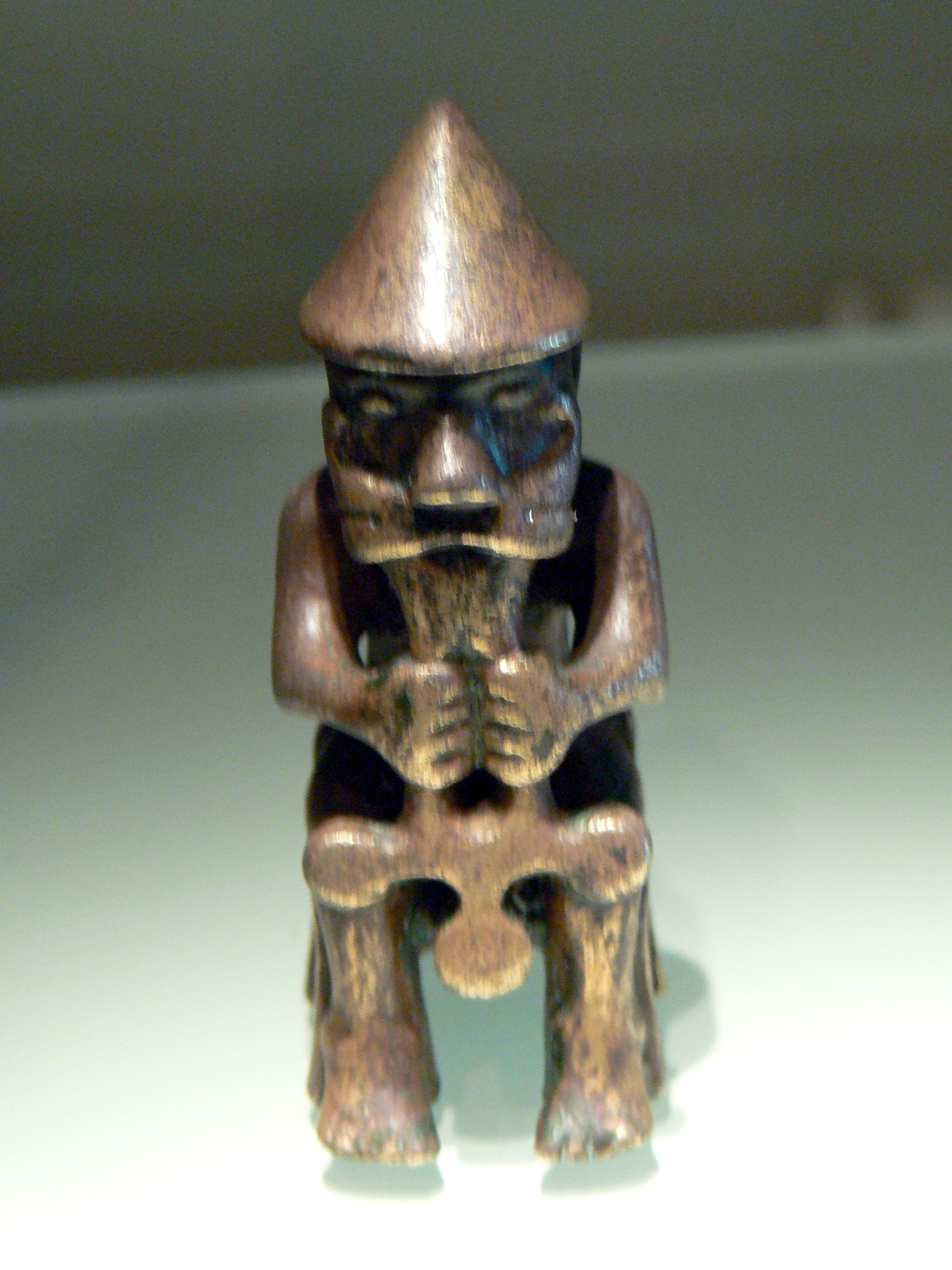
- Thor was the god of ordinary people, named in more Viking personal names than any other deity (Toke, Thorsten, Thorvald, Thorolf), and his temple at Gamla Uppsala held a statue of him enthroned between Odin and Freyr, per Adam of Bremen's c. 1070s account; his name still sits in English 'Thursday' (Old English Þunresdæg, Thor's day).
Gallery
Sources
- Thor was the most popular of the Norse gods, worshipped by most Vikings as the god of the common people; his veneration peaked in the Viking Age (c. 790–1100), when he was Christ's greatest rival. National Museum of Denmark
- More amulets of Thor's hammer survive from the period when Christianity and the Norse religion were in contention than from any other; by the 12th century Thor's cult was a memory and churches stood where his temples had been. Thursday / Donnerstag means 'Thor's day'. World History Encyclopedia
- The temple at Gamla Uppsala, described by Adam of Bremen with a statue of Thor enthroned in the centre flanked by Odin and Freyr, was destroyed by the Christian King Inge the Elder c. 1080, and a church was built on the site. World History Encyclopedia
A graveyard tradition: leave a stone to show you came, and remembered.