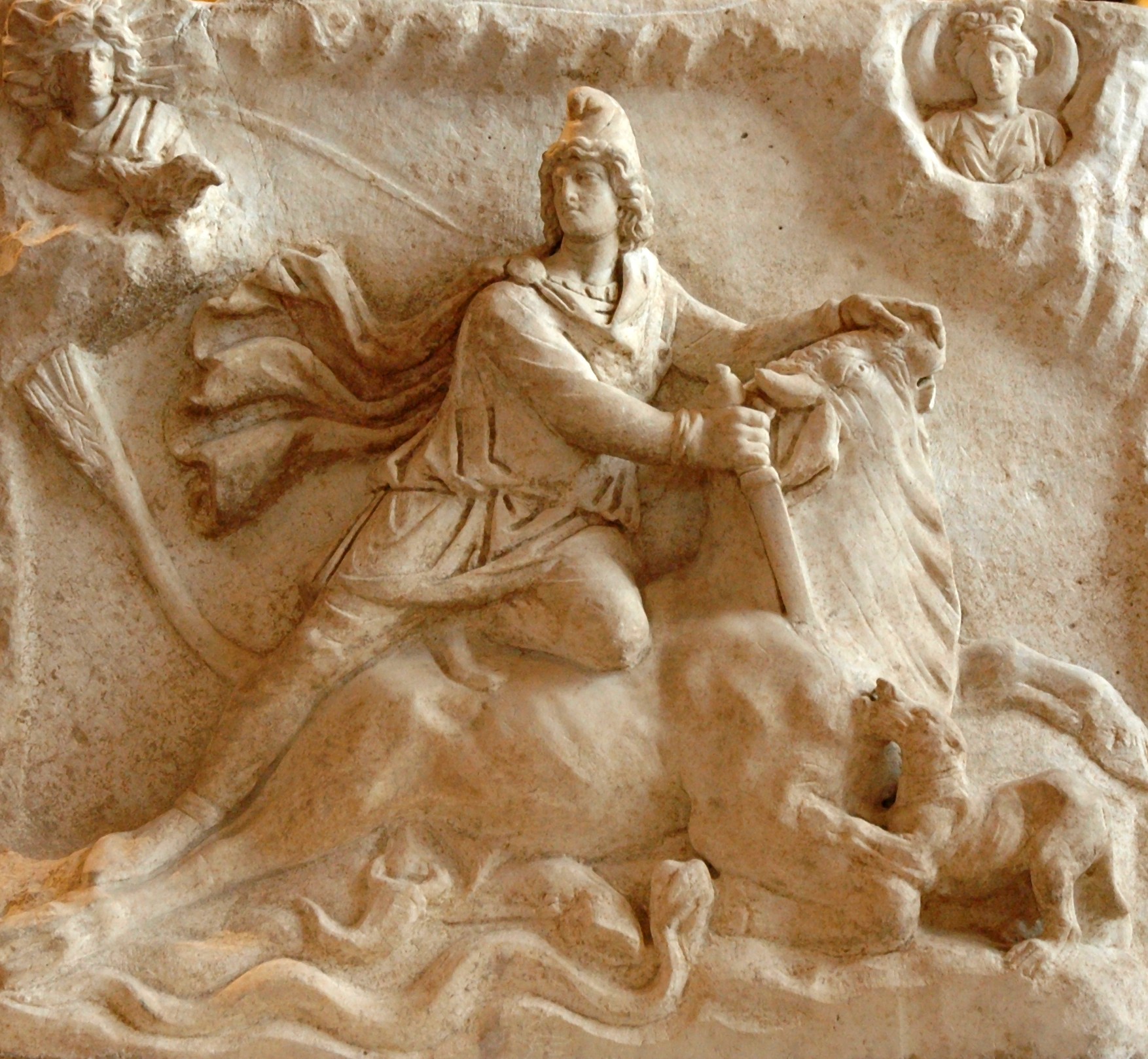
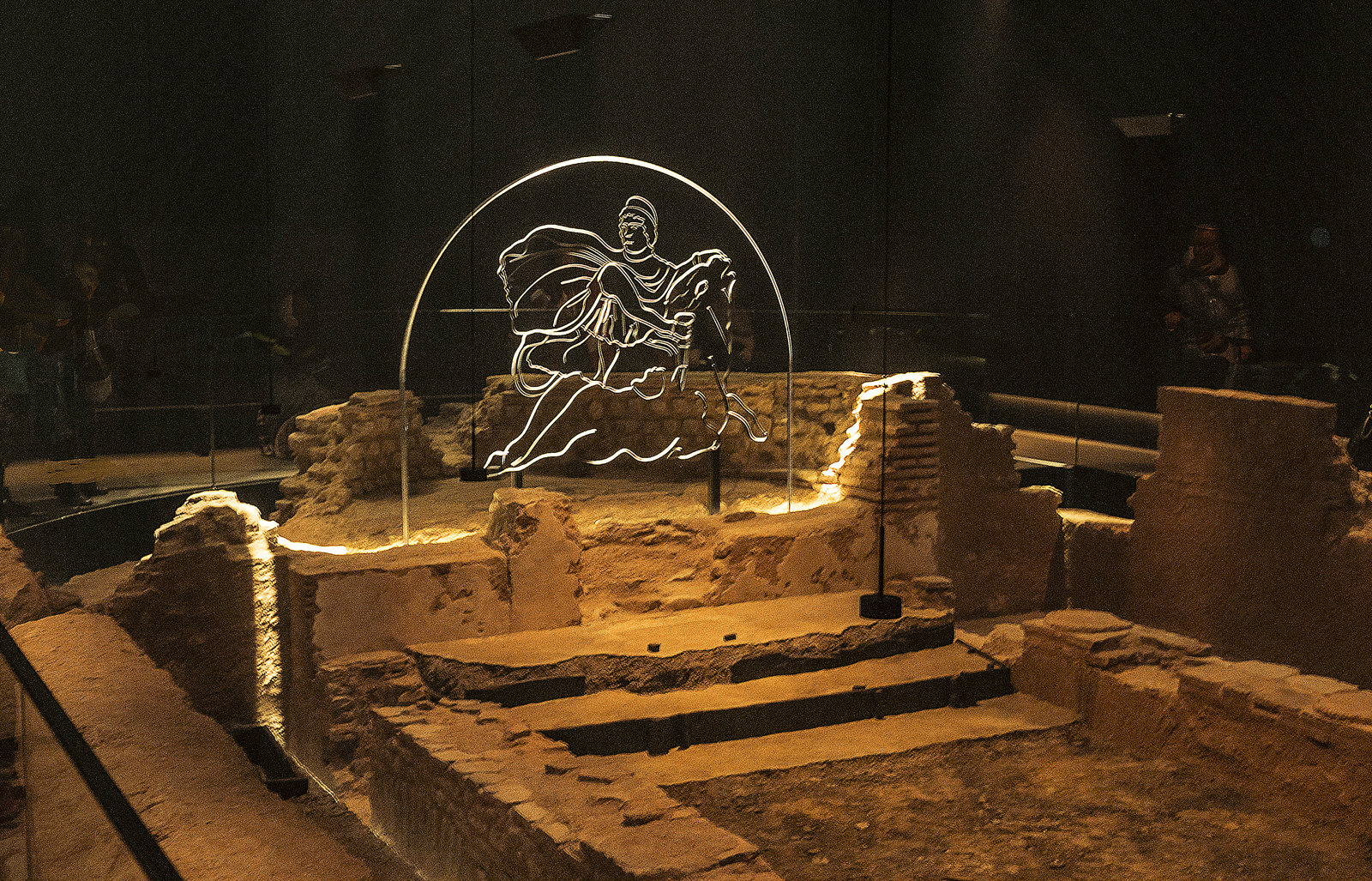
Mithras — the Roman mystery god named for the older Iranian god Mithra — was a god men met in the dark. His cult appeared in the late 1st century CE and spread along the Rhine, the Danube and Hadrian’s Wall, carried by the people who moved most along those lines: legionaries, officers, merchants, freedmen, customs officials. They worshipped underground, in windowless rooms dressed as caves, with raised stone benches down each side for ritual meals. At the head of every room stood the same image — Mithras killing the bull — and to belong you climbed through seven grades, from raven up to father, each rank with its own dress and its own planet. London had one of these temples by about 240 CE, dug into the Walbrook valley; Rome had dozens. No women were admitted. For the 2nd and 3rd centuries the cult ran in parallel with the rest of Roman religion and, in its appeal to soldiers and its promise of salvation through a divine sacrifice, stood as a direct competitor to the new Christian congregations growing in the same garrison towns.
It lost. Through the 4th century the emperors turned Christian, and Theodosius I’s anti-pagan edicts of the 390s closed the public machinery that the mysteries had always sheltered beside. Mithraea were walled up, abandoned, or smashed; in Rome, churches were raised directly over the temples beneath San Clemente and Santa Prisca, sealing the caves under the new faith. The London temple was out of use by about 350 CE, its Mithras head buried and not seen again until 1954. The cult had kept its secrets so thoroughly that it died nearly mute: no scripture, no liturgy, no theology in its own words survives — only inscriptions, scattered remarks by hostile Greek and Latin writers, and the roughly 650 bull-slaying reliefs. Everything reconstructed about what these men believed is read off the stones they left in the ground.
Worth remembering
- Every mithraeum was built around the tauroctony: Mithras kneeling on a bull, dragging back its head and driving a dagger into its neck, with a dog and serpent at the wound and a scorpion at the bull's genitals. About 650 of these reliefs survive across the empire.
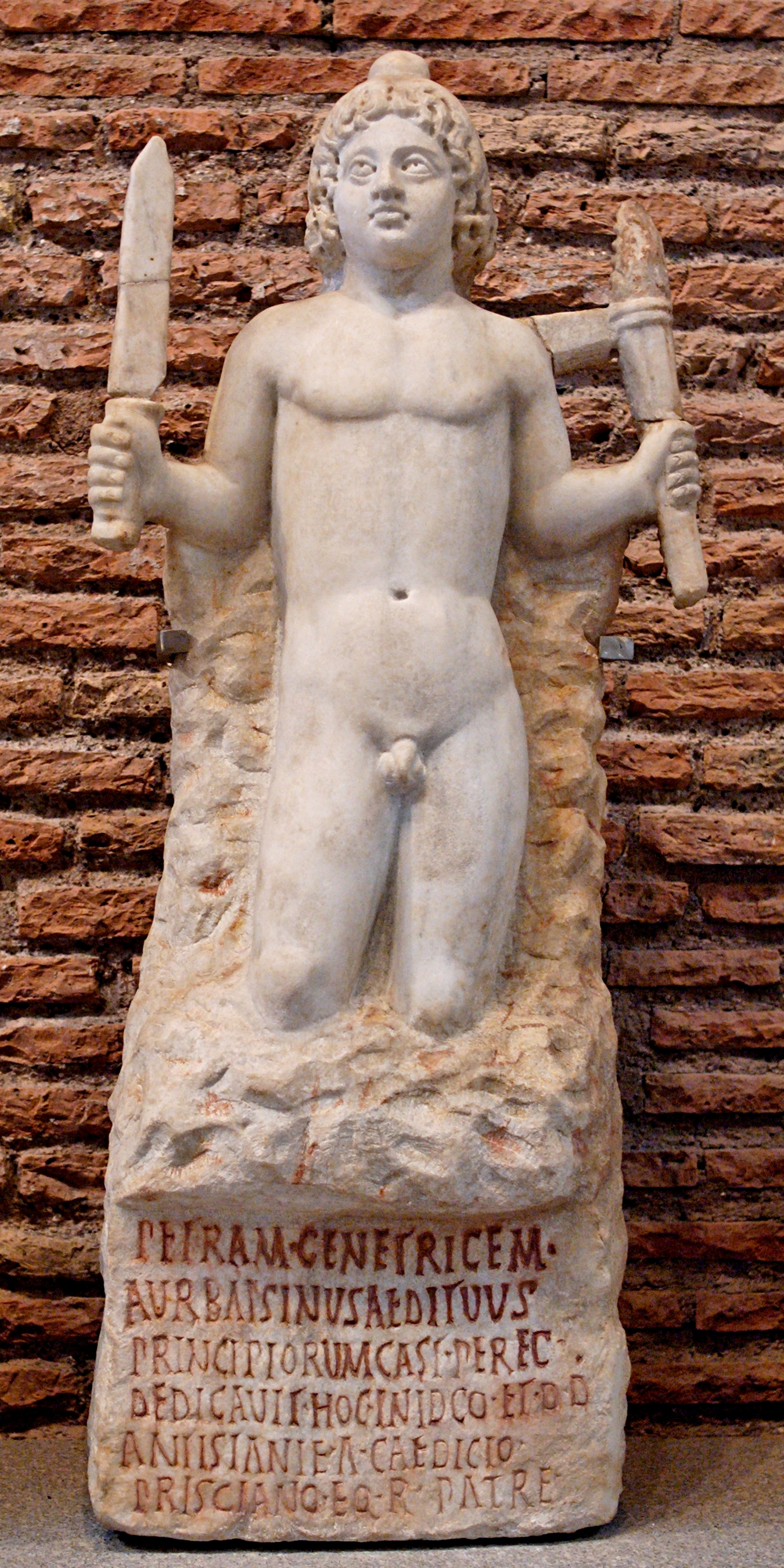
- Initiates climbed seven graded ranks — corax (raven), nymphus (bridegroom), miles (soldier), leo (lion), Perses (Persian), heliodromus (sun-runner), pater (father) — each tied to a planetary god. The earliest documented followers were soldiers and officers of the Roman army.
Gallery
Sources
- The Roman cult appeared in the late 1st century CE, organised initiates into seven grades (corax, nymphus, miles, leo, Perses, heliodromus, pater), and centred on the tauroctony — Mithras slaying the bull — with roughly 650 such reliefs found across the empire; temples were later walled up or destroyed by Christians. World History Encyclopedia
- Roman London's Temple of Mithras was built around 240 CE in the Walbrook valley and used until about 350 CE; it was a secret cult for men — soldiers, merchants and civil servants ranked in seven grades — who left no written records; excavated in 1954, its marble Mithras head drew tens of thousands of queuing visitors. London Museum
- Bull-slaying imagery seems specific to Roman Mithraism — there is no evidence the Iranian god Mithra ever killed a bull; no written narratives or theology survive, only inscriptions and passing references in Greek and Latin literature; churches were built over the San Clemente and Santa Prisca mithraea in Rome. Wikipedia
A graveyard tradition: leave a stone to show you came, and remembered.