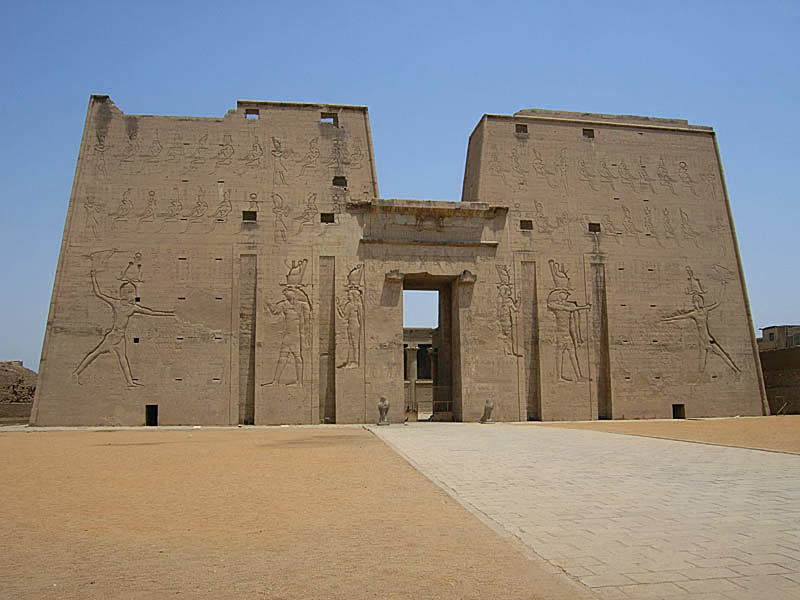
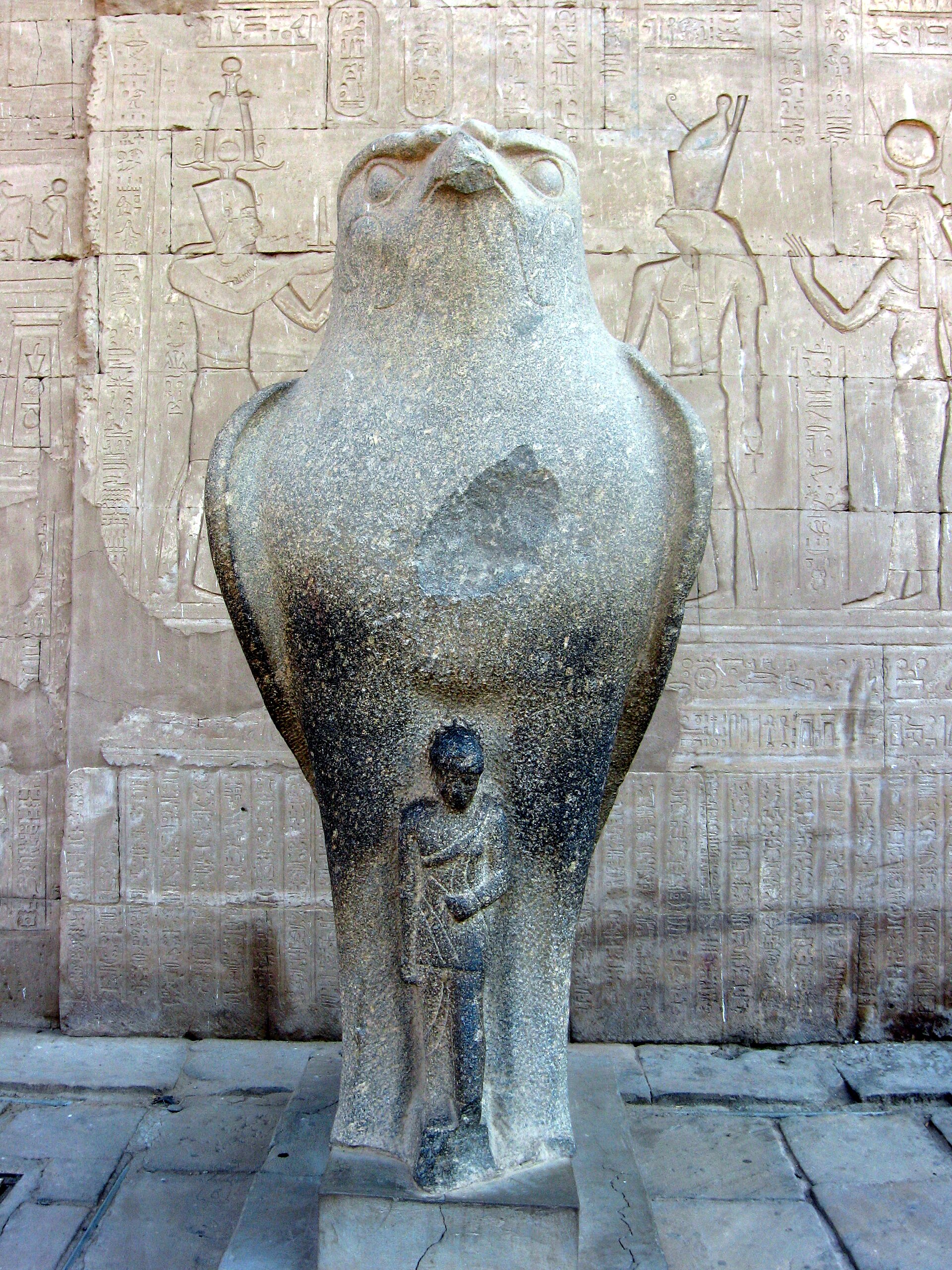
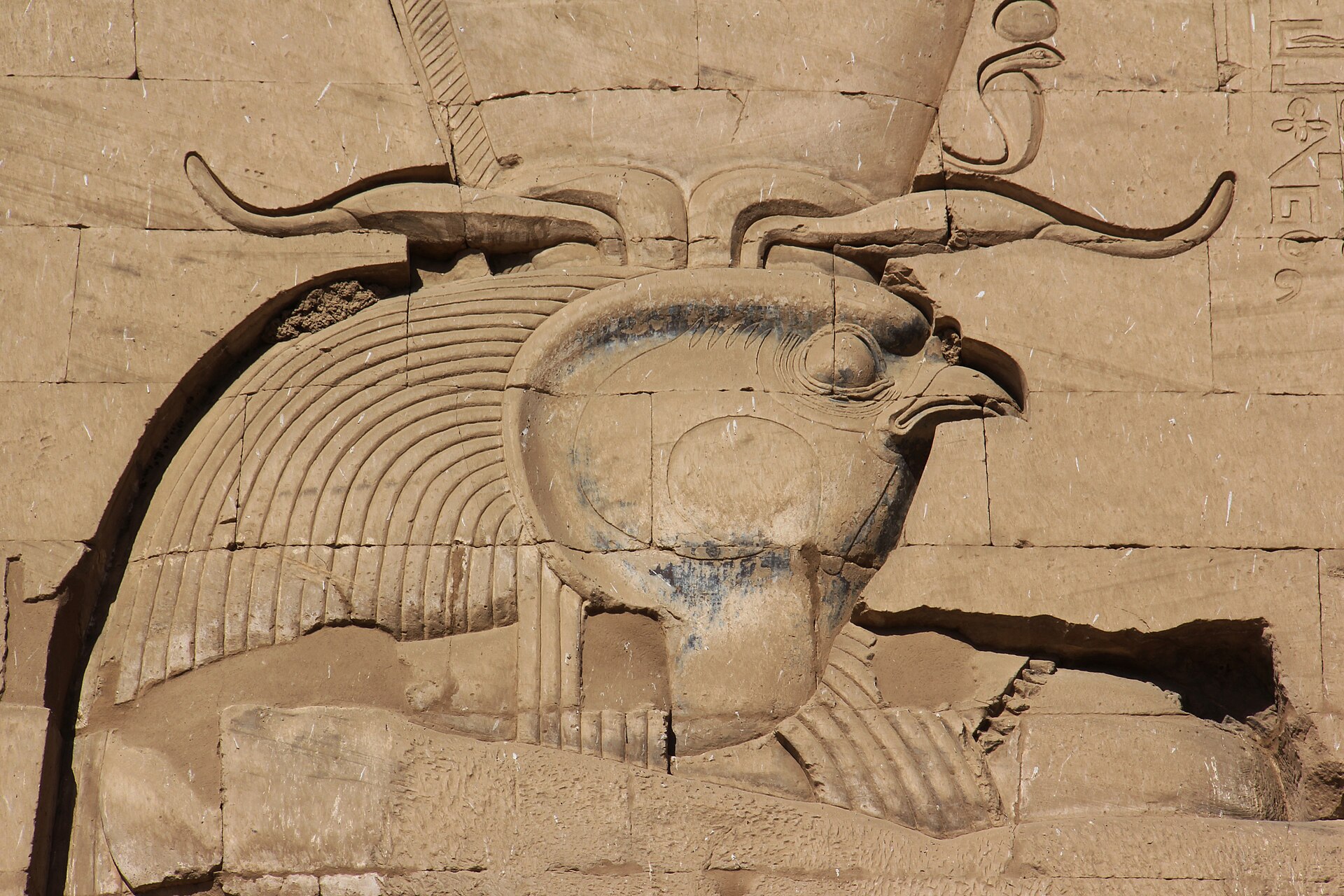
Horus was the god a king became. The falcon of the sky, whose two eyes were the sun and the moon, he was the heir of Osiris and Isis and the avenger who fought his uncle Set across a string of brutal contests to win back his father’s throne. From the first dynasties around 3100 BCE, every reigning pharaoh was Horus made flesh: the king wrote his throne name inside a serekh crowned by the falcon, took a “Horus name” at his coronation, and ruled as the god walking among the living. The dead king passed into Osiris; the new one was Horus again, an unbroken succession the Egyptians repeated for three thousand years. His great house at Edfu, raised by the Ptolemies between 237 and 57 BCE, still holds a black granite falcon over three metres tall in the double crown, and once a year a living bird was crowned there as the god-king of Egypt.
The succession ran out when the religion did. As Christianity became the faith of Rome’s empire, the temples that fed Horus closed; the last hieroglyphs were cut at Philae in 394 CE, and around 537 the emperor Justinian sent Narses to shut Philae itself, the final working sanctuary of Egypt’s gods. No pharaoh has been crowned as the living Horus since. The wedjat that once guarded the dead is now a jewelry motif and a Unicode emoji; Edfu is a ticketed ruin where guides point out the falcon and tourists photograph it. The god who made and unmade every king of Egypt has no priests, no temple in use, and no one who worships him.
Worth remembering
- Every pharaoh from the Old Kingdom to the Roman era was the living Horus on earth: each king took a 'Horus name' at his coronation and wrote it inside a serekh topped by the falcon, the oldest royal emblem in Egypt. The dead king became Osiris; the living one was always Horus.
- At the Temple of Edfu, built for Horus under the Ptolemies (237–57 BCE), a black granite falcon over 3 m tall stands wearing the double crown of Upper and Lower Egypt, and priests once held an annual Coronation of the Sacred Falcon in which a live bird was chosen to reign as the god-king.
Gallery
Sources
- Horus is a sky god whose name is attested from the beginning of the Dynastic Period (c. 3150 BCE); Egyptian kings identified themselves with Horus in life and Osiris in death, and the falcon Horus appears in the serekh, the earliest royal emblem. World History Encyclopedia
- Horus was a falcon god whose right eye was the sun and left eye the moon; every pharaoh from the Old Kingdom to the Roman era bore Horus's name in their royal titulary, and after Horus's eye was damaged fighting Seth and healed by Thoth, the restored wedjat eye became a powerful protective amulet. Encyclopaedia Britannica
- The wedjat — the healed eye of Horus, combining a human and a falcon eye — was one of the most popular amulets in ancient Egypt; it embodied healing power and symbolized rebirth, and an amulet in this shape was thought to protect its wearer. The Metropolitan Museum of Art
- According to the sixth-century historian Procopius, the temple of Isis at Philae — one of the last active ancient Egyptian temples — was officially closed in 537 CE by the commander Narses on the order of the emperor Justinian I, conventionally taken to mark the end of ancient Egyptian religion. Wikipedia
A graveyard tradition: leave a stone to show you came, and remembered.