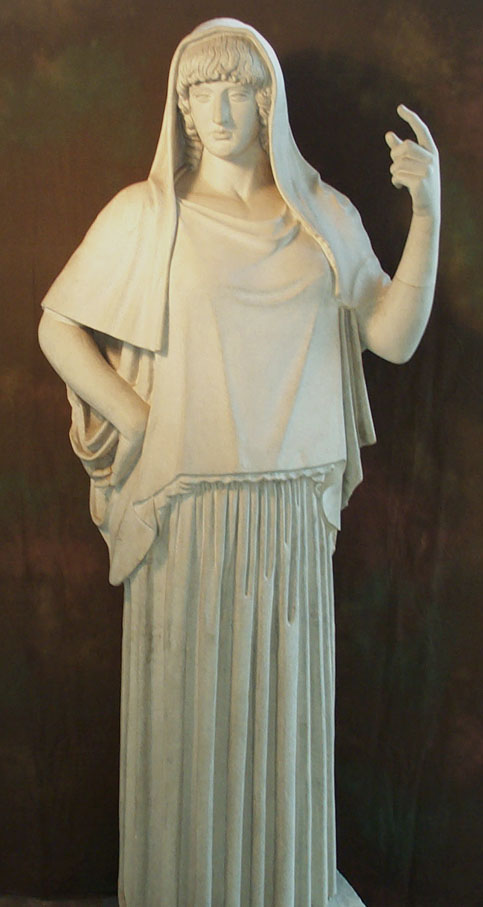
Hestia was the firstborn of Cronus and Rhea — first devoured, per Hesiod, and so last disgorged, making her at once the eldest and the youngest of the Olympian siblings. She swore to remain unwed, and in place of a marriage or a myth she received something no other Olympian held: a claim on every hearth in Greece. Every household fire was hers. Every city kept a public hearth too, the koine hestia, usually housed in the prytaneion, tended as an eternal flame; when a city founded a colony, its priests carried embers from that hearth to kindle the new settlement’s own, physically threading Hestia’s fire between mother city and daughter. At every sacrifice and every feast, Hesiod, Sophocles, Aristophanes, and Plato agree, she received the first portion and the last — a god that had to be paid at both ends of every ritual before it counted. Ancient sources even disagree on whether she or Dionysus held the twelfth Olympian seat: the altar of the Twelve Gods in the Athenian agora included her, the Parthenon’s east frieze put Dionysus there instead. The tidy story that she stepped aside for him voluntarily has no ancient source behind it — it is a modern gloss on a genuine ambiguity — but the ambiguity itself is real, and unlike her ambiguity-free siblings it never produced a war, a rape, or a rivalry. She is the only Olympian with no personal myth of any weight: no abduction, no affair, no battle. She was everywhere and did nothing, the one god too structural to need a story.
Her end came with the same imperial decrees that ended her siblings’ cults. Theodosius I’s laws of 391–392 CE banned all pagan sacrifice, public or private, and on 8 November 392 he outlawed worship of the old gods outright — hearth-offerings included, since every meal that opened or closed without her portion was by definition already a violation. Unlike Zeus’s Olympia or Athena’s Parthenon, Hestia had no single flagship temple whose burning or conversion marks her death on a monument; her cult was distributed across a hundred thousand ordinary hearths and a few hundred civic ones, and it went out the same way it had always been lit — quietly, at the edges of a ritual most people were performing for someone else. She left behind no epic, no statue anyone can be certain is her rather than a generic draped woman, and no flagship ruin — only the structural fact that for over a thousand years, no Greek meal, sacrifice, or civic act was considered complete without paying her first and last. Dominance is not eternal: the gods who fought loudest for their thrones and the goddess who never had to are equally silent now.
Worth remembering
- At the founding of every Greek colony, priests carried embers from the mother city's public hearth to kindle the new settlement's own — the physical continuity of Hestia's fire binding colony to metropolis long before any treaty did.
- At every sacrifice, feast, and civic assembly across the Greek world, Hestia was given the first offering and the last, a practice attested across Hesiod, Sophocles, Aristophanes, and Plato; the Homeric Hymn to Hestia says without her, no banquet could rightly open or close.
Gallery
Sources
- Hestia was the firstborn child of Cronus and Rhea; Hesiod's Theogony has her as the first devoured and the last disgorged, making her simultaneously eldest and youngest of the Olympian siblings. Wikipedia (citing Hesiod, Theogony)
- Ancient sources disagree on whether Hestia or Dionysus held the twelfth seat among the Olympians: the altar of the Twelve Gods in the Athenian agora (set up under Peisistratus, c. 522 BCE) included Hestia, while the Parthenon's east frieze depicts Dionysus in her place. The later story that she voluntarily surrendered her throne to keep the peace has no secure ancient source and is generally treated by classicists as a modern retelling of that discrepancy. Wikipedia
- Every Greek city kept a communal hearth (koine hestia), typically housed in the prytaneion, tended as an eternal flame; when a city founded a colony, embers from the mother city's hearth were carried to light the new settlement's own. Wikipedia
- Hesiod, Sophocles, Aristophanes, and Plato all attest that Hestia was owed the first and last portion or libation at every sacrifice and feast; the Homeric Hymn to Hestia states that without her, gods and mortals alike could hold no banquet. Theoi Greek Mythology (Homeric Hymns, Hesiod)
- Theodosius I's decrees of 391–392 CE (Codex Theodosianus xvi.10.10–12) banned all public and private pagan sacrifice and forbade entry to temples, and on 8 November 392 he prohibited worship of the old gods outright. Wikipedia (citing Codex Theodosianus)
A graveyard tradition: leave a stone to show you came, and remembered.