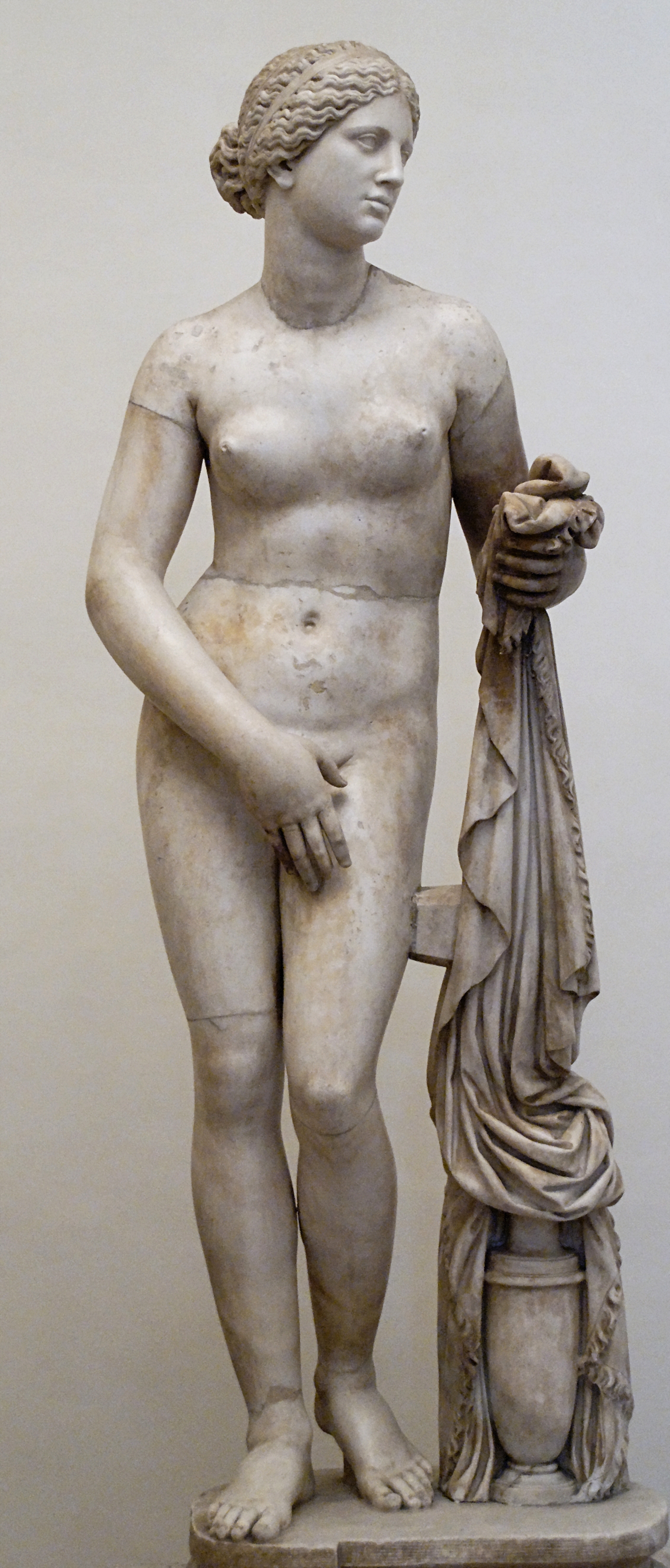
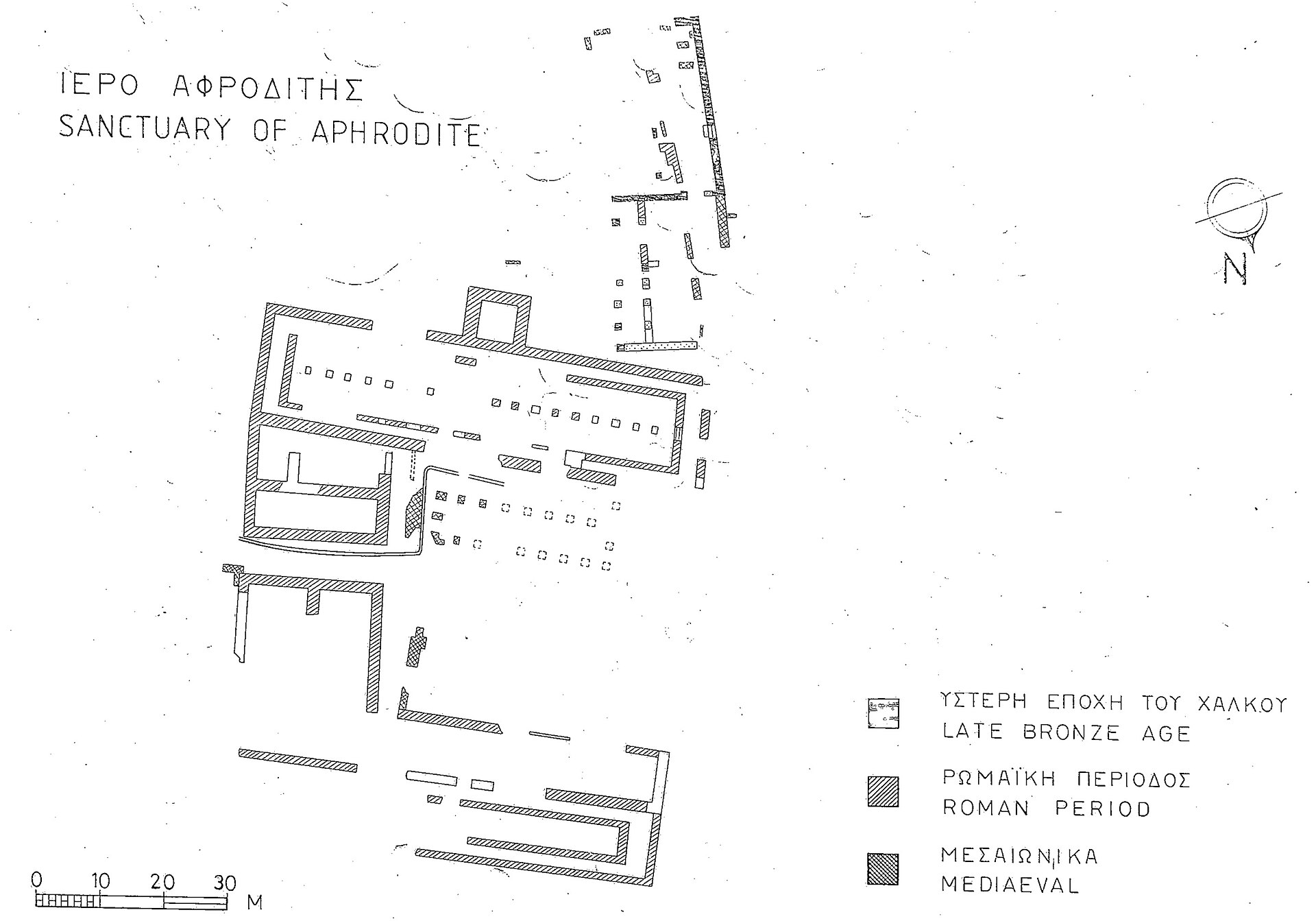
Aphrodite governed love, beauty and sexual desire across the Greek world and, as Venus, across Rome’s. Her oldest and greatest cult sat at Paphos on Cyprus, where the shoreline was held to be the place she rose from the sea-foam; the goddess there was older than the Greeks, worshipped through a conical stone rather than a statue, with roots reaching back to the Near Eastern goddesses Ishtar and Astarte. Corinth was a second major centre. Around 340 BCE Praxiteles gave her the most famous body in antiquity: the Aphrodite of Knidos, the first monumental female nude in Greek sculpture, placed in a circular shrine so visitors could walk around her. Pliny the Elder judged it the finest statue ever made, and copies multiplied through the Roman world. Rome took her further still. Identified with Venus, she became a dynastic claim: on 26 September 46 BCE Julius Caesar dedicated the Temple of Venus Genetrix in his new Forum, honouring her as the mother of Aeneas and the divine ancestress of the Julian family, the line of Caesar and Augustus.
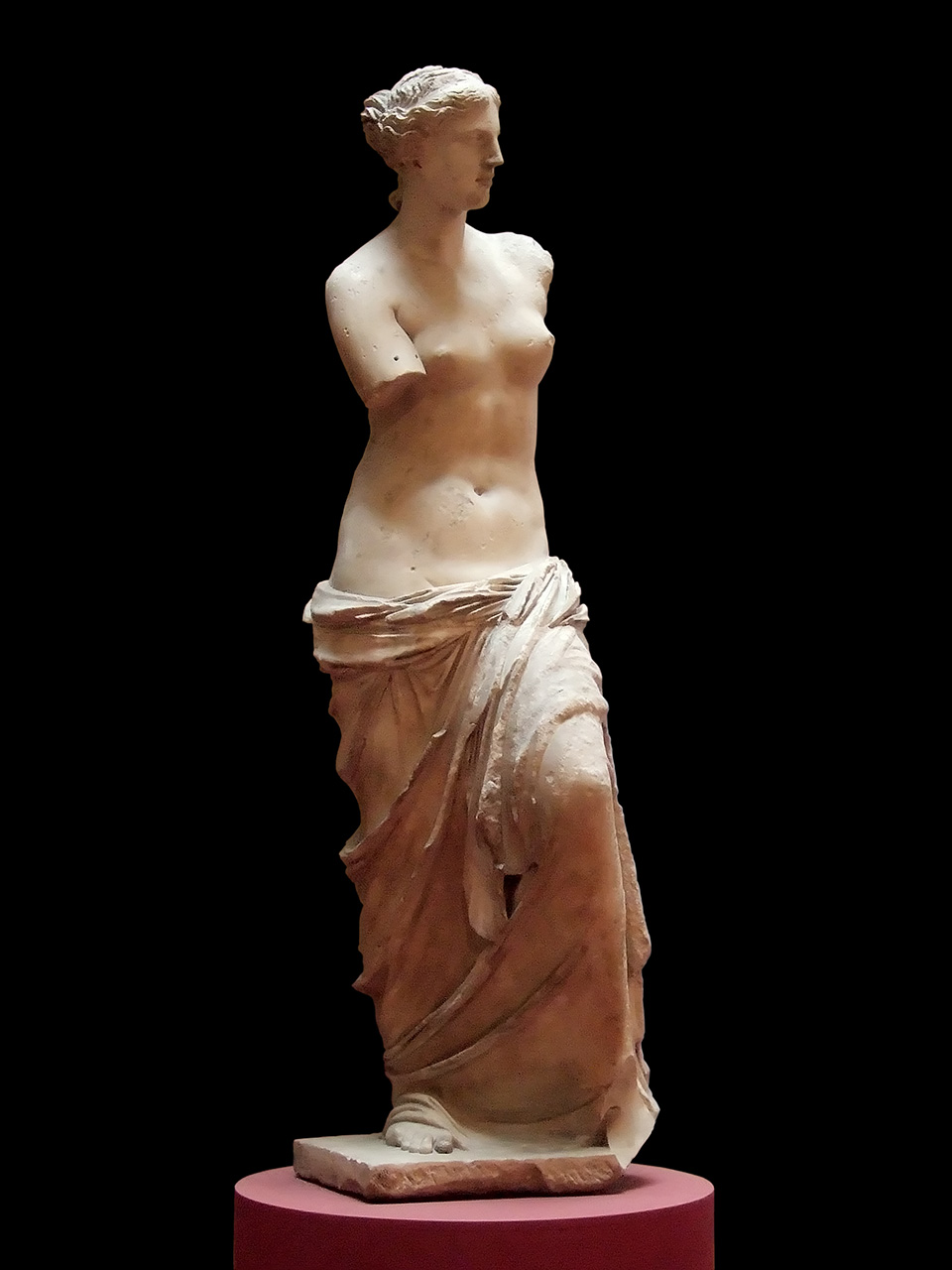
The cult was switched off by imperial law. The sanctuary at Paphos held unbroken worship until 391 CE, when Theodosius I outlawed every pagan religion across the empire; the temple was abandoned and decayed into the ruins that stand today, and the anti-pagan edicts of 391–393 ended public sacrifice to the old gods everywhere. Her image, though, never left. The Aphrodite of Milos — the Venus de Milo, dug up on a Greek island in 1820 and now in the Louvre — is among the most reproduced sculptures in the world, and Botticelli’s Birth of Venus puts her sea-foam arrival on classroom walls and tote bags. The face of love in Western art is still hers. No one prays to her.
Worth remembering
- Her sanctuary at Palaipaphos on Cyprus marked the spot where she stepped ashore from the sea-foam; the goddess there was worshipped aniconically, embodied not in a human figure but in a black-green conical stone, and the site drew pilgrims for over a millennium before it was closed in 391 CE.
- Around 340 BCE Praxiteles carved the Aphrodite of Knidos, the first life-size female nude in Greek sculpture, set in a round shrine so she could be seen from every angle; Pliny the Elder called it the finest statue in the world, and Roman copies of it filled the empire.
Gallery
Sources
- Praxiteles's Aphrodite of Knidos was the first large-scale freestanding sculpture of a female deity in the nude, displayed in a circular shrine on Knidos where she could be viewed from all sides; Pliny the Elder rated it the finest statue in the world. The Metropolitan Museum of Art
- Aphrodite was born from the sea-foam after Cronos cast the genitalia of Uranus into the sea; she was especially worshipped on Cyprus, and her Roman equivalent was Venus. Praxiteles sculpted his Aphrodite, the first full female nude in Greek sculpture, c. 340 BCE. World History Encyclopedia
- Julius Caesar dedicated the Temple of Venus Genetrix in his Forum on 26 September 46 BCE, to Venus as the divine ancestress of the Julian gens through Aeneas. Encyclopaedia Romana, University of Chicago
- The sanctuary of Aphrodite at Paphos was her main sanctuary and a pilgrimage site for centuries, marking where she rose from the sea; there was unbroken continuity of cult until 391 CE, when Theodosius I outlawed all pagan religions and the sanctuary fell into ruin. Wikipedia (citing the Ashmolean Museum)
A graveyard tradition: leave a stone to show you came, and remembered.