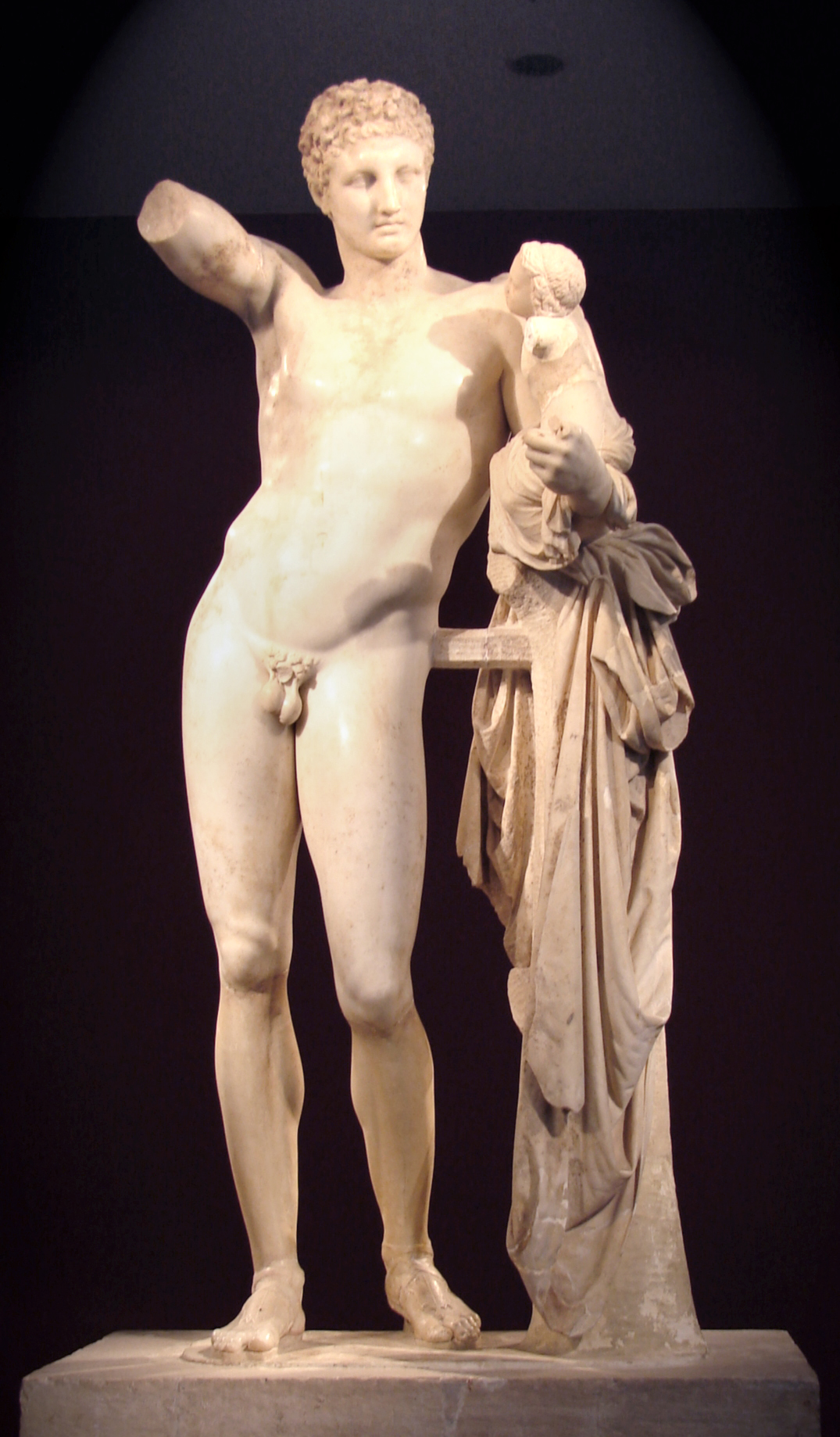
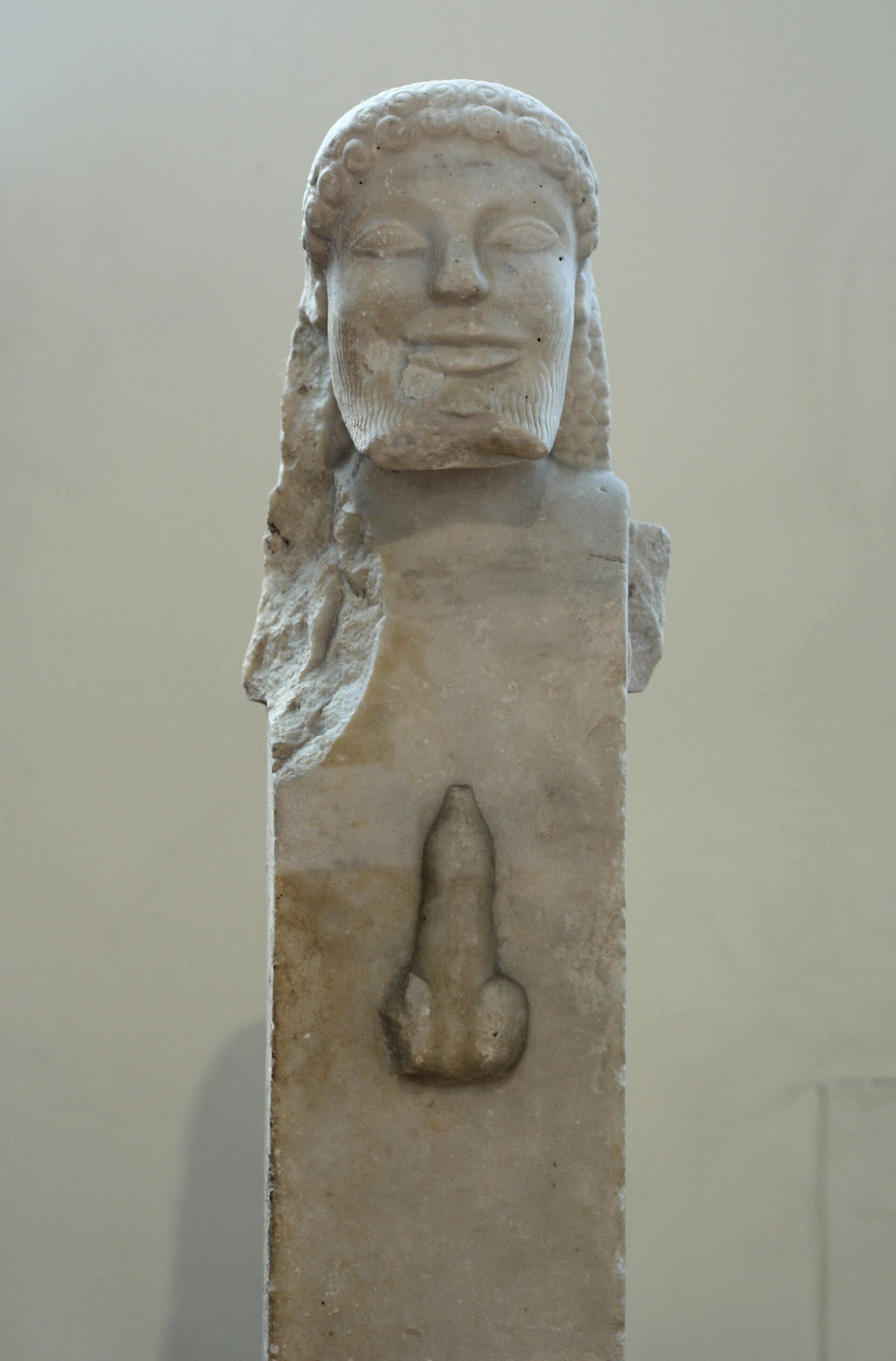
Hermes carried messages for the other Olympians and carried the dead where the living could not follow — the one god trusted to move freely between every boundary the Greeks recognized: between gods and mortals, the living and the dead, host and stranger, buyer and seller. That same freedom of movement made him patron of merchants, of travelers, and, without contradiction to Greek worshippers, of thieves. His cult reached back to Mycenaean Greece, where his name appears as “e-ma-a2” on Linear B tablets from Pylos and Knossos in the 14th–13th century BCE, and forward through a thousand years of daily practice: stone hermae — a squared pillar topped with his head — stood at crossroads, farm boundaries, temple gates, and city entrances throughout the Greek and later Roman world, anointed with oil and garlanded as protection for anyone who passed. When Athenians woke one morning in 415 BCE to find the city’s hermae smashed on the eve of the Sicilian Expedition, the sacrilege was serious enough to end a general’s career. At Olympia, a temple to his father’s wife held a Parian marble statue of Hermes cradling the infant Dionysus, later credited to Praxiteles — one of the most reproduced images of the god ever made.
His worship ended the same way Athena’s and Zeus’s did: by imperial decree, not by loss of belief. Theodosius I’s edicts of 391–392 CE banned sacrifice and closed the temples, and by 8 November 392 the emperor had outlawed worship of the old gods outright. A god defined by boundaries lost every institution that let people cross them in his name — the crossroads oil, the wayside garlands, the sacrifices that kept the hermae more than stone. The statue at Olympia was buried in clay and found again in 1877, astonishingly whole; the herms themselves survive in museum courtyards from Athens to Naples, still standing guard over nothing. He gave his name to hermeneutics, to Mercury’s element and Wednesday’s Romance-language names, to a fashion house — everywhere except an altar. Dominance is not eternal: the god who guided every traveler’s crossing has none left to guide.
Worth remembering
- Stone hermae stood at crossroads, farm boundaries, temple gates and gymnasium entrances across the Greek world — a squared pillar topped with the god's head, genitals carved into the shaft below. Athenians rubbed them with olive oil and hung wreaths on them for luck; in 415 BCE the mass mutilation of the city's hermae on the eve of the Sicilian Expedition became a political scandal that helped destroy the general Alcibiades.
- In 1877, German excavators under Ernst Curtius uncovered a 2.1-metre Parian marble statue of Hermes cradling the infant Dionysus in the ruins of the Temple of Hera at Olympia — buried under clay that had preserved it in near-perfect condition for over two thousand years, and long attributed to Praxiteles on the word of the 2nd-century traveler Pausanias.
Gallery
Sources
- Hermes was the herald and messenger of the Olympian gods and a psychopomp who led souls of the dead to the underworld; he was also patron of trade, wealth, thieves, travelers, language and shepherds. World History Encyclopedia
- Hermes appears as 'e-ma-a2' on Mycenaean Linear B tablets of the 15th–13th century BCE found at Pylos, Thebes and Knossos. World History Encyclopedia
- Hermae — stone pillars topped with a head of Hermes, genitals carved on the shaft — were set up at crossroads, country borders, temple entrances, tombs, houses and gymnasia across ancient Greece as protective boundary markers; Athenians anointed them with oil and hung garlands on them. Wikipedia
- The marble Hermes and the Infant Dionysus, traditionally attributed to Praxiteles and dated to the 4th century BCE, was found on 8 May 1877 in the ruins of the Temple of Hera at Olympia during German excavations led by Ernst Curtius; it stands about 2.1 m tall, Parian marble, now in the Archaeological Museum of Olympia. Wikipedia
- Theodosius I's decrees of 391–392 CE (Codex Theodosianus xvi.10.10–12) banned all public and private sacrifice and forbade entry to temples; on 8 November 392 he prohibited worship of the pagan gods entirely. Wikipedia (citing Codex Theodosianus)
A graveyard tradition: leave a stone to show you came, and remembered.