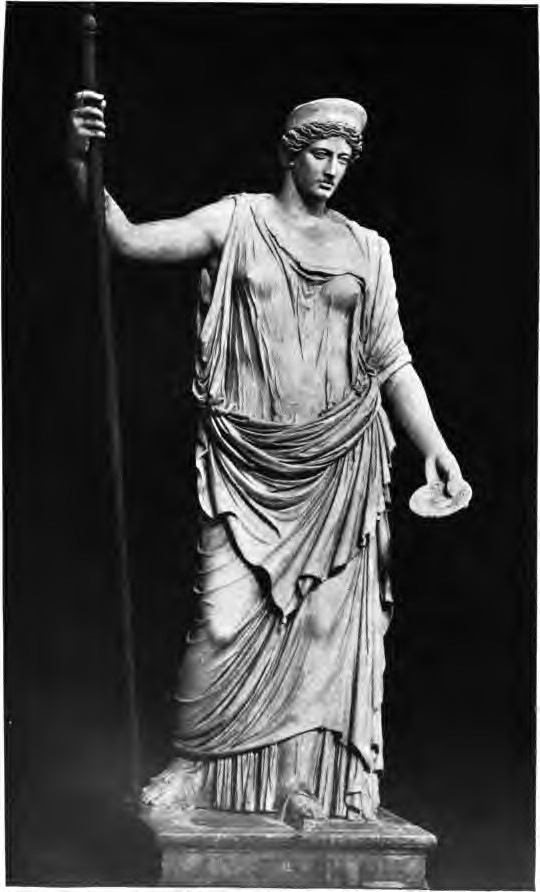
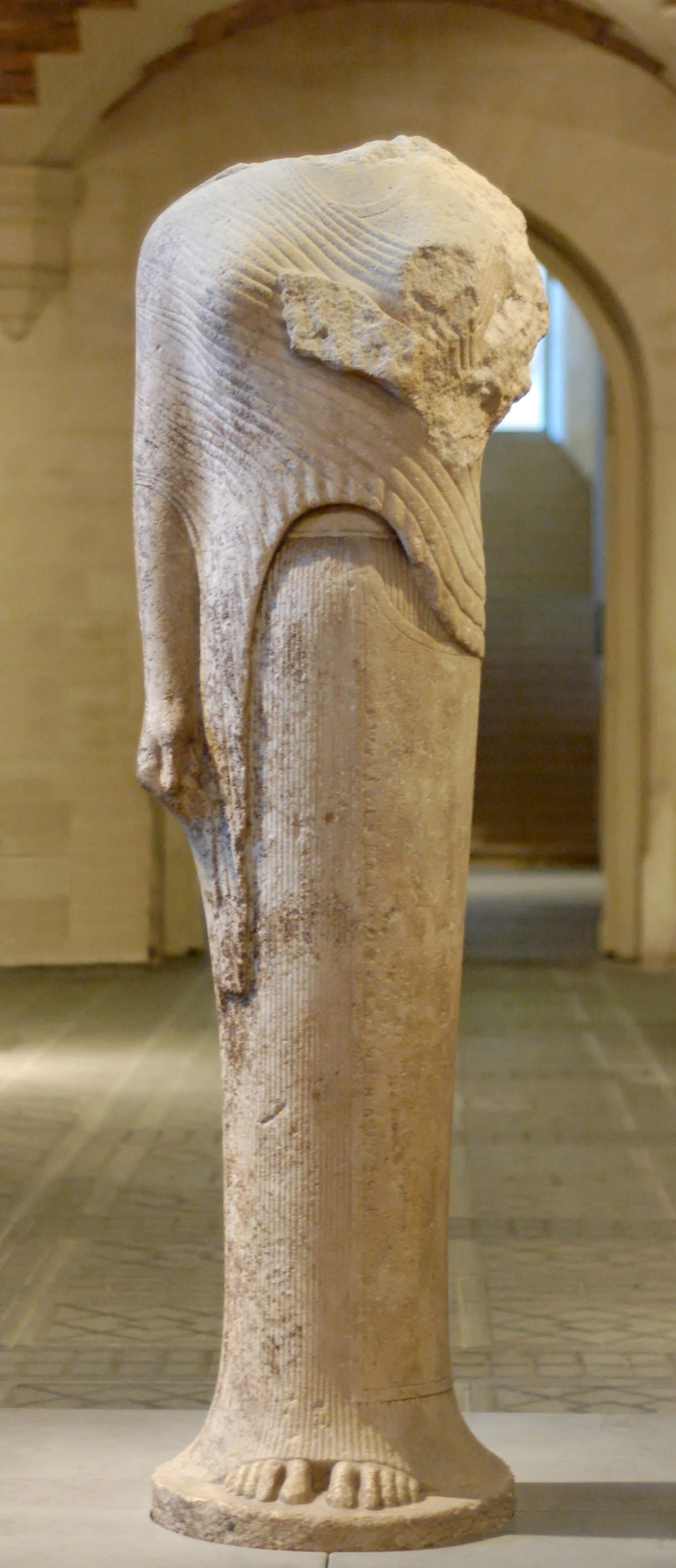
Hera was queen of the Olympian gods, sister and wife of Zeus, and the guardian of marriage, women and the family across the Greek world. Her worship reached back to Mycenaean Greece, where her name appears as “e-ra” on Linear B tablets from Pylos and Thebes around 1300–1200 BCE — older than Zeus’s own attested cult at some sites and older than Athens itself. Her two great sanctuaries anchored the cult on opposite sides of the Aegean: the Heraion of Argos, one of the oldest shared sanctuaries on the Greek mainland, and the Heraion of Samos, which grew by the 6th century BCE into one of the largest temples ever built for a Greek god — large enough that Herodotus singled it out as the biggest he knew. Myth cast her as jealous and vindictive toward Zeus’s lovers and children, tormenting Io, delaying Leto’s labor, and turning on the infant and later the grown Heracles, but her civic role was serious business: as protector of legitimate marriage and childbirth, she was invoked at weddings and in the rites of women throughout the Greek world, and her loss to Aphrodite in the Judgement of Paris was blamed for tipping Troy into a war that ended the city.
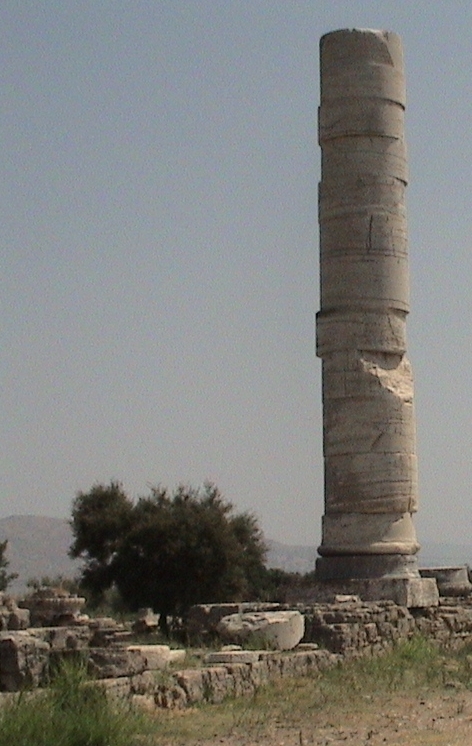
Her cult ended where the others did. Theodosius I’s edicts of 391–392 CE banned pagan sacrifice outright and forbade entry to temples, cutting off the rites that sustained her sanctuaries at Argos and Samos; within a few centuries the Samos temple was picked apart for building stone, leaving a single standing column amid its foundations. As Juno she persisted a while longer in Roman civic religion before falling to the same decrees. She is remembered now as a stock figure of jealousy and rage in retellings of Greek myth — the vengeful wife rather than the queen who once outranked every goddess but one. Dominance is not eternal: the deity who commanded fidelity from an unfaithful king could not command a single sacrifice past 392 CE.
Worth remembering
- Herodotus ranked the Heraion of Samos among Samos's three great works, calling it the largest temple he knew of; the third version, begun under Polycrates around 570–560 BCE, measured roughly 55 by 109 metres. Byzantine builders later stripped it for stone, and today one column stands where a forest of them once did.
- When Hera found that Zeus had fathered Heracles on a mortal woman, she sent two snakes into his cradle to kill him; when that failed, myth has her waiting decades and then striking the grown hero with madness, driving him to kill his own wife and children — the origin of the Twelve Labors he undertook as penance.
Gallery
Sources
- The name Hera is attested in Mycenaean Greek, written in Linear B syllabary as 'e-ra', on tablets found at Pylos and Thebes. Wikipedia
- The Heraion of Samos grew into one of the largest temples in the Greek world; Herodotus called it the largest of all the temples he knew of. Today only a single column of the site still stands, and the Heraion is jointly inscribed as a UNESCO World Heritage Site with the Pythagoreion. Wikipedia
- The Heraion of Argos, established in the late 9th or 8th century BCE, was one of the oldest and most important sanctuaries in the Argive plain, serving as a shared cult center before excavations by Waldstein, Blegen and Caskey uncovered its terracotta and bronze votive offerings. Wikipedia
- Hera was the goddess of marriage and the family and protectress of women in childbirth; myth records her tormenting Io with a gadfly after Zeus's affair, delaying Leto's labor out of jealousy, and sending serpents to kill the infant Heracles in his cradle. World History Encyclopedia
- In the Judgement of Paris, Hera, Athena and Aphrodite each claimed the golden apple of Eris; Paris chose Aphrodite after her bribe of Helen of Sparta, earning Hera's enmity and her support for the Greeks against Troy in the war that followed. Wikipedia
- Theodosius I's decrees of 391–392 CE banned all public and private pagan sacrifice and forbade entry to temples; from 394 CE state funds were never again made available for pagan rites or the maintenance of pagan temples. Wikipedia
A graveyard tradition: leave a stone to show you came, and remembered.