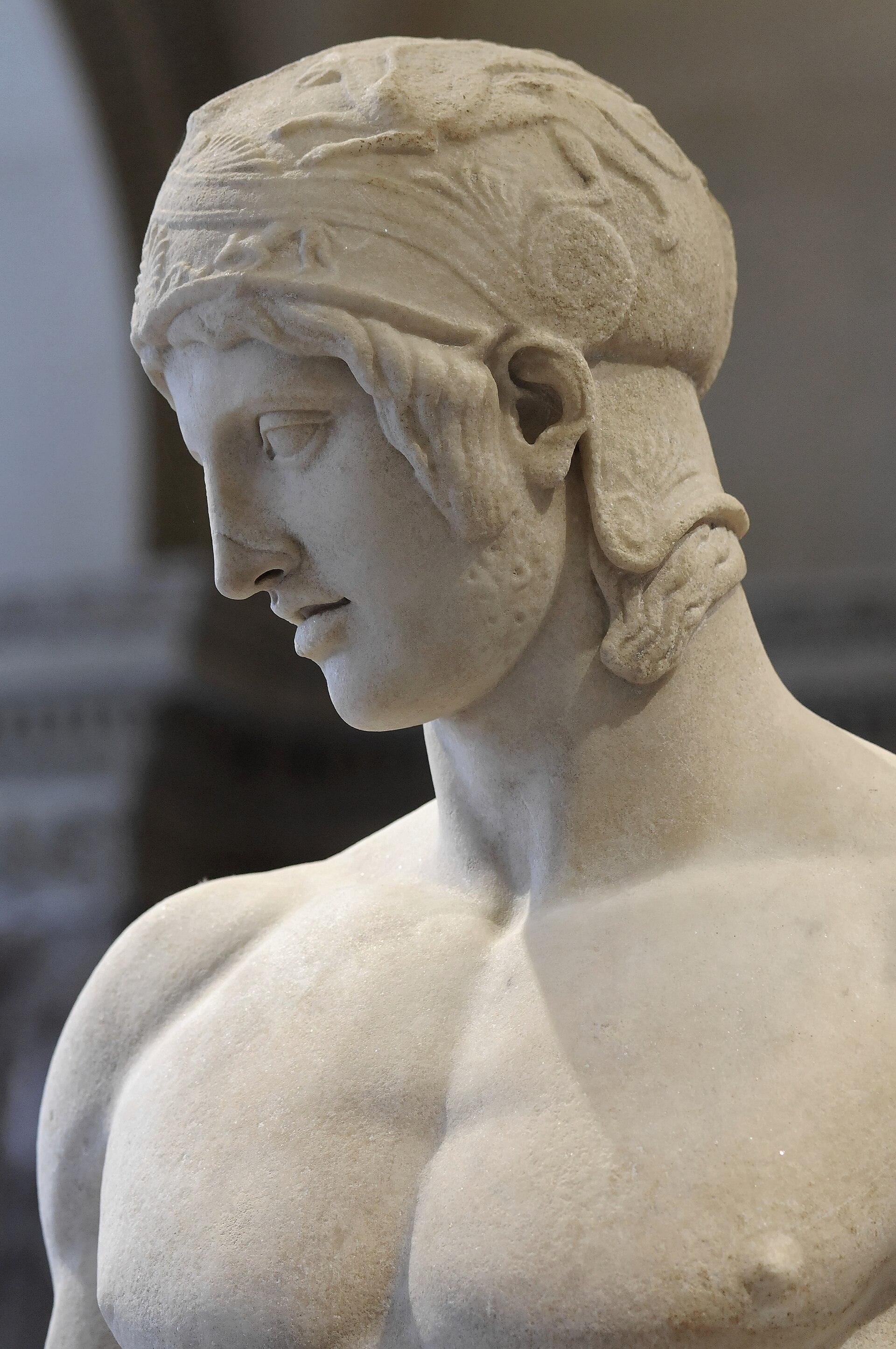
Ares was the Greek god of war in its most physical and least admired form — bloodlust, slaughter, the frenzy of battle rather than its strategy, which belonged to Athena. Son of Zeus and Hera, he was one of the least-loved Olympians in Greece itself: only a handful of cities, among them Athens, Argos, Tegea and Troezen, maintained him a formal temple, and even Sparta, whose whole civic identity was built on war, gave him no significant cult and never put him on a coin — the Spartans instead kept a statue of Ares in chains, penned inside a temple of Enyalios as if the city needed protection from him rather than his favor. Greek writers located his true home in Thrace, a region they regarded as barbarous, and it was there and among the Black Sea Colchians that his worship was said to run deepest. Athens did preserve one lasting mark of him: the Areopagus, the “Hill of Ares,” took its name from the myth of his trial for killing Poseidon’s son Halirrhothius, and the hill became the seat of the city’s court for homicide.
Rome did what Greece never had: it made him central. As Mars, Ares was refitted with a more dignified myth — father, by the Vestal Virgin Rhea Silvia, of Romulus and Remus, and so ancestor of the Roman people themselves — and Augustus gave him one of the most important temples in the city, Mars Ultor, dedicated in 2 BCE after a vow made at Philippi in 42 BCE. The Senate met in its precinct to debate war and peace; generals collected their standards there before leaving for the provinces and returned their honors there after triumphs. The god scorned in his homeland became one of Rome’s two or three most consequential deities. None of it survived the empire’s conversion: the same Theodosian decrees of 391–392 CE that closed Athena’s and Zeus’s temples closed Mars’s altars too, and by the early 5th century no sacrifice was legally offered to him anywhere in the empire he had once been sworn to protect. The god who could not command Sparta’s respect, and who Rome had raised to guard its Senate and its founding myth, ended exactly where every other Olympian did — extinguished by decree, not defeat in battle.
Worth remembering
- Sparta, a city built around war, gave Ares no important cult and put his image on no coin — instead the Spartans kept a statue of Ares bound in chains inside a temple of Enyalios, so that the god of war-frenzy could not leave the city that most needed his restraint.
- Augustus vowed the temple of Mars Ultor ('the Avenger') at Philippi in 42 BCE and dedicated it in Rome's new Forum in 2 BCE; the Senate convened there to debate war and peace, and departing generals collected their military standards from the god who, by Roman myth, had fathered Rome's founder Romulus.
Gallery
Sources
- Ares was 'not commonly worshipped' in Greece; formal temples and cults are attested only in a handful of places, including Crete, Argos, Athens, Erythrae, Geronthrae, Megalopolis, Tegea, Therapne and Troezen. World History Encyclopedia
- In Sparta — despite Ares typifying the traditional Spartan warrior character — he 'had no important cult' and never appeared on Spartan coinage; the Spartans kept a statue of Ares in chains in a temple of Enyalios, believed to bind the spirit of war within the city. Wikipedia
- Greeks regarded Thrace as Ares's birthplace and refuge, and he had a genuine, prominent cult following there and among the Colchians on the Black Sea, in contrast to his marginal status in Greece proper. World History Encyclopedia
- The Areopagus ('Hill of Ares') in Athens took its name from the myth of Ares's trial for killing Poseidon's son Halirrhothius; the hill became the seat of Athens' court for homicide and impiety cases. Wikipedia
- Augustus vowed a temple to Mars Ultor after the Battle of Philippi in 42 BCE and dedicated it in 2 BCE in his new Forum; the Senate met there to deliberate war and peace, generals received their standards there before departing for the provinces, and its pediment showed Mars flanked by Venus and Romulus. Wikipedia
- Theodosius I's decrees of 391–392 CE (Codex Theodosianus xvi.10.10–12) banned all public and private pagan sacrifice and forbade entry to temples; on 8 November 392 he prohibited worship of the old gods entirely. Wikipedia (citing Codex Theodosianus)
A graveyard tradition: leave a stone to show you came, and remembered.