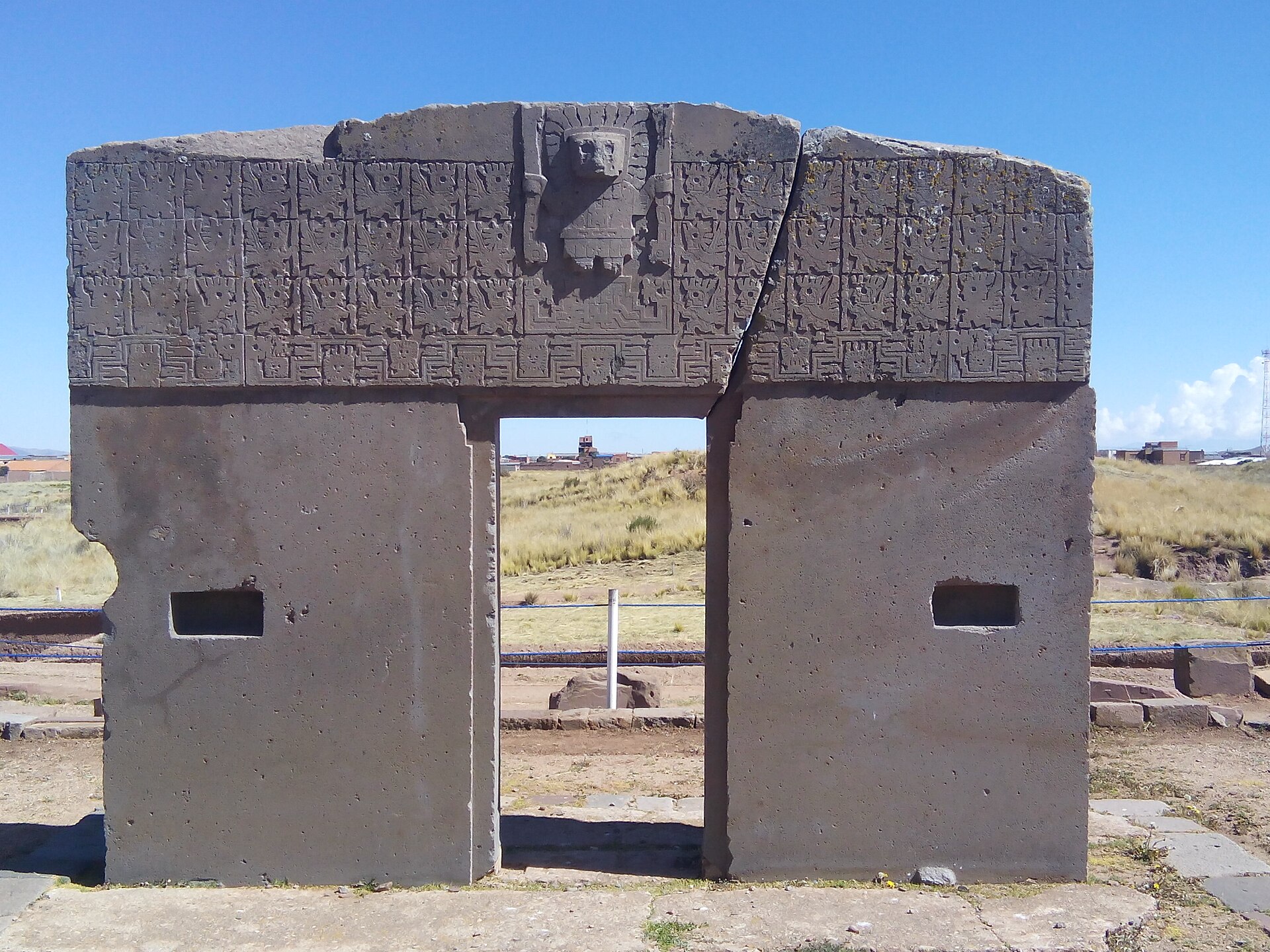
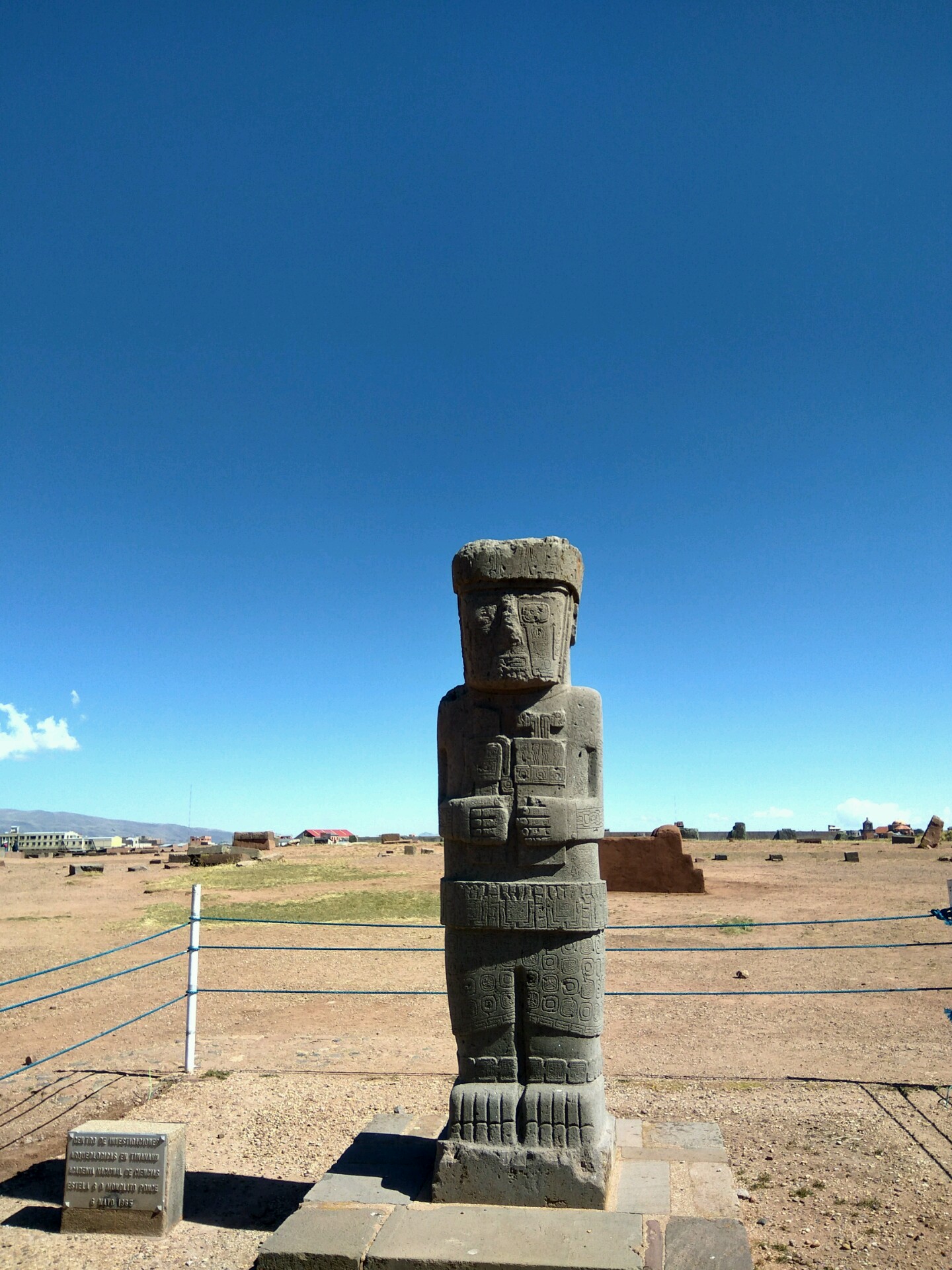
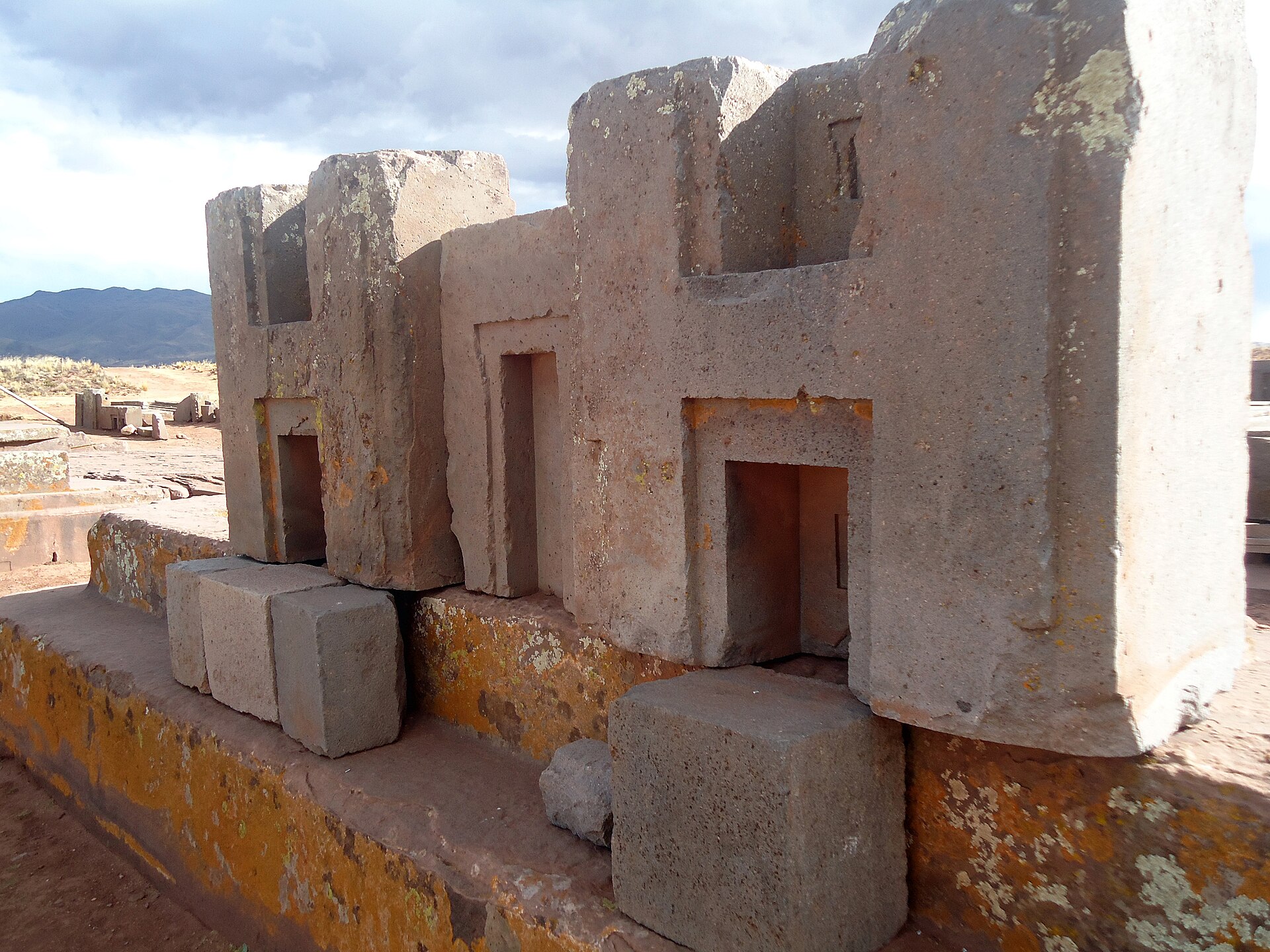
Tiwanaku sat on the southern shore of Lake Titicaca at 3,850 metres, higher than most cities the world has ever built. From around 500 CE it grew from a lakeside settlement into the capital of a state that reached across the south-central Andes through colonies and trade rather than a single marching frontier. Its engineers worked stone with a precision that still draws attention: the Gateway of the Sun cut from one andesite block 2.8 metres tall, its lintel carved with 48 winged figures around a central Staff Deity; the H-profile blocks of Pumapunku fitted at hard right angles; the terraced Akapana platform and the walled Kalasasaya court. The economy underneath the monuments was raised-field farming, the “suka kollus” — soil mounded into long beds between water channels that buffered frost and held moisture, feeding 10,000 to 20,000 people on potatoes and quinoa in a basin where ordinary fields would freeze.
Around 1000 CE the rain failed. Sediment cores from the basin record a prolonged drought, the lake level dropped, and the channels and raised fields that the population depended on dried out. The leadership lost its grip, people drifted off the monumental core into smaller rural settlements, and by roughly 1100 CE the city was empty. The Aymara lordships rose on the same ground in the centuries that followed. When the Inca arrived, several hundred years after the abandonment, they did not inherit Tiwanaku — they found ruins and took them for a sacred origin place, telling that their creator Viracocha had made the first people there at Lake Titicaca and reading the standing stone figures as remnants of an earlier race. The city they revered had already been dead for centuries.
Worth remembering
- The Gateway of the Sun was cut from a single block of andesite 2.8 m high and 3.8 m wide, its lintel carved with 48 winged attendants flanking a central Staff Deity.
- At Pumapunku the builders cut and fitted andesite blocks into interlocking H-shaped profiles with sharp right angles, and fed a city of 10,000–20,000 people at 3,850 m by farming raised fields ('suka kollus') in the wetlands of Lake Titicaca.
Gallery
Sources
- Tiwanaku flourished c. 200–1000 CE at 3,850 m near Lake Titicaca; the Gateway of the Sun was carved from a single block of andesite 2.8 m high and 3.8 m wide; the city collapsed around 1000 CE and was abandoned by c. 1100 CE, probably due to excessive drought from regional climate change. World History Encyclopedia
- A city was built at Tiwanaku around 400 CE; residents farmed with raised fields growing potatoes and quinoa; around 1000 CE the leadership was overthrown and people dispersed; the Aymara are descendants, and the Inca, arriving centuries later, folded the ruins into their creation myth of Viracocha emerging from Lake Titicaca. ORIAS, University of California, Berkeley
- The Gateway of the Sun, carved from a single massive block of andesite (2.8 m high, 3.8 m wide), bears 48 winged attendant figures flanking a central Staff Deity, a pan-Andean god and forerunner of the Inca creator Viracocha. World History Encyclopedia
- Tiwanaku was founded around AD 110 and collapsed around AD 1000, with a regional drought likely playing a role; its monuments include the Akapana platform, the Kalasasaya, Pumapunku, and the Gateway of the Sun. Wikipedia
A graveyard tradition: leave a stone to show you came, and remembered.