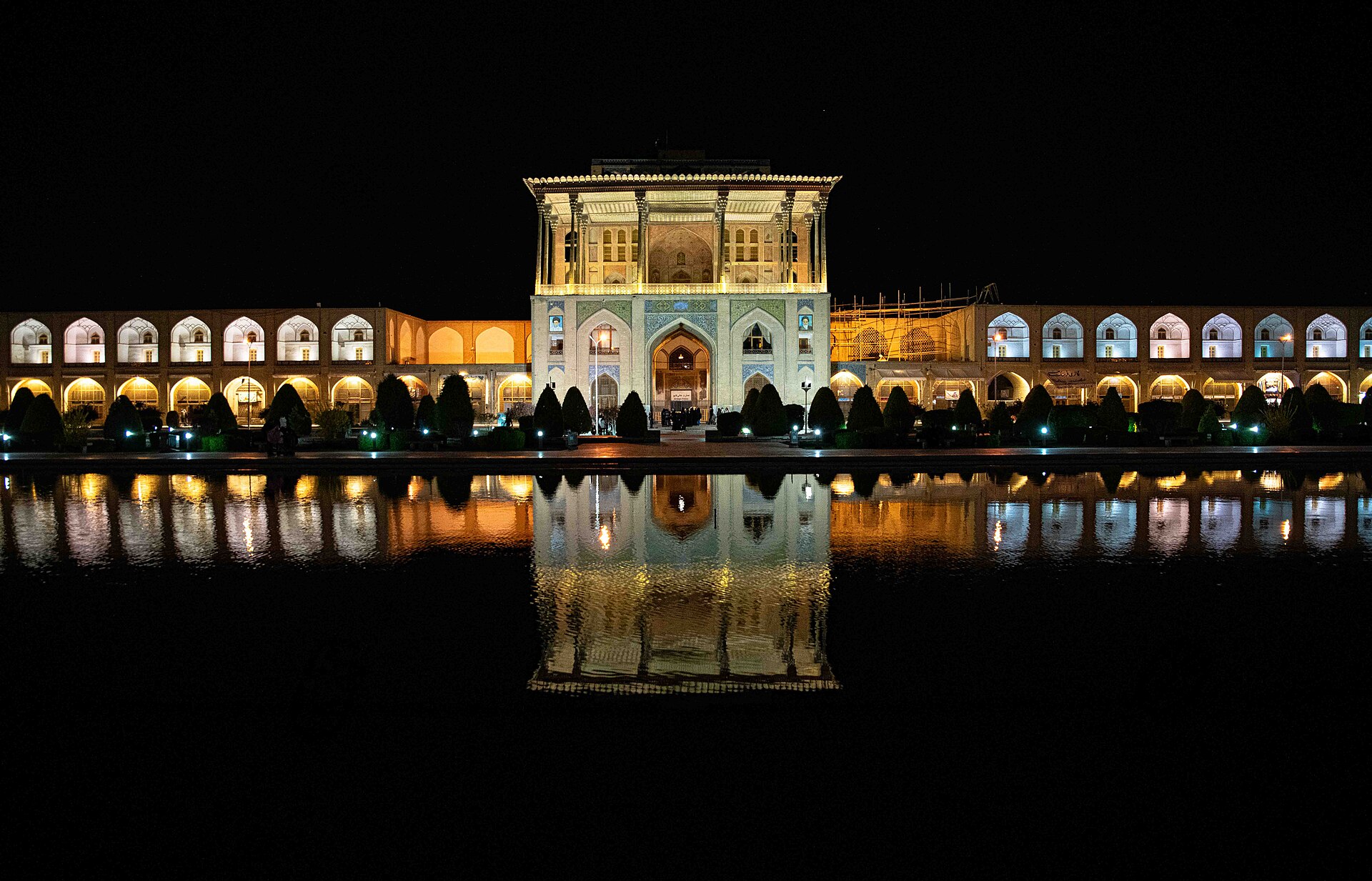
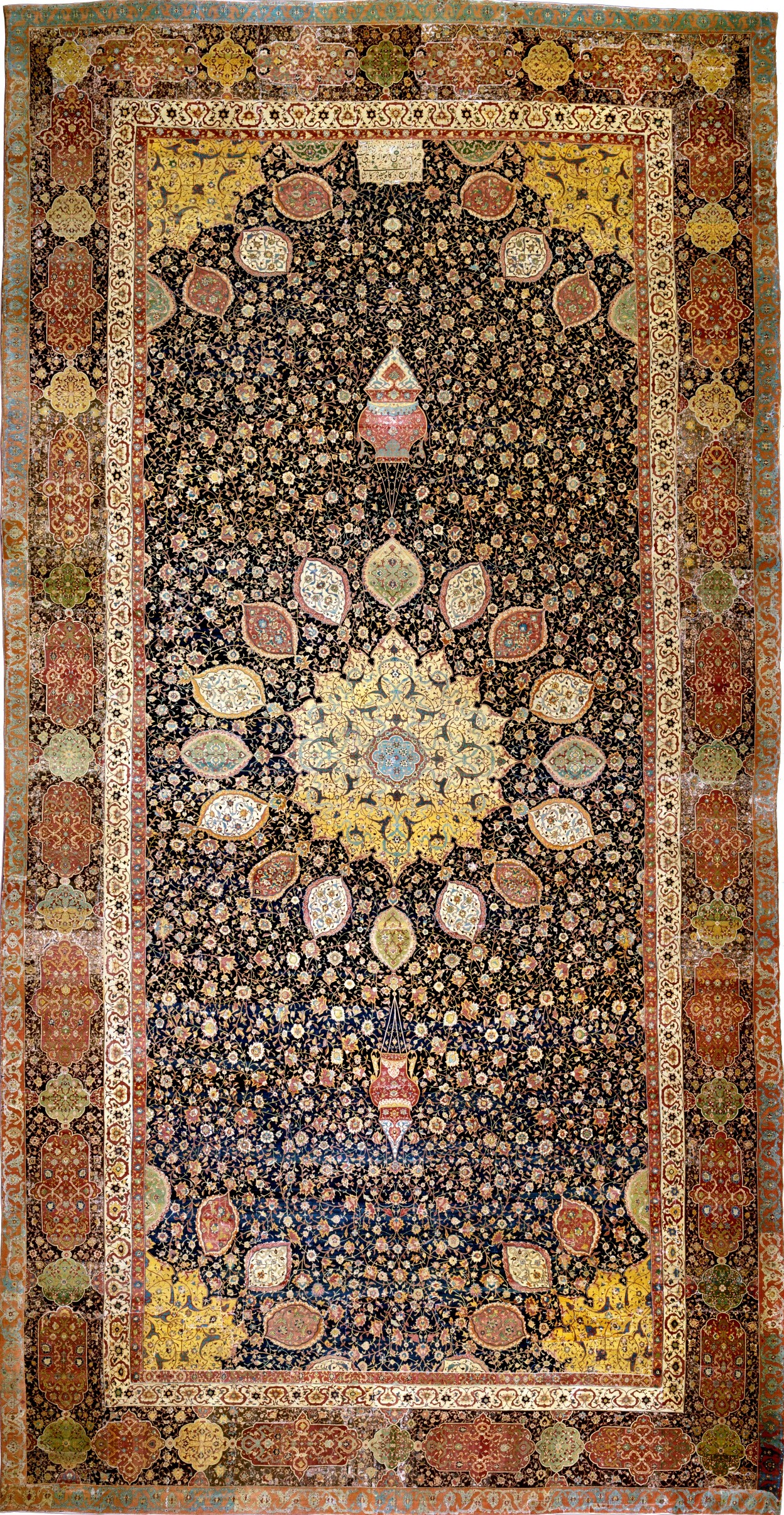
The Safavid state began in 1501 when Isma’il I, a teenage leader of a militant Sufi order, was enthroned as shah at Tabriz and within a decade subjugated most of Iran. He proclaimed Twelver Shia Islam the state religion over a population that was largely Sunni, enforcing its creed in the mosques of his dominion. That decree reshaped Iran’s identity and made it the demographic centre of Shia Islam. The empire reached its height under Shah Abbas I, who took the throne in 1587, broke the power of the Qizilbash tribal cavalry, and in 1598 moved his capital to Isfahan. There he laid out the Naqsh-e Jahan square, 524 by 158 metres, framed by the Shah Mosque, the Sheikh Lotfollah Mosque, and the Ali Qapu palace — the works behind the saying “Isfahan is half the world.” Safavid Iran traded silk and carpets with Europe, fought the Ottomans to its west and the Mughals to its east, and ran royal workshops that wove the finest Persian carpets ever made, some with silk pile and roughly 500 knots per square inch.
After Abbas I the dynasty weakened. In 1722 an Afghan force under Mahmud Hotak besieged Isfahan for months; the city, starved, surrendered, and the shah abdicated. The Safavid state never recovered. A claimant dynasty held on nominally until 1736, when the warlord Nader Khan deposed the infant Abbas III, had himself crowned Nader Shah on the Moghan Plain on 8 March, and founded the Afsharid dynasty. The Safavid line was finished. Iran remained — and remains — a Shia state, so the religious settlement Isma’il imposed in 1501 outlived by centuries the dynasty that imposed it. The grave here is the Safavid state itself: the capital fell, the throne passed to a conqueror, and the dynasty ended.
Worth remembering
- Isma'il I imposed Twelver Shiism as the state religion in 1501 over a largely Sunni population, enforcing its creed in the mosques of his realm and setting Iran's religious identity for the next five centuries.
- Shah Abbas I moved the capital to Isfahan in 1598 and built the Naqsh-e Jahan square (524 × 158 m), ringed by the Shah Mosque, the Sheikh Lotfollah Mosque and the Ali Qapu palace — the showpiece behind the phrase 'Isfahan is half the world.'
Gallery
Sources
- The Safavid dynasty ruled Iran 1501–1736; its establishment of Twelver Shiʿism as the state religion was a major factor in the emergence of a unified national consciousness. Ismāʿīl was enthroned shah in July 1501 and proclaimed Shiʿism the state religion despite the territory's predominantly Sunni character; the capital moved to Isfahan (1598–1736) and the Afghan invasion came in 1722. Encyclopaedia Britannica
- After his victory over the Uzbeks in 1598, Shah ʿAbbas transferred his capital from Qazvin to Isfahan; a new royal square, the Meydān-e Naqš-e Jahān (524 × 158 m), formed the fulcrum of his design, overlooked by the ʿAlī Qāpū palace and the masterpieces Masǰed-e Shaikh Loṭfallāh (begun 1603) and Masǰed-e Shah (begun 1611). Encyclopaedia Iranica
- Meidan Emam (Naqsh-e Jahan) in Isfahan was built by the Safavid shah Abbas I in the early 17th century and was the heart of the Safavid capital, anchored by the Sheikh Lotfallah Mosque, the Ali Qapu pavilion, the Qeyssariyeh portico and the Royal Mosque; inscribed on the World Heritage List in 1979. UNESCO World Heritage Centre
- Nader Khan deposed the nominal Safavid shah Abbas III and was crowned Nader Shah on the Moghan Plain on 8 March 1736, ending the Safavid dynasty and founding the Afsharid dynasty. Wikipedia
A graveyard tradition: leave a stone to show you came, and remembered.