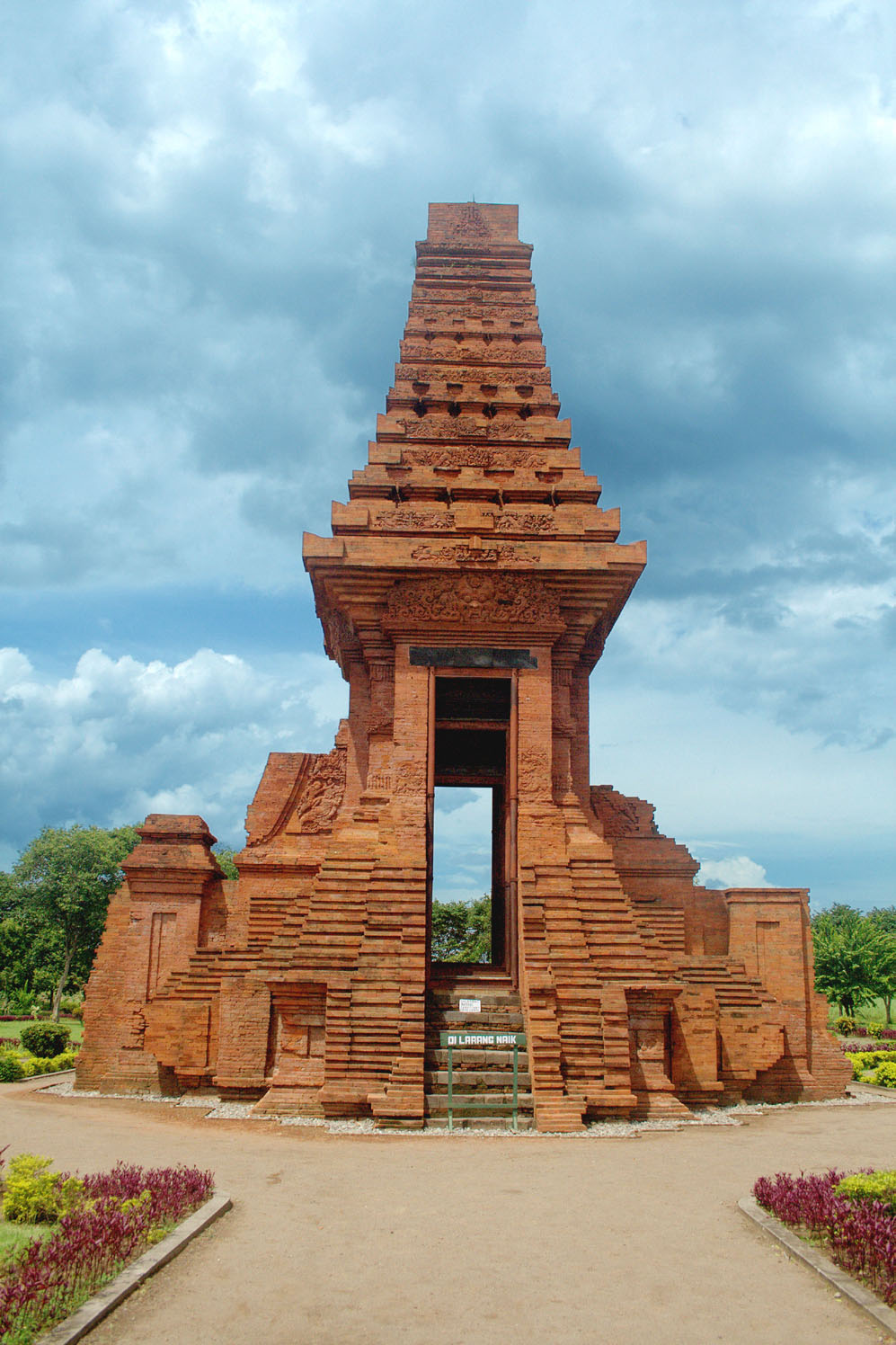
Raden Wijaya founded Majapahit in 1293 after turning a Mongol-Yuan invasion fleet against his rivals and then driving the Mongols off Java. From a capital at Trowulan in the east of the island, the dynasty built a maritime power that reached its height in the mid-14th century under King Hayam Wuruk, who reigned from 1350 to 1389, and his minister Gajah Mada, in office until 1364. Gajah Mada’s Palapa oath bound him to subjugate the archipelago, and the court poem Nagarakretagama, composed by Mpu Prapanca in 1365, recorded a sphere of roughly 98 tributaries stretching from Sumatra to New Guinea, taking in the Malay peninsula and reaching toward the southern Philippines. The claim was a court’s account of its own reach, much of it tribute and trade dependency rather than direct rule, but it marks the furthest extent any Javanese state would project across the islands.
The structure did not survive its founders. After Hayam Wuruk died in 1389 the succession fractured, and the Paregreg civil war of 1404–1406 set Wikramawardhana against Wirabhumi, who was caught and beheaded; the victory left the throne intact but the realm drained. Through the 15th century the Islamic trading ports of Java’s north coast grew rich and independent, and the new Sultanate of Demak absorbed Majapahit’s territory piece by piece until it took the last Hindu remnant at Kediri around 1527. What endured was the name. For later Indonesians, Majapahit became a usable past: invoked by Demak, Pajang, and Mataram, then by the independence movement, and stamped onto the national satellite program through Gajah Mada’s oath. The 1365 manuscript itself was carried off as Dutch war booty from Lombok in 1894 and not returned to Indonesia until 1970. The empire that once listed 98 tributaries exists now as a symbol that modern states reach for, not as anything that outlived 1527.
Worth remembering
- The 1365 Nagarakretagama records Majapahit claiming suzerainty over some 98 tributary regions, from Sumatra in the west to New Guinea in the east.
- Gajah Mada took the Sumpah Palapa, vowing to eat no spiced food until the whole archipelago (Nusantara) submitted to Majapahit; Indonesia later named its first communications satellite program 'Palapa' after the oath.
Gallery
Sources
- The Nagarakretagama, written in 1365 by Mpu Prapanca, praises Hayam Wuruk during Majapahit's greatest territorial extent and lists roughly 98 tributary regions spanning modern Indonesia, Malaysia, and the Philippines. Wikipedia
- Raden Wijaya founded Majapahit in 1293; under Hayam Wuruk (r. 1350–1389) and prime minister Gajah Mada, who swore the Palapa oath to unify the archipelago, the empire reached its peak, then declined after 1389 and was conquered by the Sultanate of Demak by 1527. New World Encyclopedia
- Gajah Mada served as chief minister from 1331 to 1364; the Paregreg succession war lasted 1405–1406, ending with Wikramawardhana's victory over Wirabhumi, and Majapahit's final defeat came in 1527 when Demak conquered Kediri, the Hindu remnant of the state. Facts and Details
A graveyard tradition: leave a stone to show you came, and remembered.