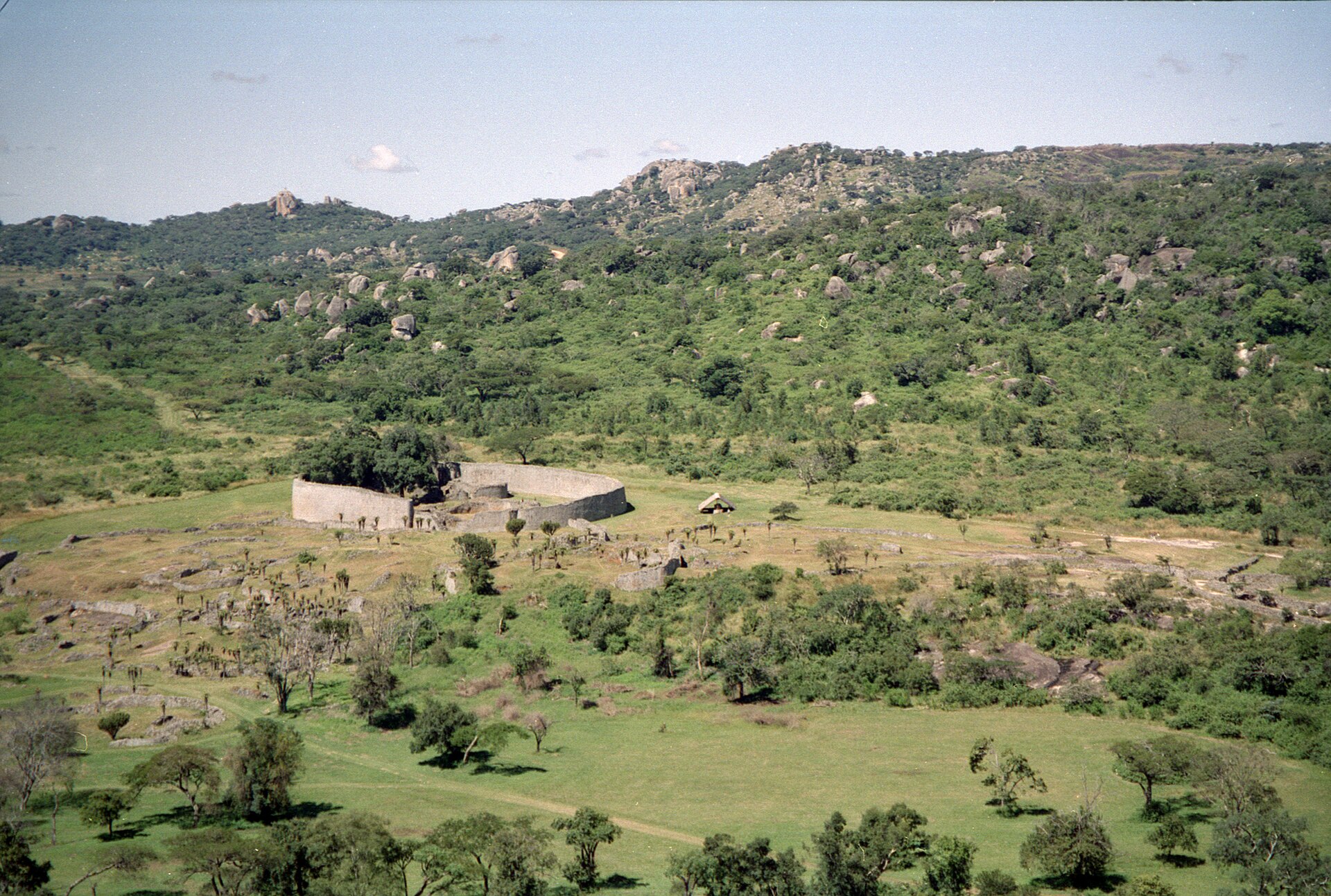
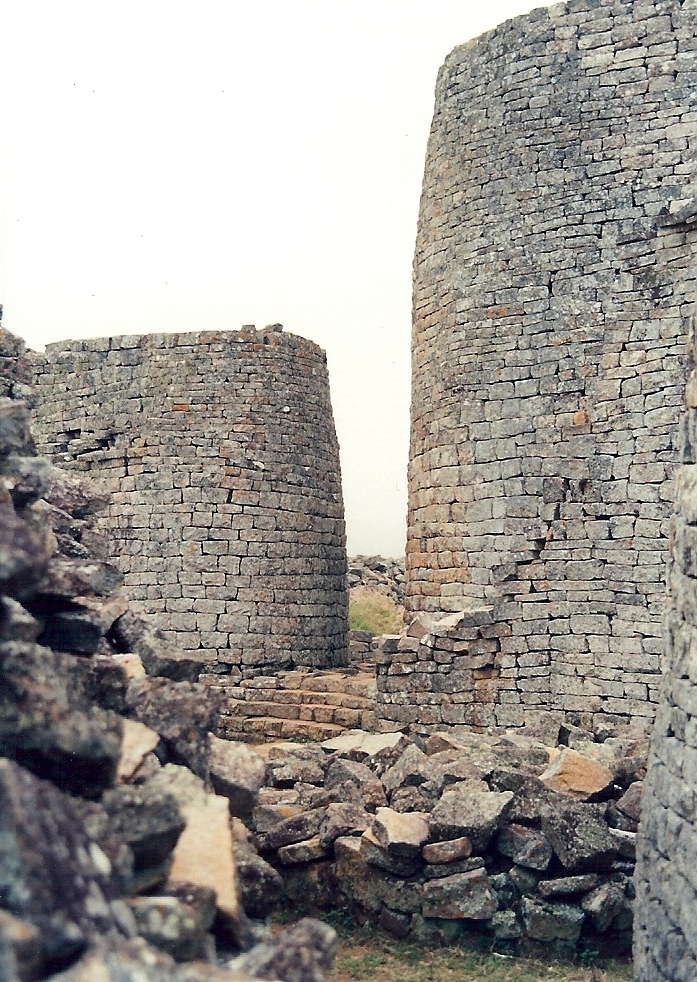
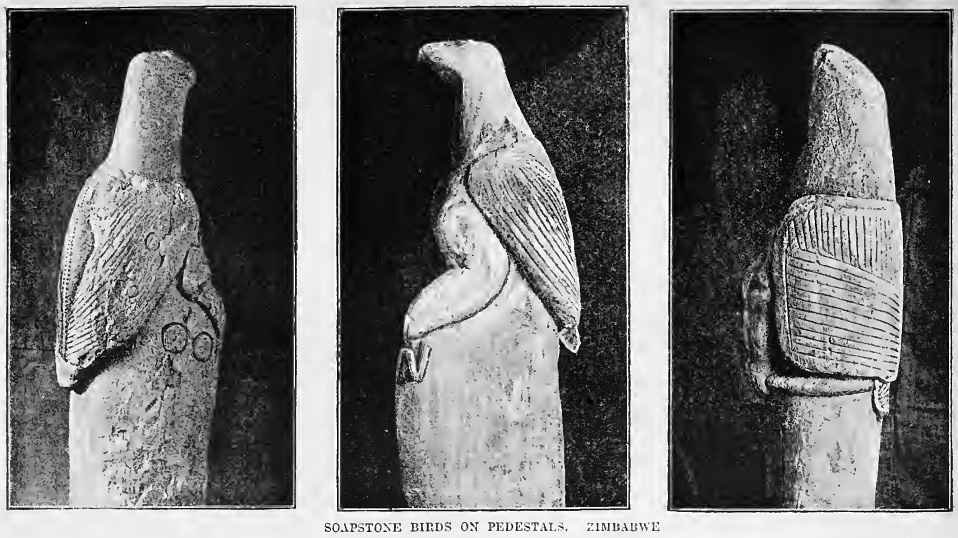
Great Zimbabwe was built by the ancestors of the Shona, a Bantu-speaking people of the southern African Iron Age, who began raising it as a major centre around 1100 CE. The name is their own: Dzimba dze mabwe, houses of stone. At its height around 1300–1450 it held an estimated 18,000 people spread across some 1,700 acres, and its stonemasons fitted hand-cut granite blocks into curved walls without a drop of mortar. The Great Enclosure runs about 250 metres around, stands up to 9.7 metres high and 5.5 metres thick at the base, and shelters a solid conical tower 10 metres tall — the largest ancient stone structures in sub-Saharan Africa. The city lived off trade. Gold, ivory and copper from the interior moved through the port of Sofala to Kilwa on the Swahili coast, and the gold that reached Sofala made Kilwa the richest of the coastal city-states. What came back is still in the ground at the site: Chinese Ming porcelain, glass beads, and carved faience from Persia. Eight soapstone Zimbabwe Birds, carved on monoliths, were recovered from the ruins.
By the mid-15th century the city was largely empty. The causes are debated — exhausted farmland and pasture around a population that size, declining local gold, and the trade drifting north as power shifted to the Mutapa state and, to the west, the Torwa/Butua. The Shona moved on; the kingdom did not collapse so much as relocate and outgrow its old capital. Then the colonial record was falsified. From Karl Mauch in 1871 through Theodore Bent in 1891 and Richard Hall in 1902, European writers attributed the walls to Phoenicians, Arabs, or the Queen of Sheba rather than admit Black Africans had built them — Hall dug out African occupation layers to prove it. David Randall-MacIver’s 1905 excavation found only Bantu material, and Gertrude Caton-Thompson’s 1929 stratigraphy fixed the date as medieval and the builders as African; the Rhodesian government suppressed the finding into the 1970s. In 1980 the new nation took its name from the ruins. That is a name carried forward, not the kingdom — the city had been a grave for five centuries by then.
Worth remembering
- The Great Enclosure was raised in dry-stone granite without mortar: an elliptical wall about 250 m around, up to 9.7 m (32 ft) high and 5.5 m thick, enclosing a solid conical tower 10 m high and 5 m across.
- Its elite drank from the Indian Ocean trade — gold and ivory went out through Sofala to Kilwa, and Chinese Ming porcelain, glass beads and carved faience from Persia came back, all excavated from the ruins.
Gallery
Sources
- Great Zimbabwe was built by the Shona, a Bantu-speaking people, inhabited c. 1100–c. 1550 and flourishing c. 1300–c. 1450, with an estimated 18,000 people; the Great Enclosure wall is 5.5 m thick and 9.7 m high with a circumference of 250 m, and the conical tower is 5 m across and 10 m high; eight soapstone Zimbabwe Birds were found at the site. World History Encyclopedia
- Colonial-era figures Karl Mauch (1871), Theodore Bent (1891) and Richard Hall (1902) attributed the ruins to Phoenicians, Arabs or the Queen of Sheba and denied African authorship; David Randall-MacIver's 1905 excavation found objects of Bantu origin and Gertrude Caton-Thompson's 1929 stratigraphic work confirmed a medieval native African origin. World History Encyclopedia
- Gold from the kingdom of Great Zimbabwe that reached Sofala helped make Kilwa the most prosperous of all the Swahili coast city-states; Kilwa imported Chinese Ming porcelain, glass beads, silk and carved faience from Persia in exchange for African gold, ivory and copper. World History Encyclopedia
A graveyard tradition: leave a stone to show you came, and remembered.