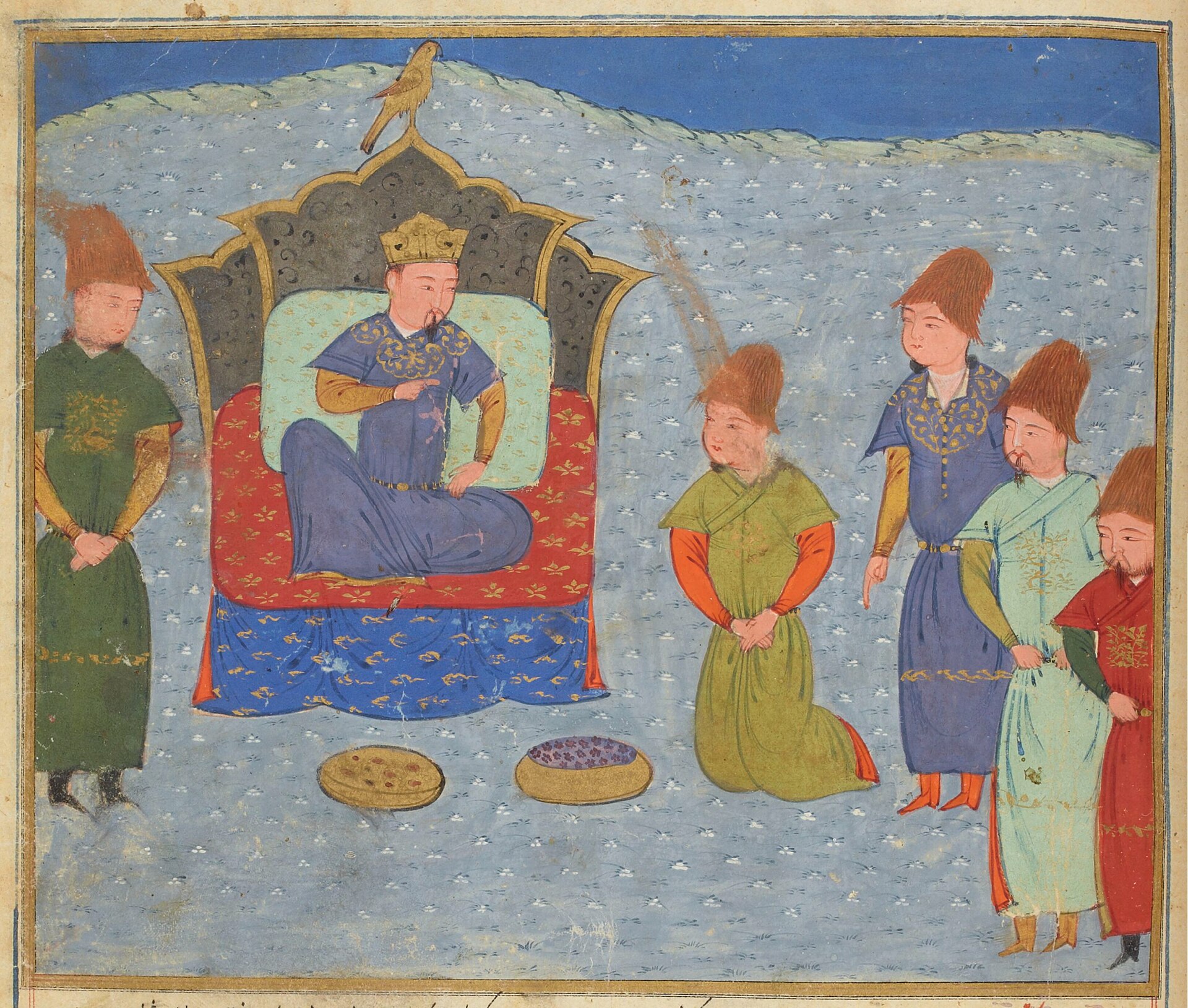
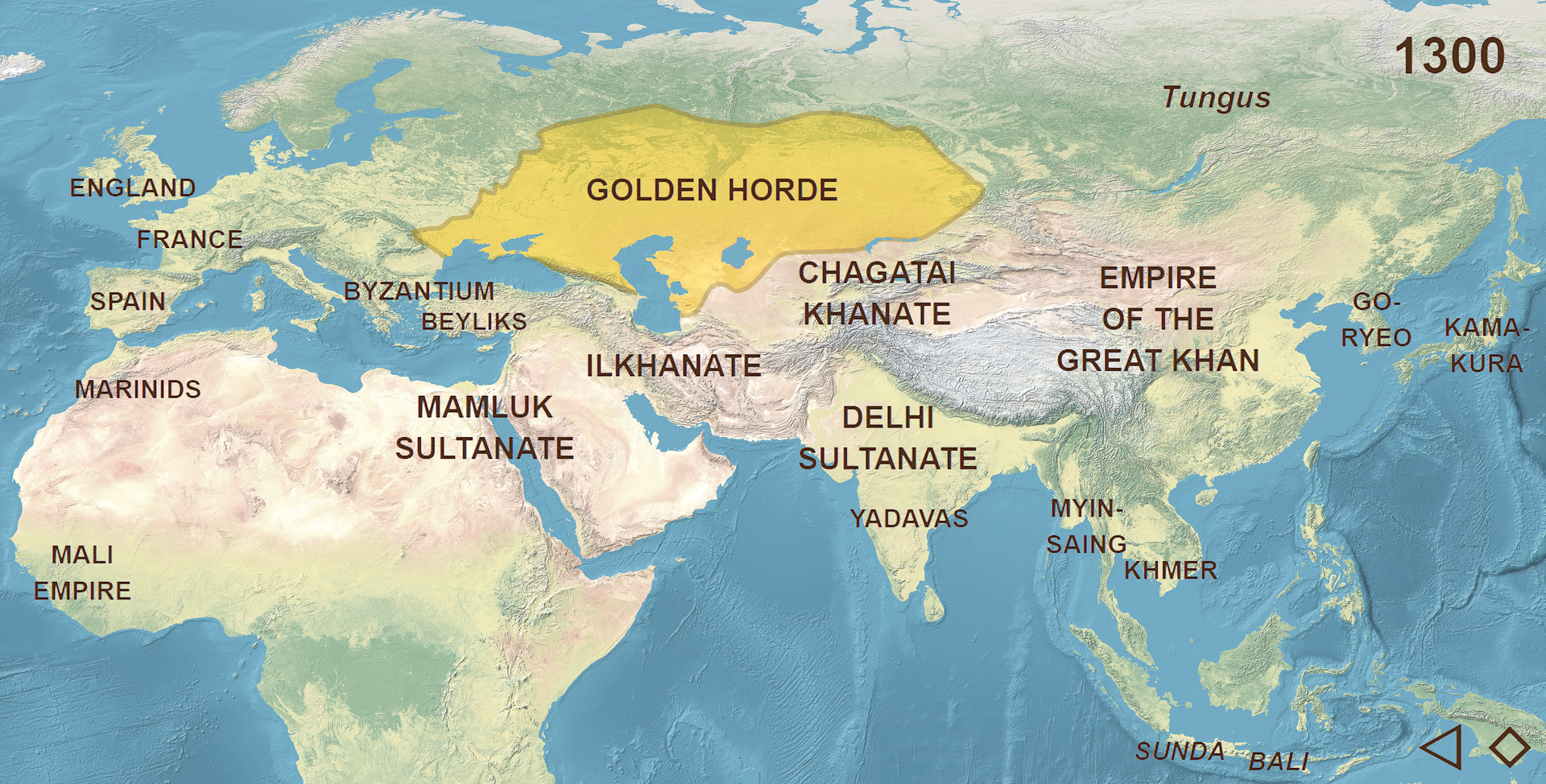
Batu Khan, grandson of Genghis, turned the western inheritance of the Mongol Empire into the Golden Horde around 1242, after the campaigns that burned Kyiv in 1240. From a capital at Sarai on the lower Volga he ran the Eurasian steppe from the Carpathians to Siberia and bound the Russian principalities into a system of tribute. Russian princes travelled to Sarai for the patent to rule, collected taxes for the khan, and paid for two centuries. Tatar punitive raids enforced the arrangement; the worst struck in 1252, 1293, and 1382, when Tokhtamysh sacked and burned Moscow to reassert the Horde’s hold. Under Öz Beg Khan (r. 1313–1341) the Horde made Islam its state religion, and Sarai grew into one of the larger cities of the medieval world.
The collapse ran through war and partition. In 1395 the conqueror Timur stormed the Horde, sacked Sarai, and broke its army; the economy never recovered. Through the 15th century the khanate fell apart along its own seams — Crimea split off in 1430, Kazan in 1436, Astrakhan in 1462 — each a separate khanate with its own khan. The Great Stand on the Ugra in 1480 ended Moscow’s tribute payments. The rump that called itself the Great Horde lasted until 1502, when Mengli Giray’s Crimean Tatars sacked Sarai, defeated the last khan Sheikh Ahmed, and ended it. Moscow did not defeat the Horde so much as outlive it: the principality that once carried tribute to Sarai went on to swallow Kazan in 1552 and Astrakhan in 1556, absorbing the heirs of the khanate that had taxed it. The Horde’s successors were conquered one by one, and the Horde itself was gone.
Worth remembering
- For roughly 240 years the Russian principalities lived under the 'Mongol yoke', paying tribute to the khans at Sarai; Tatar raids punished any principality that fell behind, the worst in 1252, 1293 and 1382, when Tokhtamysh sacked and burned Moscow.
- Under Öz Beg Khan (r. 1313–1341) the Horde adopted Islam as its state religion; in 1395 the Turco-Mongol conqueror Timur stormed in, sacked the capital Sarai and broke the army, and the khanate never recovered economically.
Gallery
Sources
- The Golden Horde was established c. 1242 by Batu Khan, grandson of Genghis Khan; its territory ran from the Carpathians to the steppes of Siberia, with its capital at Sarai on the lower Volga. World History Encyclopedia
- Batu set up a capital at Sarai near the Volga and imposed tribute on the Russian princes; under Öz Beg Khan (r. 1313–1341) Islam became the official state religion; Timur sacked Sarai in 1395 and the state never recovered, breaking up into the Kazan, Astrakhan, Crimean, Sibir and other khanates. World History Encyclopedia
- The last surviving remnant of the Golden Horde was destroyed by the Crimean khan in 1502. Encyclopaedia Britannica
- Crimea separated from the Golden Horde in 1430, Kazan in 1436 and Astrakhan in 1462; in 1502 Mengli Giray's Crimean Tatars delivered the final blow and the Golden Horde collapsed. EBSCO Research Starters
A graveyard tradition: leave a stone to show you came, and remembered.