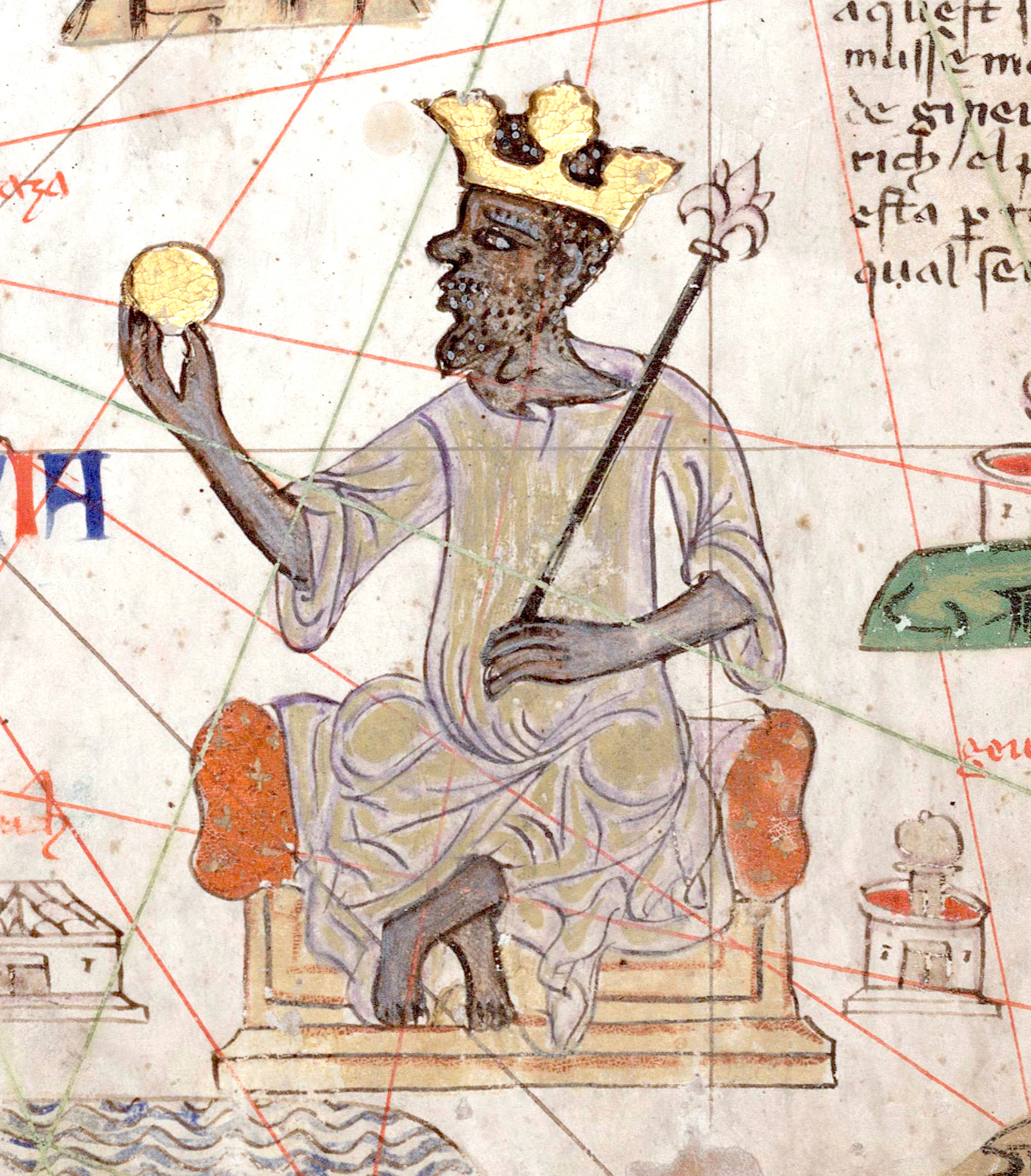
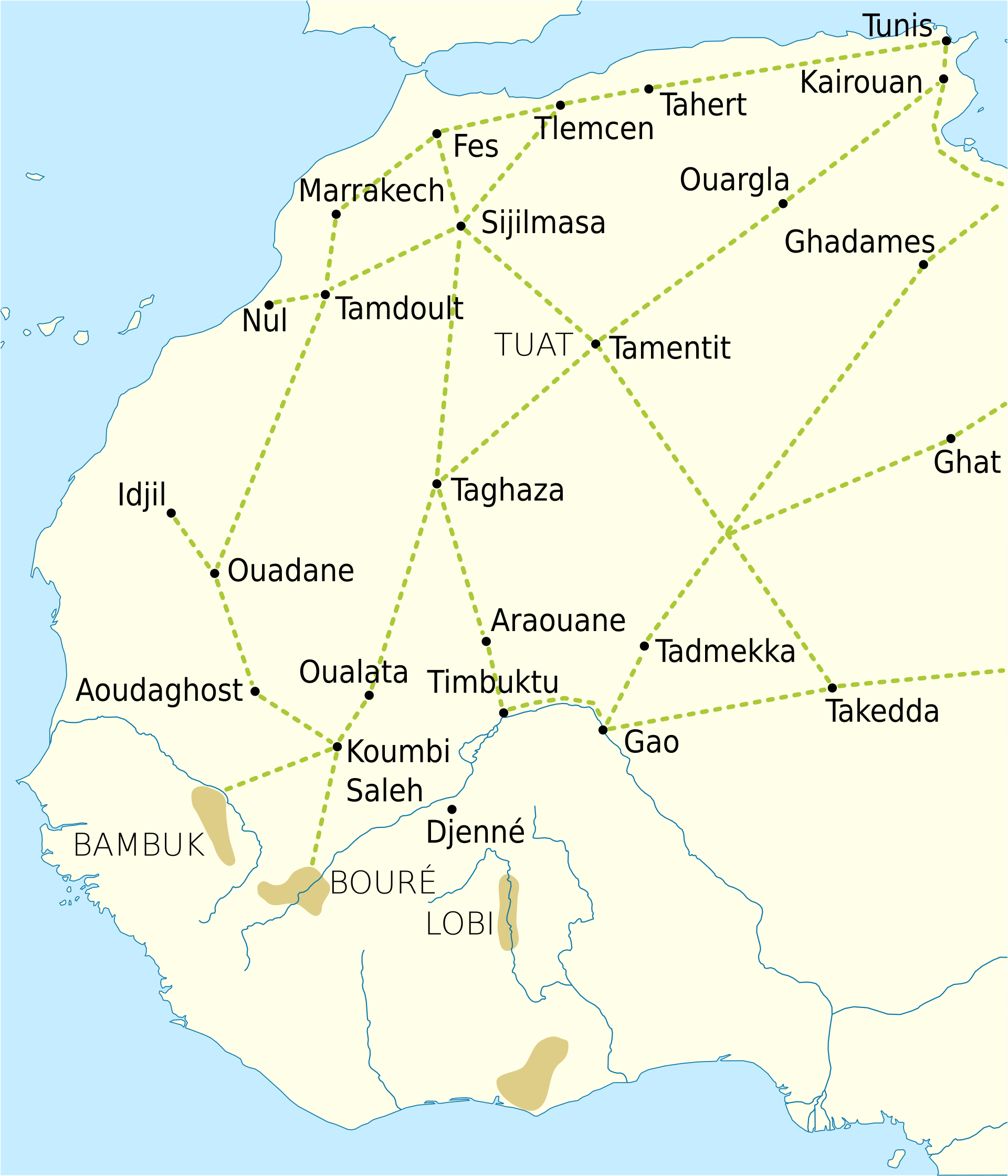
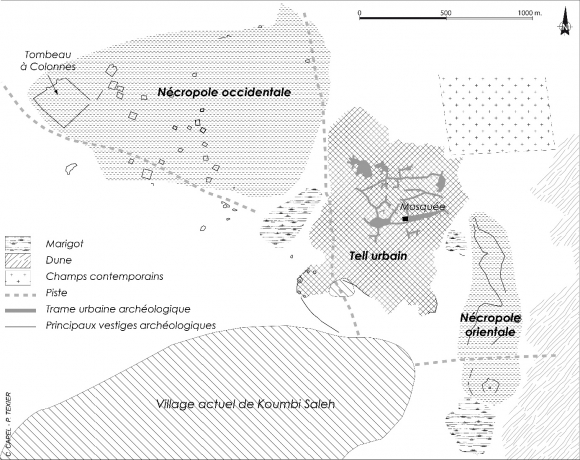
For roughly six centuries the kings of Wagadu — ruling from a capital, Koumbi Saleh, in what is now southeastern Mauritania — sat astride the southern end of the trans-Saharan trade and grew rich without owning a single goldfield. The gold came from the Bambuk region to the south; the salt came down from Saharan mines like Taghaza; Ghana sat in the middle and taxed both directions — one dinar on a donkey-load of salt entering, two on a load leaving. The empire flourished from at least the 6th century and peaked between the 9th and 11th, when the Arab geographer al-Bakri, working from merchants’ reports in distant al-Andalus, set down a description of the court around 1068: the king giving audience in a domed pavilion, horses draped in gold cloth, pages holding gold-mounted shields, the capital at Koumbi Saleh split between a royal town and a Muslim quarter with twelve mosques. The wealth ran on a deliberate scarcity — by royal monopoly every gold nugget in the realm belonged to the king, and traders were left only gold dust.
The decline came in the 11th to 13th centuries, and the old story that the Almoravids conquered Ghana in 1076 no longer holds up — there is no destruction layer in the archaeology to support it; drought, civil war among the provinces, and trade routes drifting east to new states did the slower work. By about 1240 the lands were folded into the Mali Empire, when Sundiata Keita’s forces took the old capital. Seven centuries later, in 1957, the British colony of the Gold Coast became independent and chose the name Ghana — Kwame Nkrumah reaching back to the medieval empire as a symbol of a precolonial African state. The modern nation lies on the Atlantic coast, several hundred kilometres south of where Wagadu ever held power. The name was borrowed; the polity it names is the gold empire of the Sahel, and that one is dead.
Worth remembering
- The Arab geographer al-Bakri, writing in al-Andalus c. 1068 from traders' reports, described the king of Ghana giving audience in a pavilion ringed by horses draped in gold-embroidered cloth and pages bearing gold-mounted shields — the richest king on earth by his account.
- By royal monopoly, every gold nugget mined in the country belonged to the king; merchants were permitted to hold only gold dust, which kept the metal scarce and held its price up.
Gallery
Sources
- The empire flourished from at least the 6th to the 13th century, peaking between the 9th and 11th centuries, with its capital at Koumbi Saleh. World History Encyclopedia
- Ghana controlled the trans-Saharan gold-and-salt trade and taxed it twice — on goods entering and again on goods leaving the country; Sundiata Keita's forces seized the old capital in 1240, folding it into the Mali Empire. Lumen Learning / SUNY World Civilization
- Koumbi Saleh lay in present-day southeastern Mauritania, 322 km north of modern Bamako; the king levied one gold dinar on salt entering the country and two on salt leaving. Boston University African Studies Center
A graveyard tradition: leave a stone to show you came, and remembered.