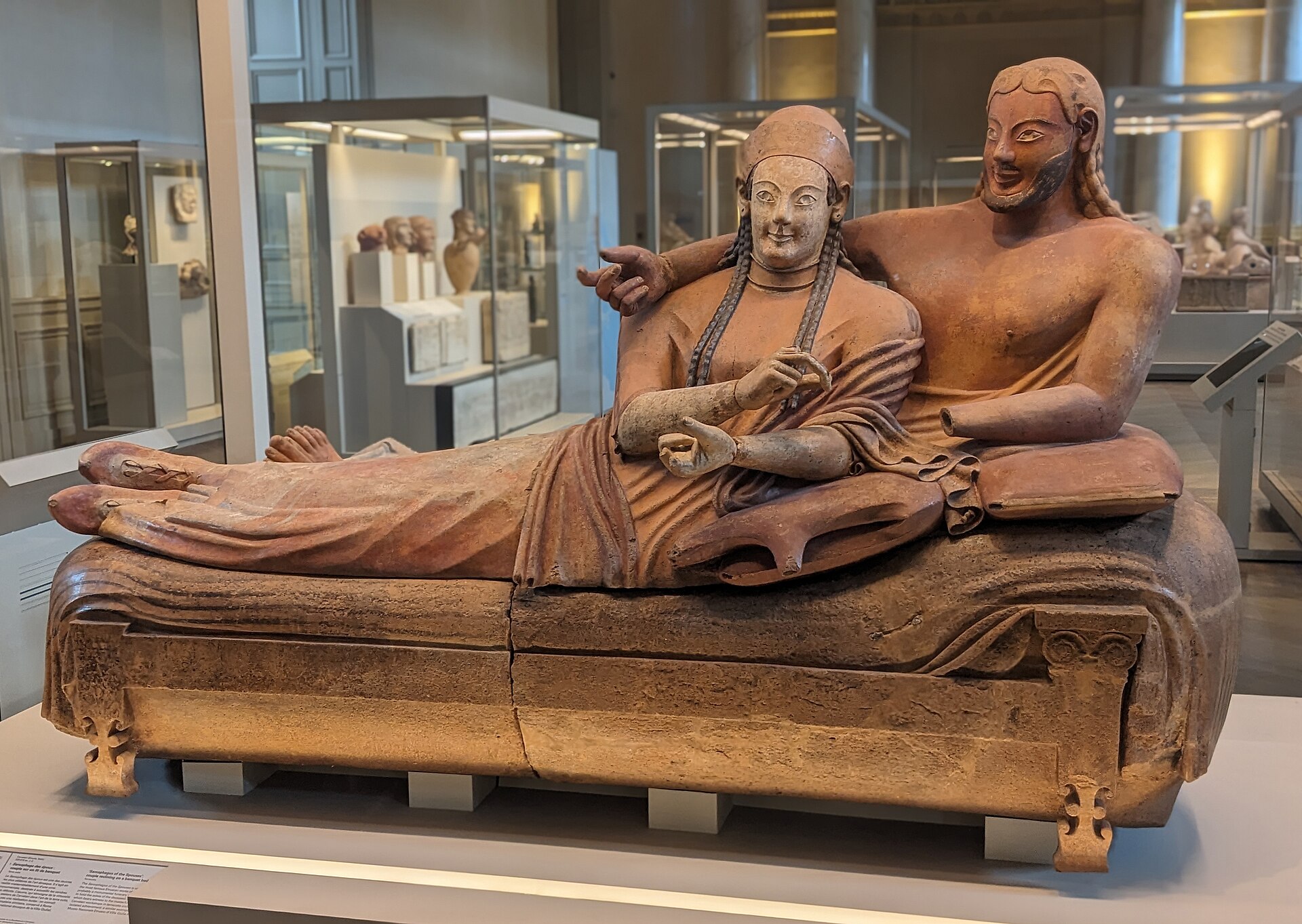
Before Rome dominated Italy, the Etruscans — who emerged in central Italy around 900 BCE from the Villanovan culture — built a league of wealthy city-states across Tuscany and beyond, skilled in metalwork, seafaring, and divination. They shaped early Rome profoundly, supplying kings, gods, gladiatorial games, and engineering such as the arch and drainage works. From the 4th century BCE Rome conquered the Etruscan cities one by one, and over the following centuries their people, customs, and tongue were absorbed into Roman life. By the early empire the Etruscan language was dead — a language isolate with no confirmed relatives, leaving thousands of tombs and inscriptions scholars still struggle to read.
Worth remembering
- Three of Rome's legendary early kings were Etruscan, including Tarquin the Proud.
- Their language is still only partly understood, written in an alphabet adapted from Greek.
Gallery
Sources
- Etruscan civilization flourished in central Italy from c. 900 BCE Wikipedia
- Etruscans were gradually absorbed by Rome, their language extinct by the 1st century BCE Encyclopaedia Britannica
- The Etruscans were one of ancient Italy's most sophisticated cultures, known for metalwork, seafaring, and a religion that shaped Roman practice including augury and the Capitoline gods World History Encyclopedia
- The Etruscan language is an isolate with no confirmed relatives; thousands of inscriptions survive but only a few hundred words are understood with confidence World History Encyclopedia
A graveyard tradition: leave a stone to show you came, and remembered.