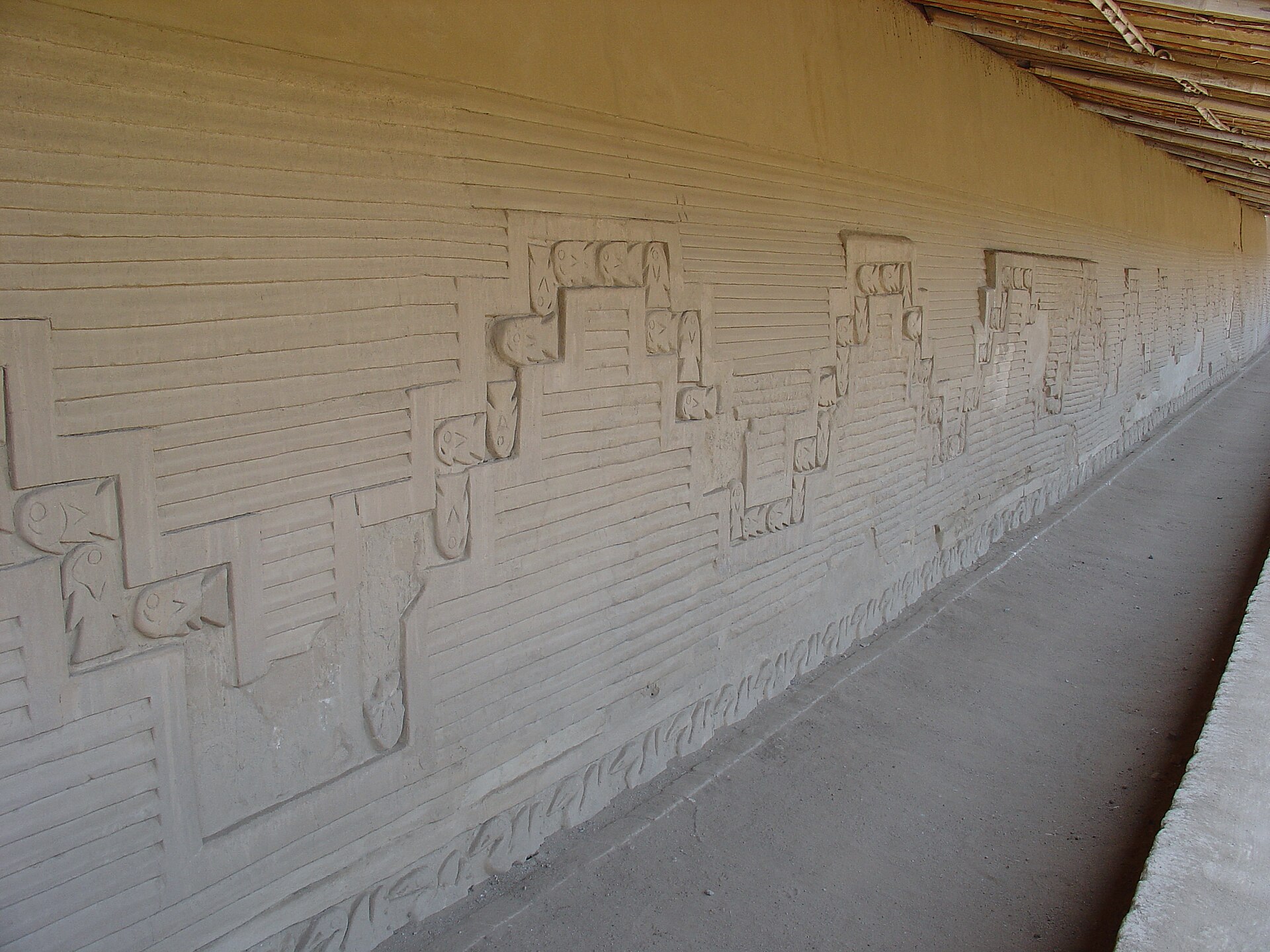
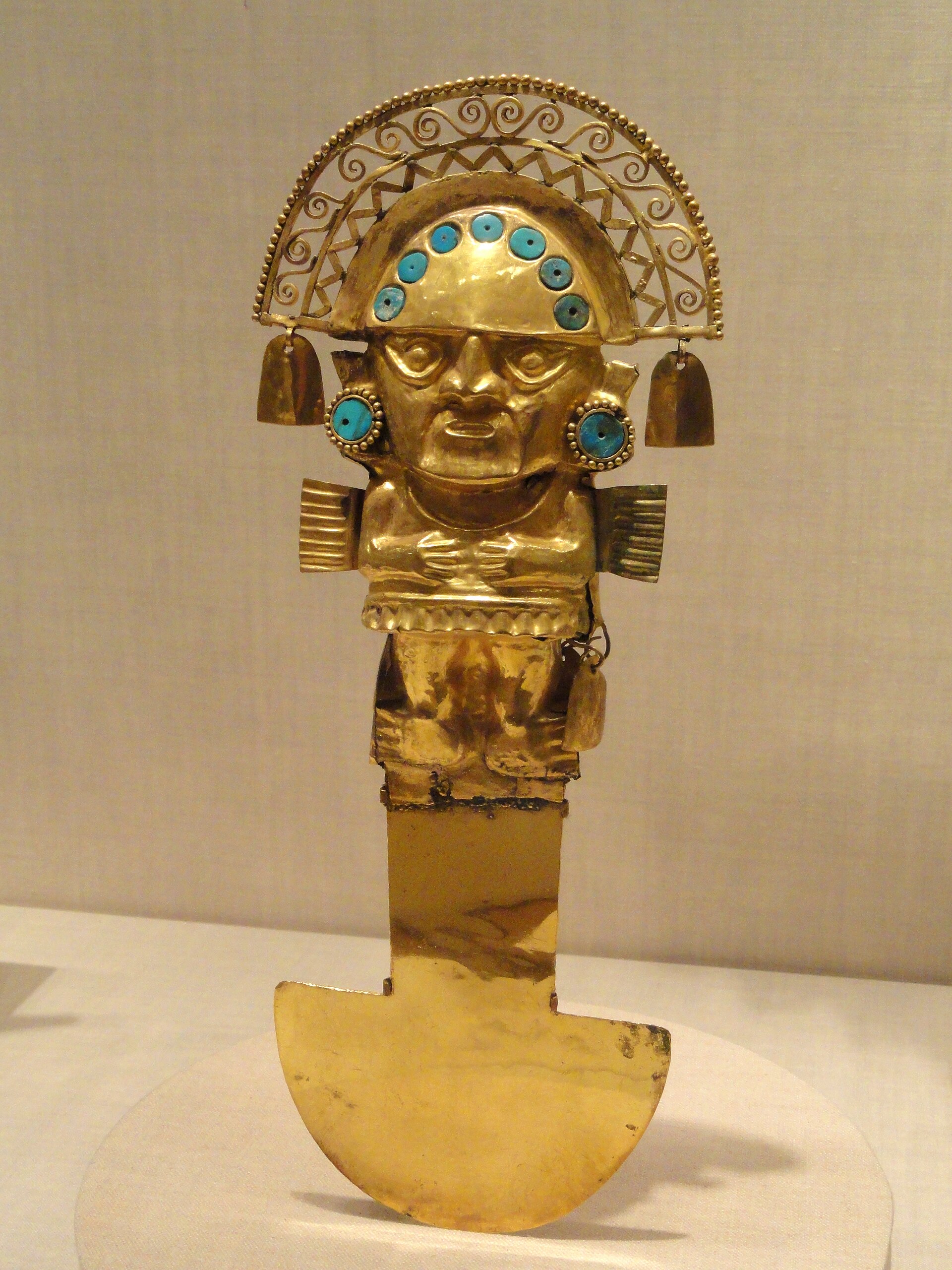
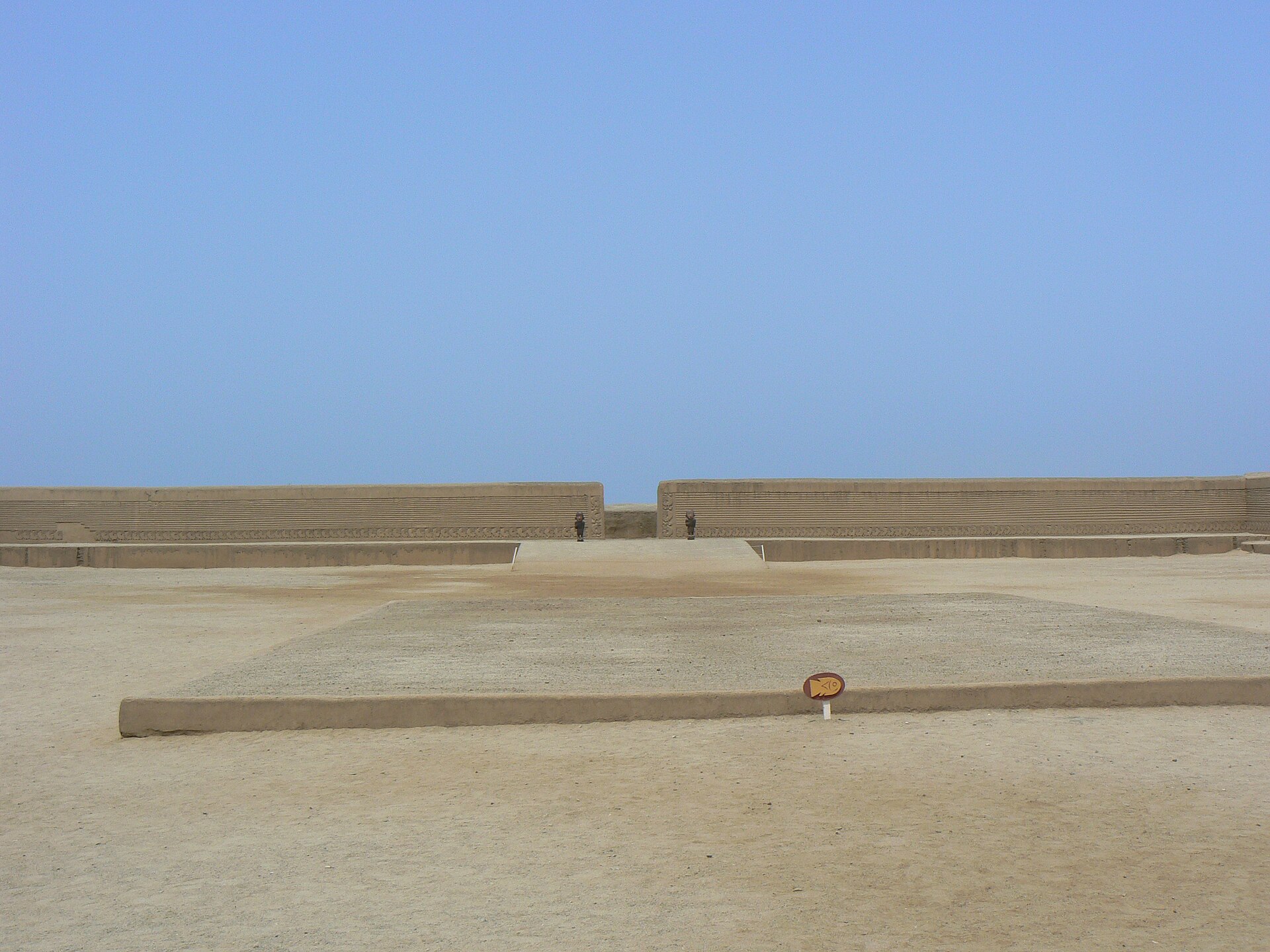
The Chimú rose around 900 CE on the desert north coast of Peru, inheriting the river valleys and the metalworking tradition of the earlier Moche. From their capital Chan Chan, at the mouth of the Moche River near modern Trujillo, they pushed their control along roughly a thousand kilometres of coast, reaching their height under the ruler Minchançaman around 1400. Chan Chan grew to some 20 km² of packed adobe — nine walled palace-citadels, lesser compounds, and dedicated quarters for weaving, woodwork and metalwork, holding up to 40,000 people. The walls were carved with low reliefs of fish, pelicans and repeating geometric nets. The kingdom ran on water it engineered into the desert: long canals and reservoirs carried river flow across dead ground to feed the valleys. Its goldsmiths and silversmiths worked copper, gold, silver and tumbaga into ceremonial knives, beakers, masks and ornaments, and the state could move that wealth and labour at scale.
Around 1470 the Inca emperor Topa Inca Yupanqui conquered Chimor, capturing Minchançaman, the eleventh known Chimú ruler. The Inca broke the kingdom by cutting the canals that fed Chan Chan and by deporting its best artisans, along with their finest objects, to Cuzco, where Chimú goldworking was folded into Inca production. The city was left to decline. When the Spanish arrived in the sixteenth century they mined Chan Chan for its remaining gold, tunnelling into tombs and compounds for metal. The site is now a UNESCO World Heritage property and has sat on the List of World Heritage in Danger since 1986: exposed adobe erodes under rain and El Niño storms, and the largest mud city the Americas ever built is slowly dissolving back into the desert it was raised from.
Worth remembering
- Chan Chan, near modern Trujillo, was the largest adobe city in the pre-Columbian Americas — about 20 km², up to 40,000 people, divided into nine walled palace-citadels, its mud-brick walls carved with friezes of fish, seabirds and geometric patterns.
- At Huanchaquito-Las Llamas, the Chimú killed 137 children and more than 200 llamas in a single ritual event around 1400–1450 CE; it is the largest known mass child sacrifice in the Americas.
Gallery
Sources
- Chan Chan was the largest earthen-architecture city in pre-Columbian America and capital of the Chimú kingdom, which reached its apogee in the 15th century before falling to the Inca; the once 20 km² city is now an eroding World Heritage site on the List of World Heritage in Danger. UNESCO World Heritage Centre
- The Chimú flourished on Peru's north coast; Chan Chan covered ~20 km² with up to 40,000 people; the kingdom built extensive canal irrigation; the Inca under Tupac Yupanqui captured the ruler Minchançaman c. 1470 and forcibly relocated artists and their finest pieces to Cuzco. World History Encyclopedia
- Excavation at Huanchaquito-Las Llamas in the Moche Valley uncovered the remains of 137 children (plus 3 adults) and over 200 llamas, radiocarbon-dated to c. AD 1400–1450, the largest single mass child-and-camelid sacrifice known from the Americas. PLOS ONE (Prieto et al.)
A graveyard tradition: leave a stone to show you came, and remembered.