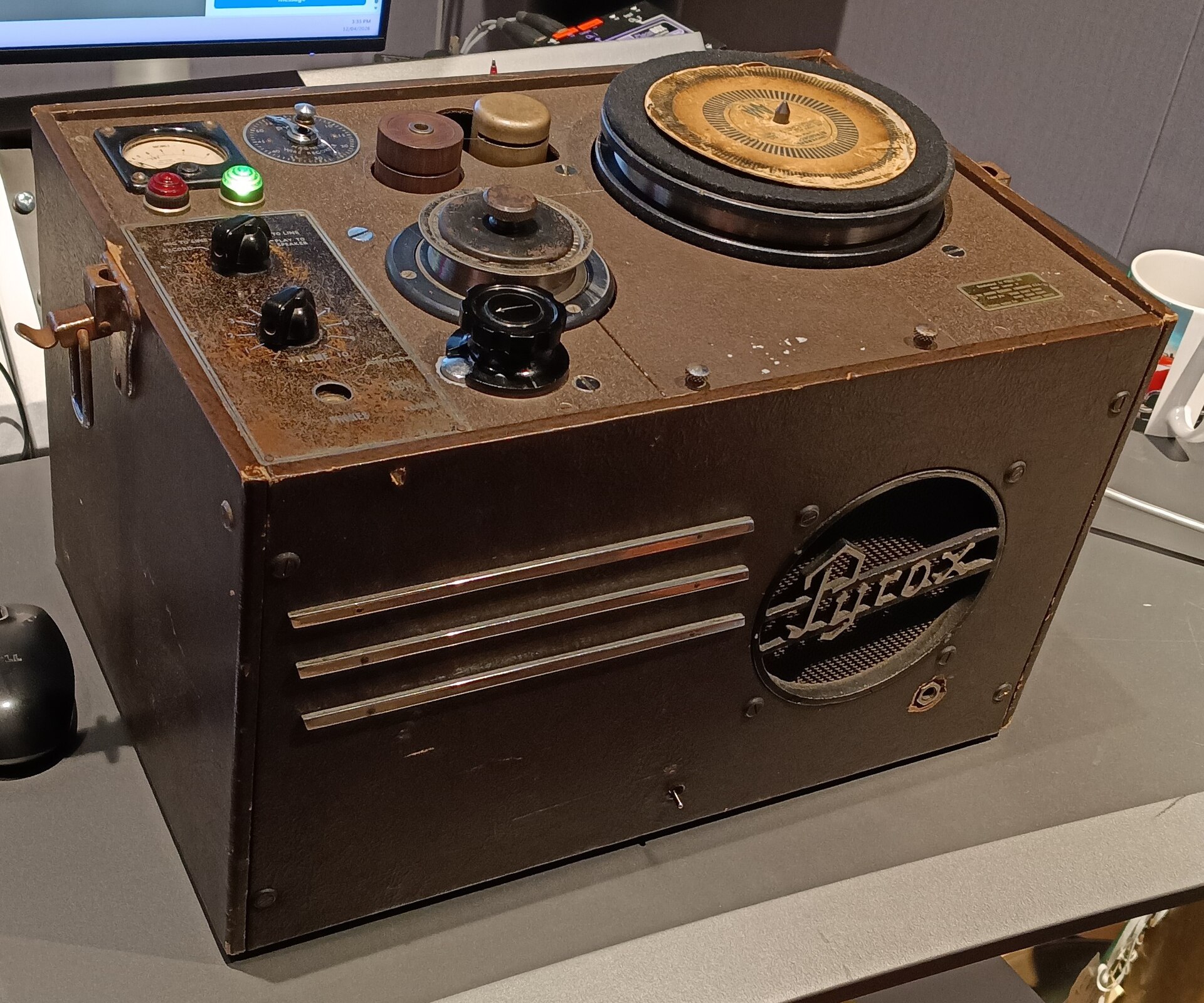
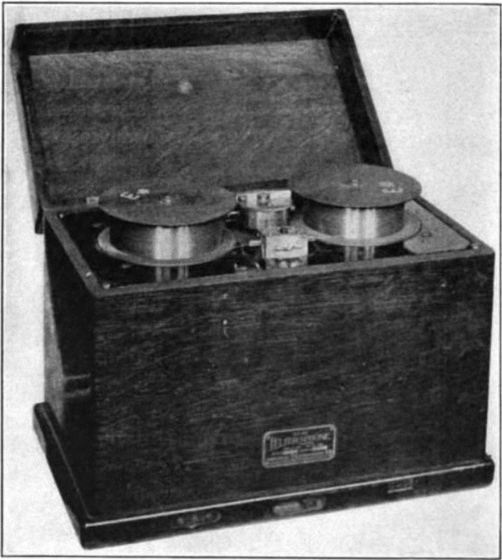
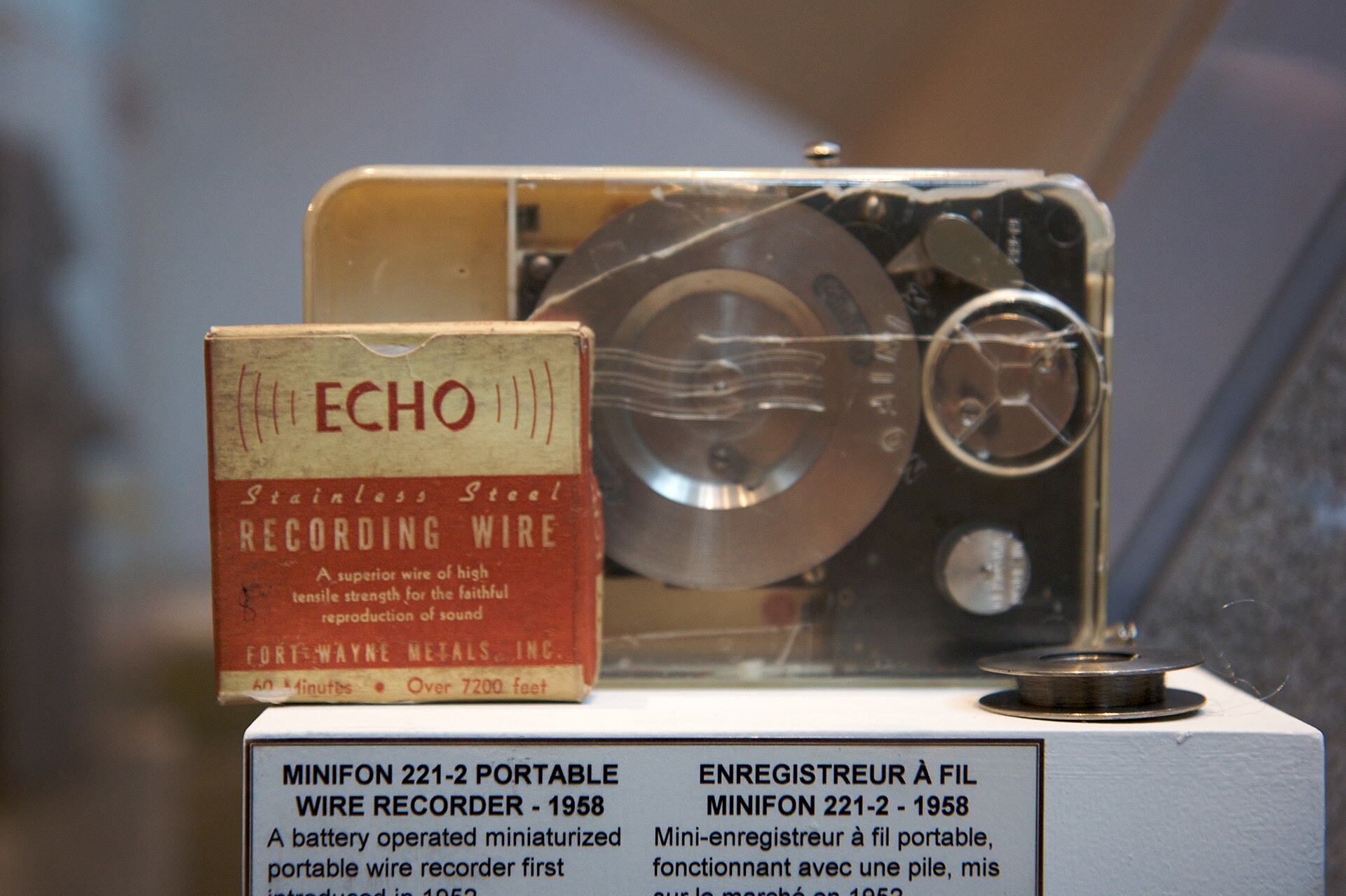
Wire recording stored sound as patterns of magnetism along a strand of steel wire thinner than a human hair. Valdemar Poulsen, a Danish engineer, patented the principle in 1898 with his Telegraphone and showed it at the 1900 Paris Exposition Universelle, where he recorded the voice of Emperor Franz Joseph — a fragment that still plays today as the oldest surviving magnetic audio recording. The mechanism was brutally simple: pull the wire past an electromagnet whose field varies with the incoming sound, and the wire keeps that variation; pull it past the head again and the magnetism induces the signal back. After vacuum-tube amplification made playback loud enough to matter, the technology had its real life between roughly 1946 and 1954. Home recorders from Webster-Chicago, Brush and Wilcox-Gay ran wire at 24 inches per second, fitting an hour of sound onto a 7,200-foot reel on a spool under three inches across. CBS edited network radio on wire; the U.S. Army’s Ghost Army carried wire recorders to fake the sound of whole divisions in 1944–45; aircraft flight recorders used it into the 1950s.
What killed it was not the death of magnetic recording but the arrival of a better carrier for the same physics. German engineers had refined the Magnetophon — magnetic coating on plastic tape — during the war, and when captured machines reached the United States, Ampex and 3M turned them into the Ampex 200 (1948). Tape held the head still against a flat, splice-able surface; wire twisted, tangled, snapped, and could not be edited with a razor blade. By 1950 professional studios and broadcasters had moved to tape, and over the first half of the 1950s the consumer wire recorder was discontinued model by model with no replacement designed. The steel wire was abandoned outright. Magnetic recording went on to cassettes, videotape and hard drives — but it went on as tape and oxide, never again as wire.
Worth remembering
- The 1900 recording of Emperor Franz Joseph's voice on Poulsen's wire still exists and is regarded as the oldest surviving magnetic audio recording.
- Postwar home recorders pulled steel wire past the head at 24 inches per second; a single one-hour reel held about 7,200 feet of wire thinner than a human hair. Makers included Webster-Chicago, Armour Research, Brush, Wilcox-Gay and Air King.
Gallery
Sources
- Poulsen patented the Telegraphone in 1898 (US patent 661,619 issued 1900), demonstrated it at the 1900 Paris Exposition where he recorded Emperor Franz Joseph — believed to be the oldest surviving magnetic audio recording. Wikipedia
- Postwar wire ran at 24 in/sec (610 mm/s); a one-hour spool held about 7,200 ft (~2,200 m) of steel wire 0.004–0.006 in thick on a reel under 3 in across. Peak consumer use ran roughly 1946–1954. Wikipedia
- Wire recorders were used by CBS for network radio, by the WWII Ghost Army for sonic deception in 1944–45, and in aircraft flight recorders into the 1950s, before affordable tape recorders superseded them in the early 1950s. Wikipedia
A graveyard tradition: leave a stone to show you came, and remembered.