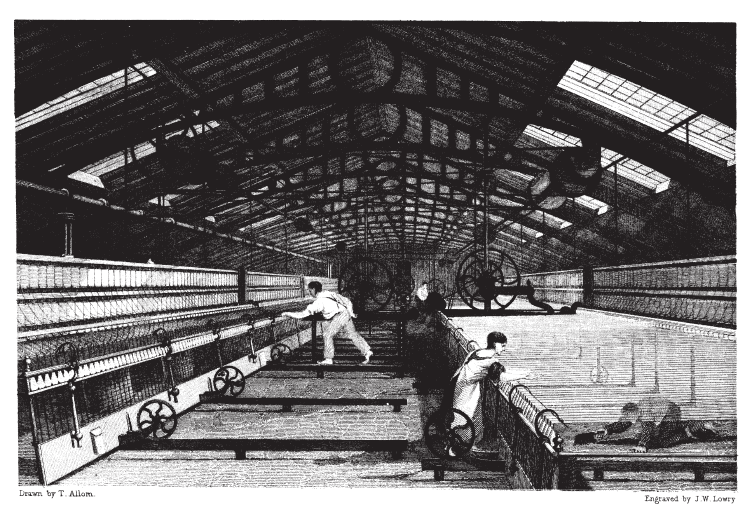
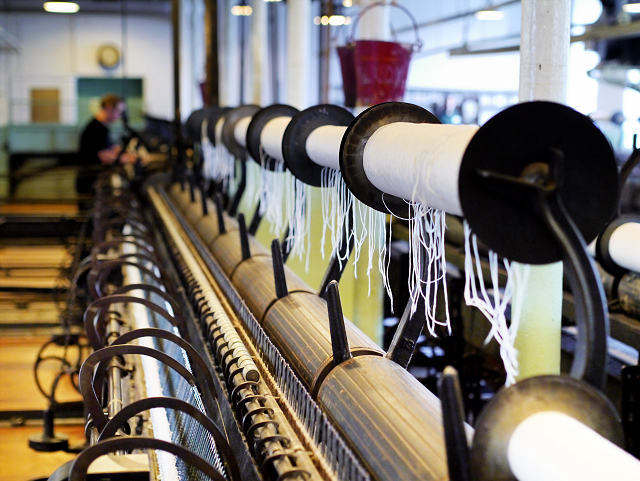
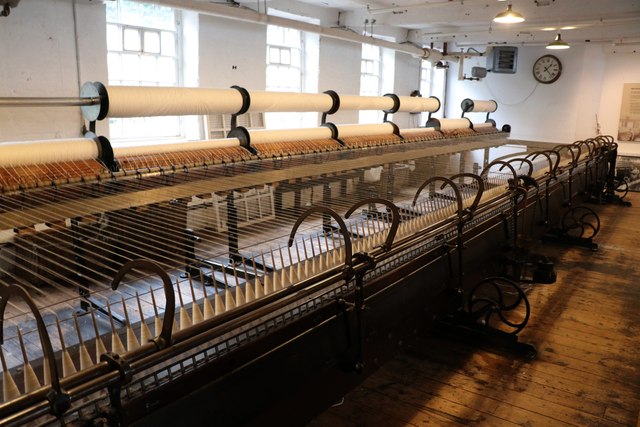
The spinning mule was the machine that made cotton cheap. Samuel Crompton built the first one in 1779 by combining the two existing spinning machines of the day — Hargreaves’s jenny and Arkwright’s water frame — into a hybrid he could never afford to patent. The result spun cotton thread of a fineness and uniformity that nothing before it could manage, fine enough for delicate muslin, and it did so at industrial scale. On the back of the mule, Lancashire became the cotton-spinning capital of the world; at the peak there were something like five million mule spindles turning in Lancashire mills alone, and British cotton cloth set the standard in every market on earth. The self-acting mule that Richard Roberts patented in the 1820s automated the heavy carriage motion and let the mills run still more spindles.
It died slowly, beaten not on quality but on cost. Ring spinning, a simpler continuous process that needed far less skill, had existed since the 1820s but was little used in Lancashire until the 1890s; once it took hold, it spread over two generations, because mill owners replaced expensive machines only as they wore out. The mule hung on in the fine-count work it did best, then in fewer and fewer mills, and finally as a curiosity: the last cotton mule-spinning in Lancashire stopped at Elk Mill, Oldham, in 1974, and a woollen mule reportedly ran near Ramsbottom until 1988. The machine that had built an industrial empire ended as the last clattering survivor in a trade that had moved on without it — kept now in working order only by museums.
Worth remembering
- Its name comes from its parentage: it was a hybrid — a 'mule' — crossing Hargreaves's spinning jenny with Arkwright's water frame, and like a mule it outperformed both, spinning thread fine enough for muslin at a count no earlier machine could reach. By 1812 some 360 mills ran about 4.6 million mule spindles.
- A skilled 'minder' worked each pair of mules with the help of 'piecers,' often barefoot children, who darted in to rejoin broken threads while the spindle carriage rolled in and out — the human cost stitched into the cheap cotton that clothed the world.
Gallery
Watch
Sources
- Samuel Crompton invented the spinning mule in 1779; it enabled large-scale manufacture of high-quality yarn, and by 1812 some 360 mills ran about 4.6 million mule spindles Encyclopaedia Britannica
- The spinning mule was the most common spinning machine from about 1790 to 1900; ring frames began displacing it from the 1890s, and the last cotton mule-spinning at Elk Mill, Oldham ceased in 1974 Wikipedia
A graveyard tradition: leave a stone to show you came, and remembered.