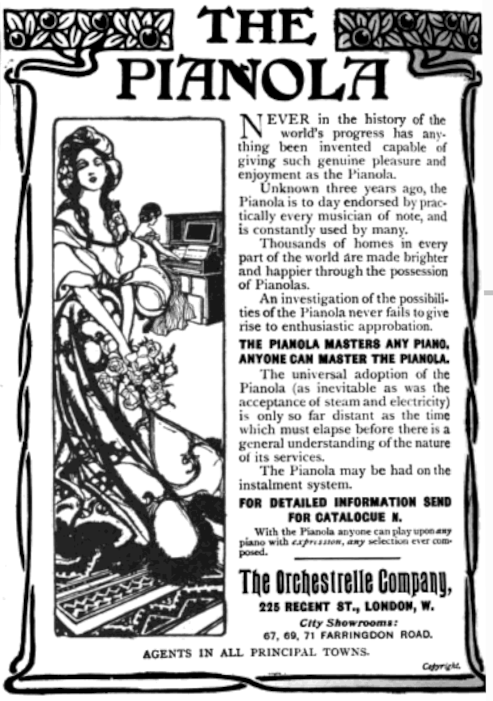
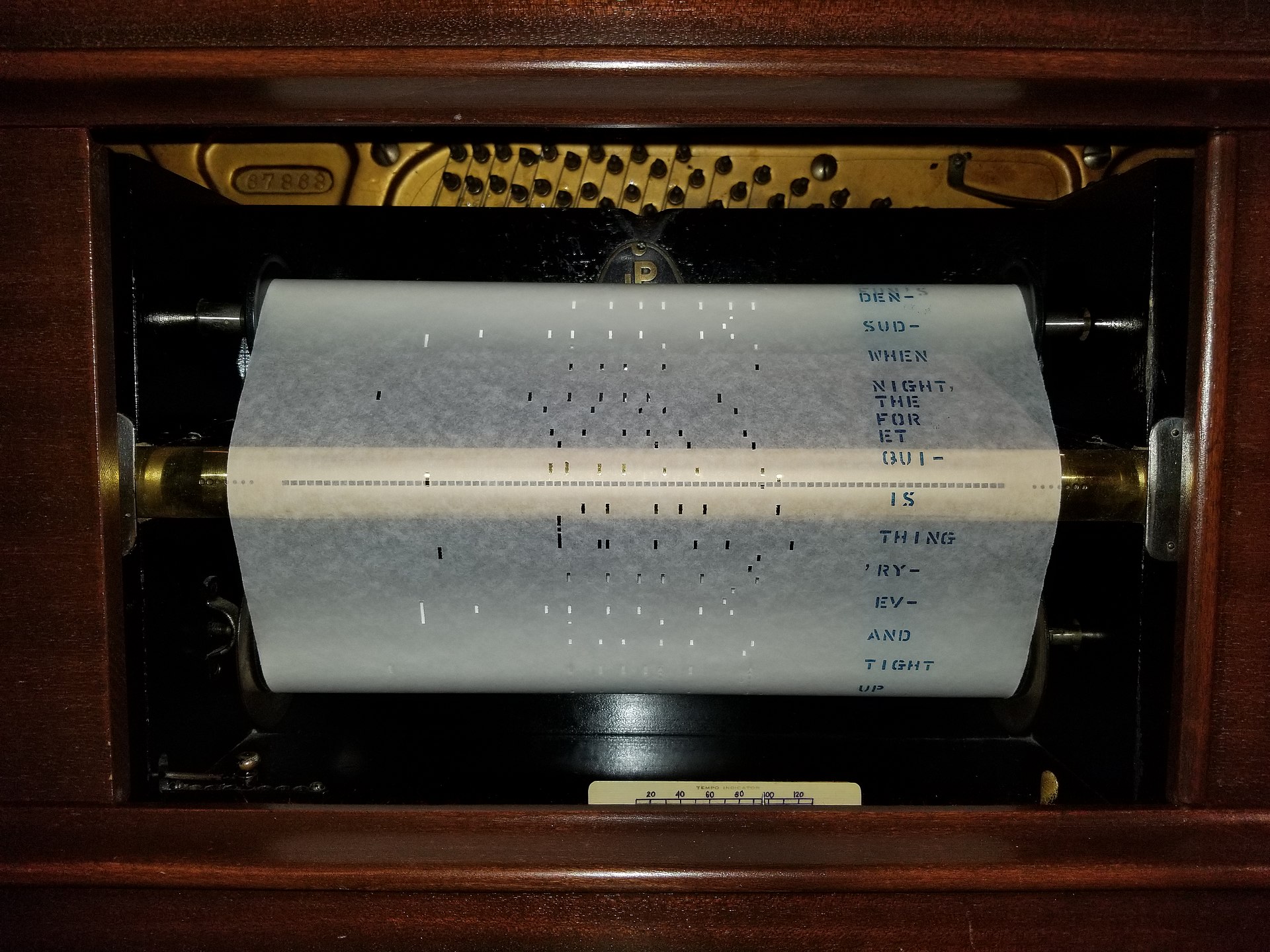
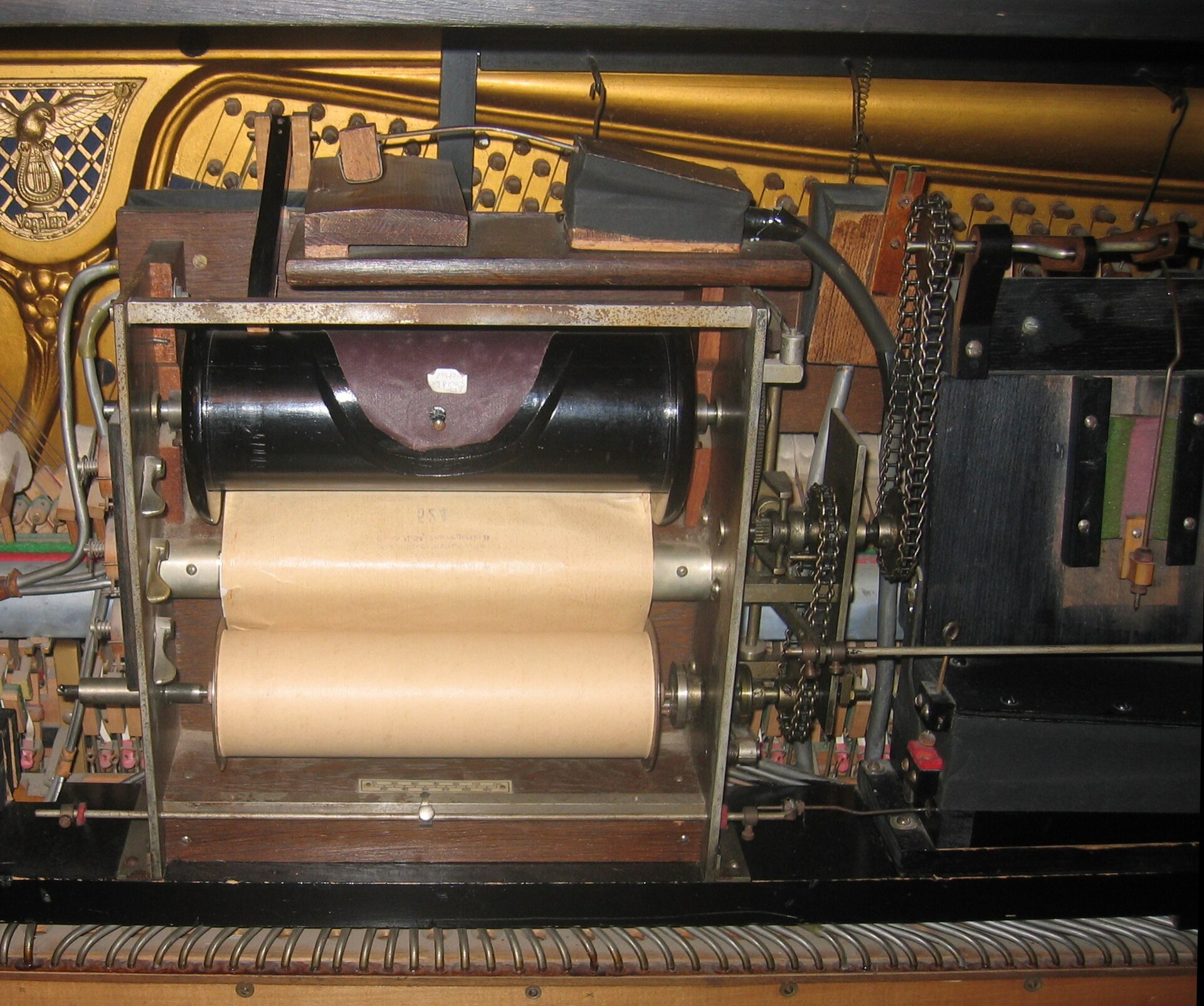
For about a quarter of a century, the way an ordinary household had music in the room — not a recording, but a real piano playing — was to let the piano play itself. The player piano worked entirely on air: pumping the foot treadles created suction that drew air through a bar of holes reading a moving roll of punched paper, and each perforation opened a tiny bellows that pressed the corresponding key. Roll in, pump, and the instrument performed. The Aeolian Company put Votey’s Pianola on sale in 1898, and the idea took over the American piano: by 1923 more than half of all pianos manufactured in the United States were players. The most sophisticated versions, the “reproducing pianos,” went further still, capturing the tempo, dynamics, and pedalling of a specific pianist, so a family could hear Rachmaninoff or Gershwin play in their own front room from a paper roll.
It was killed, fast, by better ways of bringing music home. Through the 1920s the radio set arrived, broadcasting whole orchestras for free, and the new electrical phonograph recordings finally sounded good enough to satisfy. Both offered a range of music a piano roll could never match, with no pumping and no upkeep, and player-piano sales fell by something like 86 percent between 1923 and 1929. Then the Wall Street crash took what remained, and by the early 1930s American factories had stopped shipping them. The pneumatic player piano never came back; the self-playing pianos sold today are electronic instruments of a different lineage. What survives of it is collectors’ instruments and shelves of brittle paper rolls — a clever, doomed machine that briefly put a virtuoso in every parlour and was made obsolete by a voice coming out of a box.
Worth remembering
- It ran on suction: pumping the foot pedals drew air through a 'tracker bar' that read the holes in a moving paper roll, and each hole triggered a little bellows that pressed the matching key — a whole piano played by perforated paper.
- The finest models, the 'reproducing pianos,' recorded the actual playing of named pianists — Rachmaninoff, Debussy, Gershwin all cut rolls — so a parlour instrument could replay a virtuoso's exact performance, dynamics and all, years before a phonograph could do it justice.
Gallery
Sources
- Player pianos reached 56% of US piano production in 1923; sales fell about 86% by 1929 as radio and phonographs spread, and the Depression finished the industry Baldwin Piano Company
- Player-piano sales peaked around 1924 and were 'virtually wiped out' by the 1929 crash; the modern Disklavier is a separate electronic technology, not a continuation of the pneumatic player piano Wikipedia
A graveyard tradition: leave a stone to show you came, and remembered.