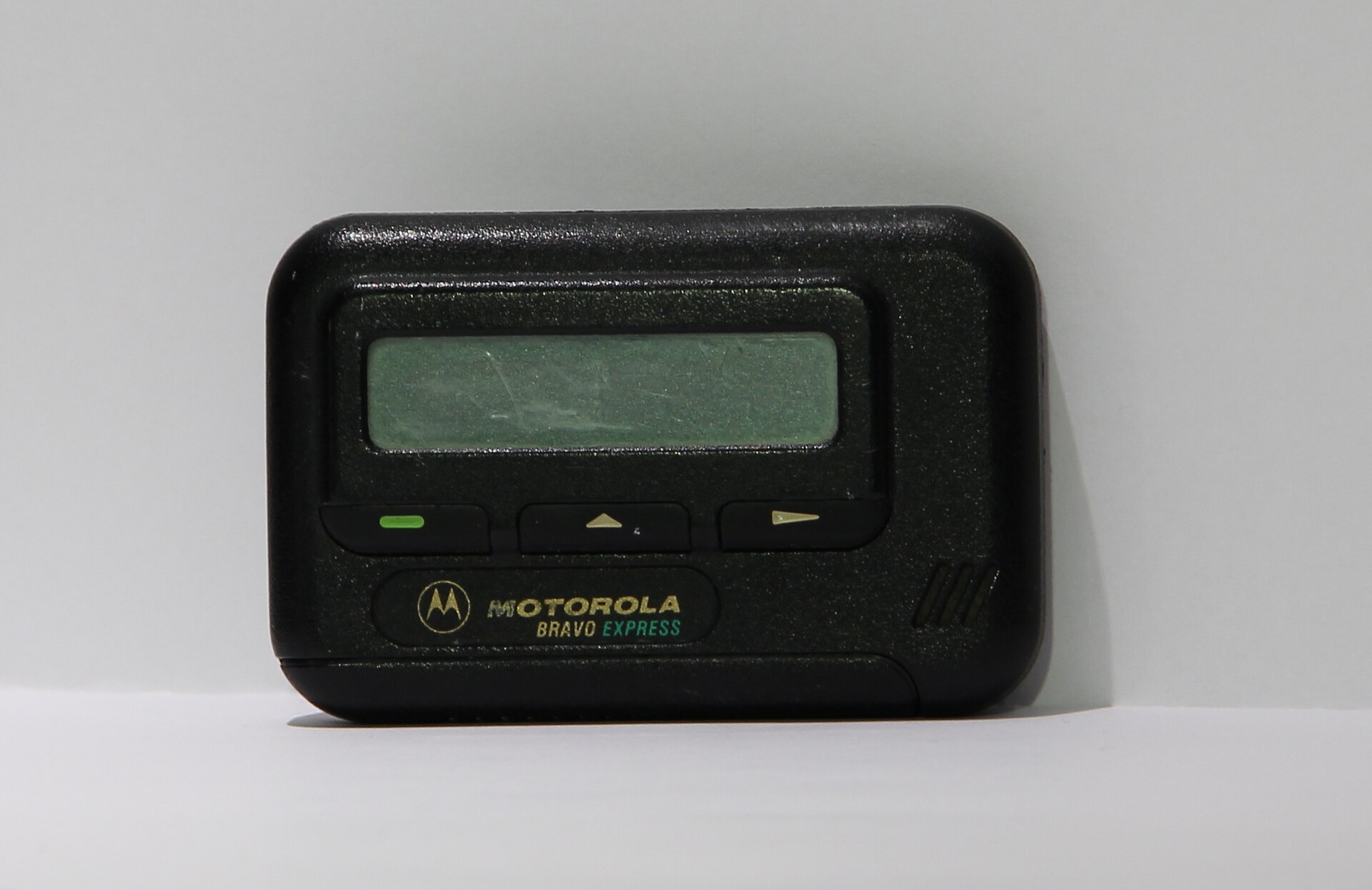
For about fifteen years the pager — patented in 1949 by Al Gross and turned into a mass-market device by Motorola — was how you reached someone who was not at a desk. It did one thing — buzz, and show a phone number — and that one-way simplicity made it indispensable, first to doctors and engineers, then to a 1990s mainstream where a beeper on the belt was a small badge of being needed. At its 1994 peak some 61 million were in use in the United States alone, and a whole numeric slang grew up around their tiny screens.
The mobile phone made the pager redundant almost completely: why be told to find a phone when you were carrying one that could also talk and text? Consumer paging collapsed through the 2000s. But the pager has the strangest afterlife in this wing — it isn’t entirely dead. Hospitals still run on pagers, because their simple radio signals reach the concrete cores of buildings and keep working when cellular networks fail. The technology the smartphone killed quietly survives in the one place where reliability outranks everything.
Worth remembering
- Numeric-only pagers bred a code dialect: 07734 reads 'hello' upside down, 143 meant 'I love you' (the letter counts).
- It outlived its killer where signals fail: more than 80% of US hospitals still use pagers, which penetrate building cores and survive network outages.
The people
-
Alfred J. "Al" Gross — Inventor of the telephone pager, 1918–2000
Wireless pioneer who patented the pager in 1949 (and earlier the walkie-talkie and CB radio).
-
Paul V. Galvin — Founder of Motorola, 1895–1959
His company, Motorola, dominated consumer paging through the 1980s and 90s.
Gallery
Further reading
Sources
- ~61 million pagers in use in the US in 1994; usage collapsed in the 2000s as cell phones spread Wikipedia
- History of pagers and peak US usage Spok
- Motorola dominated the paging market through the 1980s and 1990s, with models like the Advisor making the pager a status symbol before mobile phones displaced it. IEEE Spectrum
A graveyard tradition: leave a stone to show you came, and remembered.