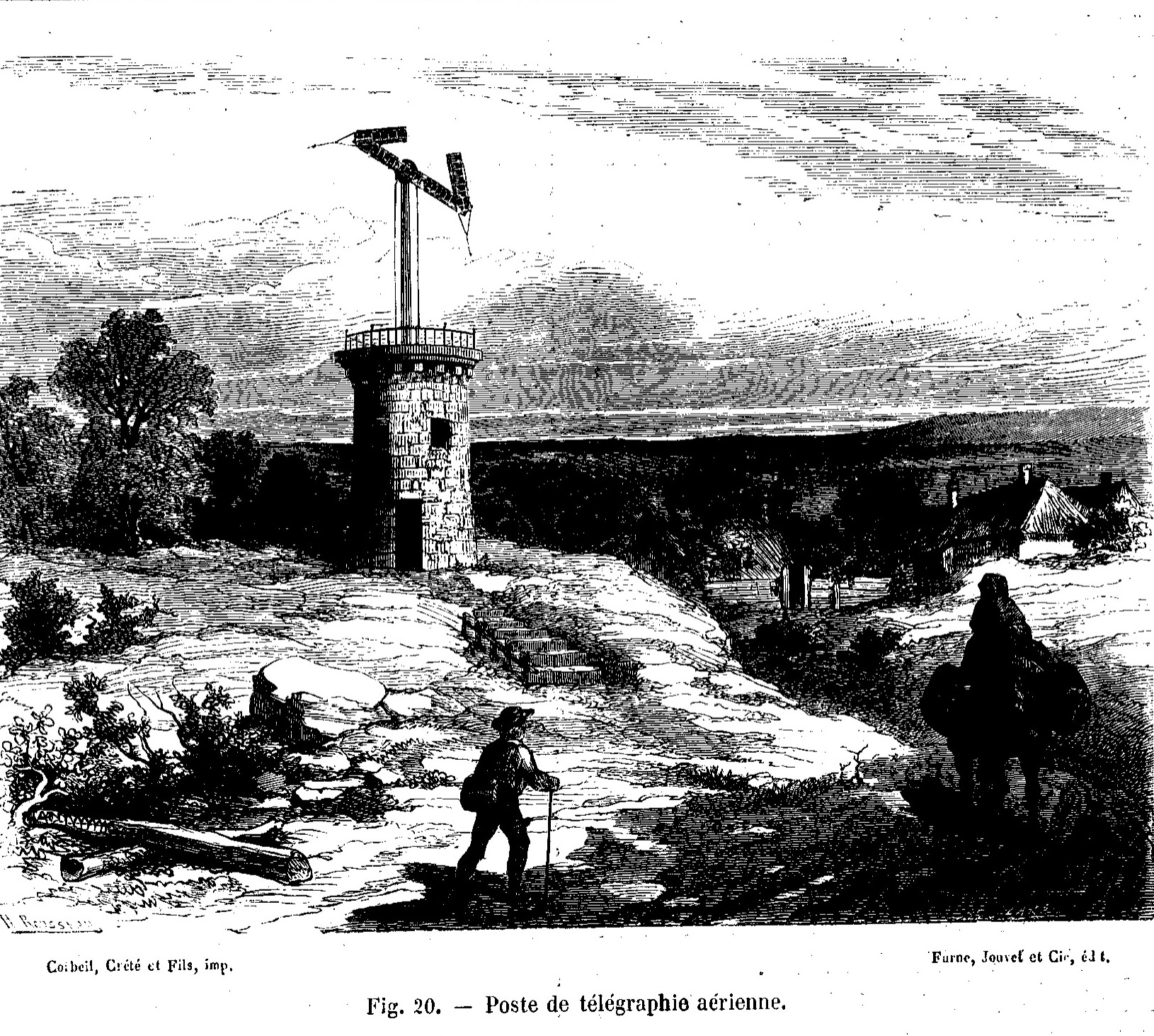
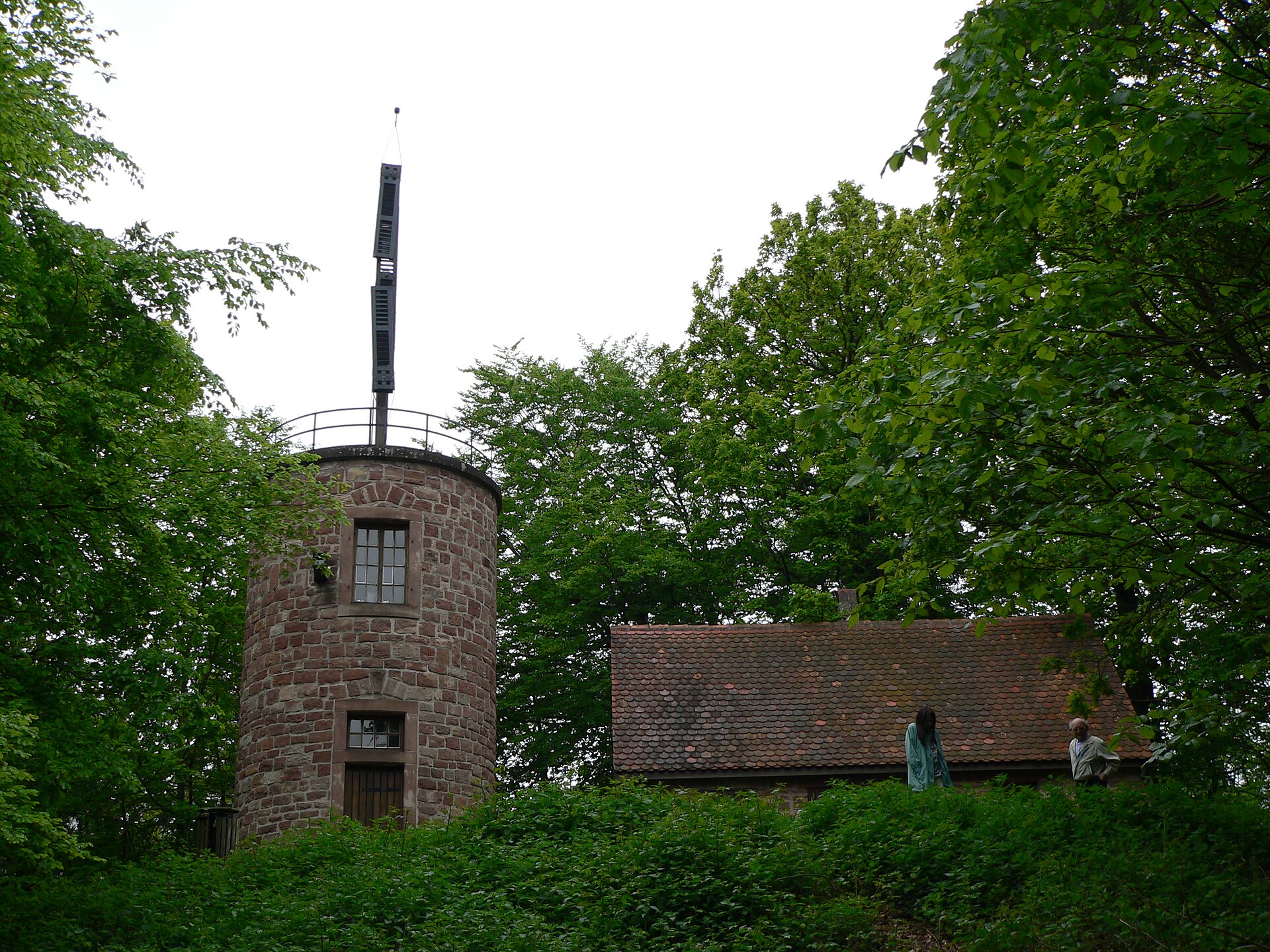
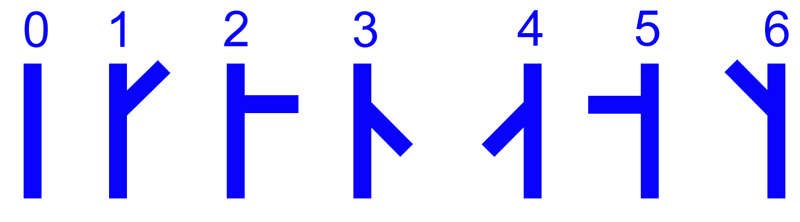
Claude Chappe’s telegraph was a network of towers, each in sight of the next, each topped with a wooden mast carrying a pivoted cross-bar and two jointed arms. By setting the arms to coded positions an operator could form any of 92 signals; the operator in the next tower, a telescope to his eye, read the shape and reproduced it down the line. The French Revolutionary government grasped what this meant immediately and put up the first line, Paris to Lille, in 1794 — in time to flash the recapture of a town from Austrian troops to the capital within the hour. Over the next half-century the network grew to more than 500 stations stretching over 5,000 kilometres, the nervous system of the French state.
Speed was the whole point. A signal hopped tower to tower in seconds, so the time it took a message to cross the country depended on the number of relays, not the distance: Paris to Lille in under nine minutes, Paris to Toulon in under an hour, at a moment when the alternative was a courier on a horse. That speed had a price the public never got to use — it was a government monopoly, the codebooks were secret, and sending a private message over it was a crime. It also had the first recorded network hack: in the 1830s two bankers, the Blanc brothers, bribed operators to bury stock-market signals inside the official traffic, a swindle that ran for two years and later gave Alexandre Dumas a plot.
The wires ended it fast. Once Morse and his rivals showed that a current down a copper line could carry messages day or night, through fog, without a chain of telescope-watching towers, the optical telegraph had no defence. France trialled the electric system in the early 1840s and resolved in 1846 to replace the towers; the last French station shut in 1852. Sweden held a single link open until 1880, the final survivor of a technology that had been the fastest thing in the world and was made obsolete inside ten years.
Worth remembering
- Each tower carried a pivoted cross-bar with a movable arm on each end; the combinations gave 92 working signals, which operators read off the next tower through a telescope and copied onward. A message from Paris to Lille — 230 km and fifteen towers — arrived in under nine minutes, against roughly a day on horseback.
- It was a state monopoly: private use was illegal, and the codebooks were secret, so the operators relaying a message usually had no idea what it said. Napoleon expanded the network to coordinate armies and watch the borders.
Gallery
Sources
- At its peak around 1844 the French network ran over 530 stations across more than 5,000 km; France decided to replace it with the electric telegraph in 1846, the last station closing in 1852 Shannon Selin
- In the 1830s the Blanc brothers bribed Chappe operators to slip stock-market information into the official signal stream — a real fraud that inspired the telegraph subplot of Dumas's 'Count of Monte Cristo' — an early documented attack on a communications network IEEE Spectrum
A graveyard tradition: leave a stone to show you came, and remembered.