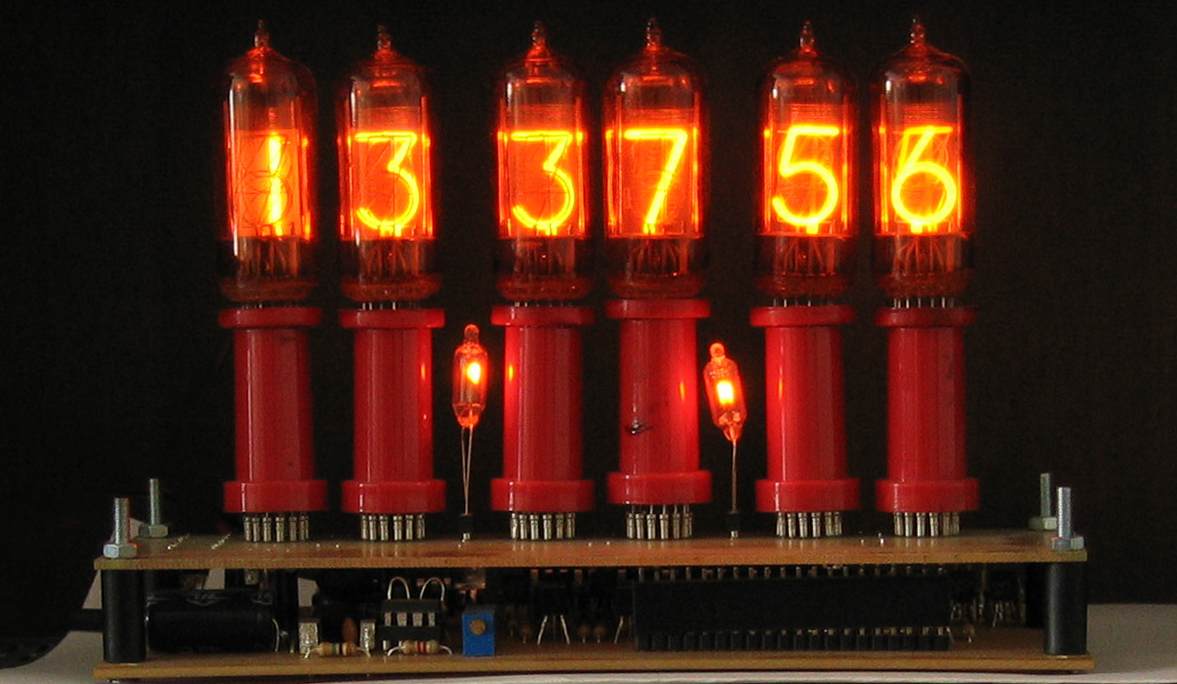
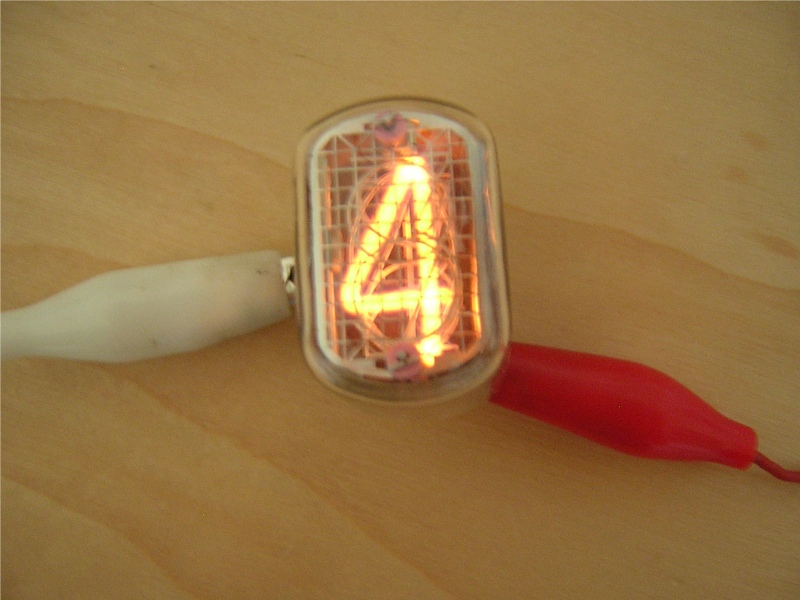
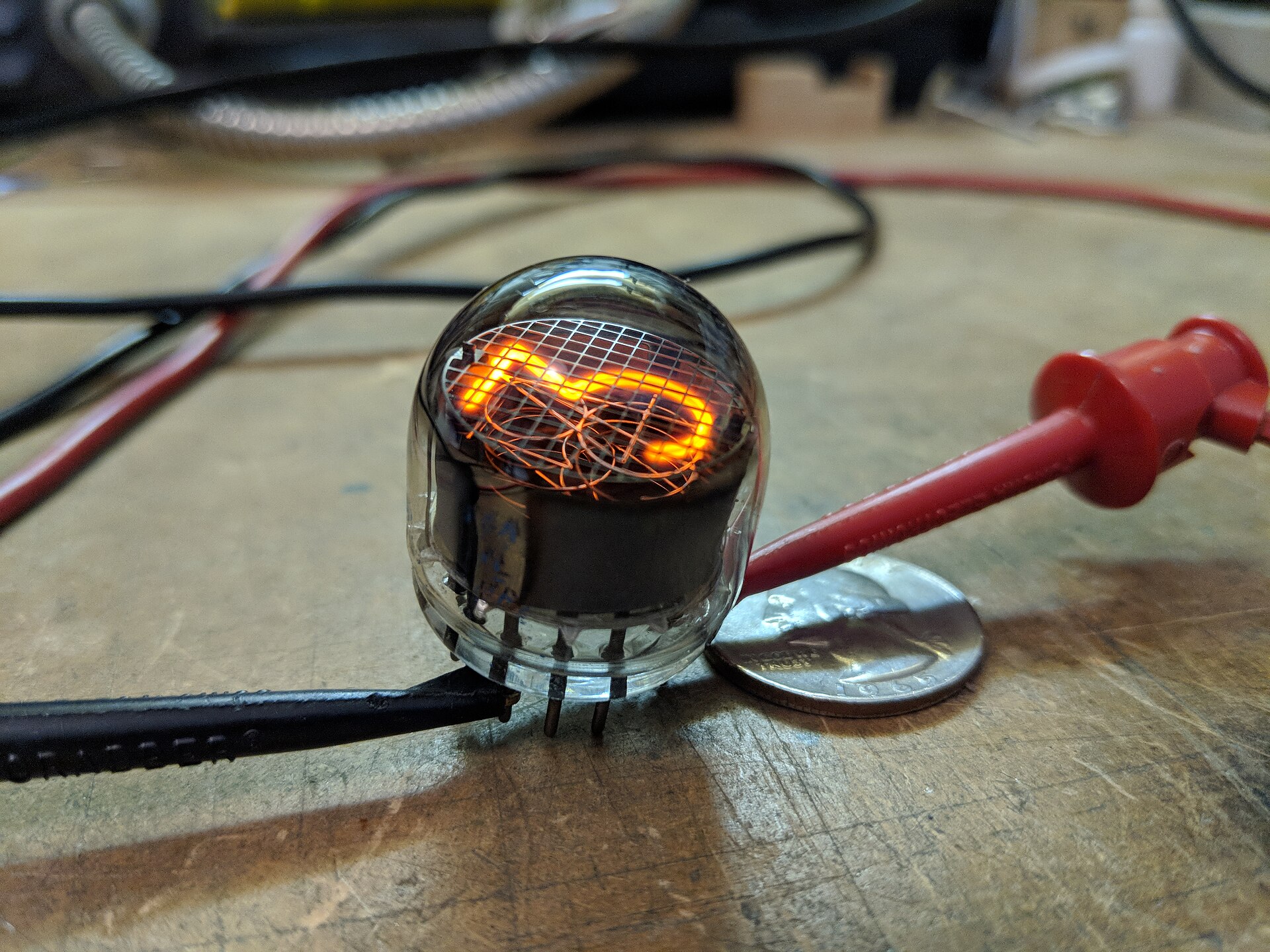
The Nixie tube was a cold-cathode gas-discharge display built from ten wire-mesh cathodes, each bent into the shape of a digit 0 through 9, stacked inside a single neon-filled glass envelope. Applying a few hundred volts to one cathode caused only that digit to glow orange around its wire outline — no scanning beam, no phosphor, no refresh cycle, just direct discharge lighting up one shape at a time. Haydu Brothers Laboratories developed the design in the late 1940s and early 1950s; Burroughs Corporation acquired the company and introduced the tube commercially in 1955 under the trademarked name “Nixie,” a label that reportedly began as an engineering tag, “NIX I,” for “Numeric Indicator eXperimental No. 1.” National Union had beaten Burroughs to market by a year with a similar tube called Inditron, but it was Burroughs’ version, and the name, that stuck. Through the late 1950s and 1960s, Nixies became the default numeric readout for desktop calculators, frequency counters, voltmeters, and clocks — anywhere a machine needed to show a number to a person standing in front of it.
The tube’s decline had nothing to do with legibility or reliability; it had to do with power and cost. A Nixie needed on the order of 170 volts to strike and needed separate driver circuitry to switch that voltage to the right cathode, which made it expensive and bulky to integrate into anything battery-powered. The LED seven-segment display, and around the same time the vacuum-fluorescent display, ran on a few volts, dropped straight into transistor-transistor logic, and cost a fraction as much to manufacture at scale — the calculator boom of the early 1970s was built on that difference. Burroughs wound down Nixie production by the mid-1970s as the tubes disappeared from new calculator and clock designs, replaced first by LED and VFD digits and later by LCD. What survives now is a collector’s circuit: since the early 2000s, hobbyists have kept a market alive for new-old-stock tubes, mostly to build retro clocks that glow with the same orange light instruments used to show a number by fifty years ago.
Worth remembering
- The name 'Nixie' traces to a Burroughs prototype labeled 'NIX I,' short for 'Numeric Indicator eXperimental No. 1' — an engineering label that stuck as a trademark, though some accounts hold it was chosen to evoke the mythical water-nixie.
- Each tube stacked ten wire-mesh cathodes shaped like the digits 0-9 inside a neon-filled glass envelope; energizing one cathode made only that digit glow orange, with no scanning or refresh circuitry needed.
- Since the early 2000s, hobbyists have driven a secondary market for new-old-stock Nixie tubes, mostly to build retro digital clocks — a niche revival, not a return to industrial or consumer use.
Gallery
Further reading
Sources
- Burroughs Corporation acquired the Haydu Brothers Laboratories cold-cathode numeric tube design and introduced it commercially in 1955 under the trademarked name 'Nixie' Wikipedia
- The name derives from 'NIX I,' an abbreviation of 'Numeric Indicator eXperimental No. 1,' though this may be a backronym Wikipedia
- Nixie tubes were superseded in the 1970s by LEDs and vacuum fluorescent displays, often in seven-segment format, which required lower voltages and were more cost-effective for calculators and digital watches Wikipedia
- National Union Co. introduced the first mass-produced cold-cathode numeric display tubes in 1954 under the brand name Inditron, predating Burroughs' Nixie Wikipedia
A graveyard tradition: leave a stone to show you came, and remembered.