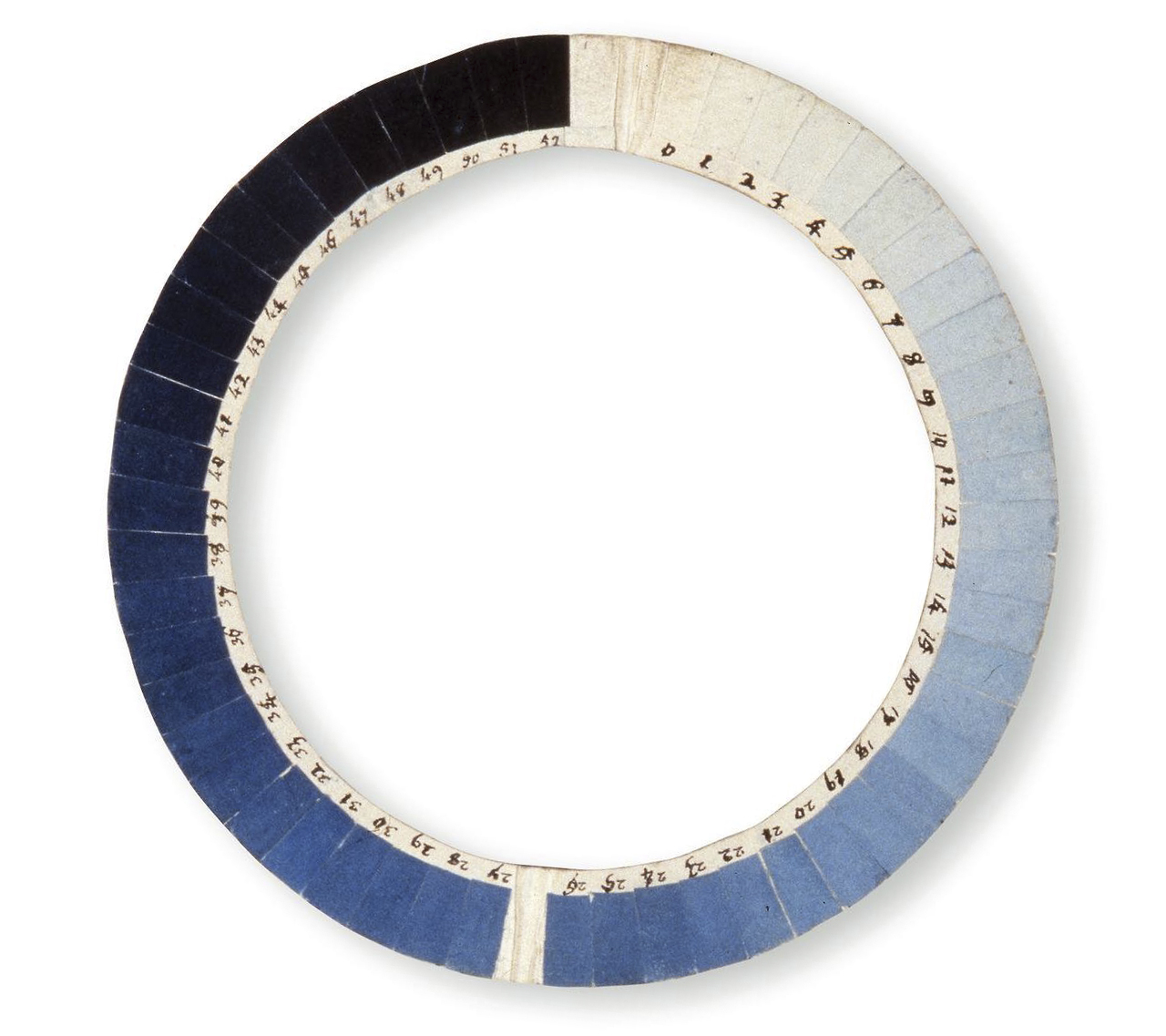
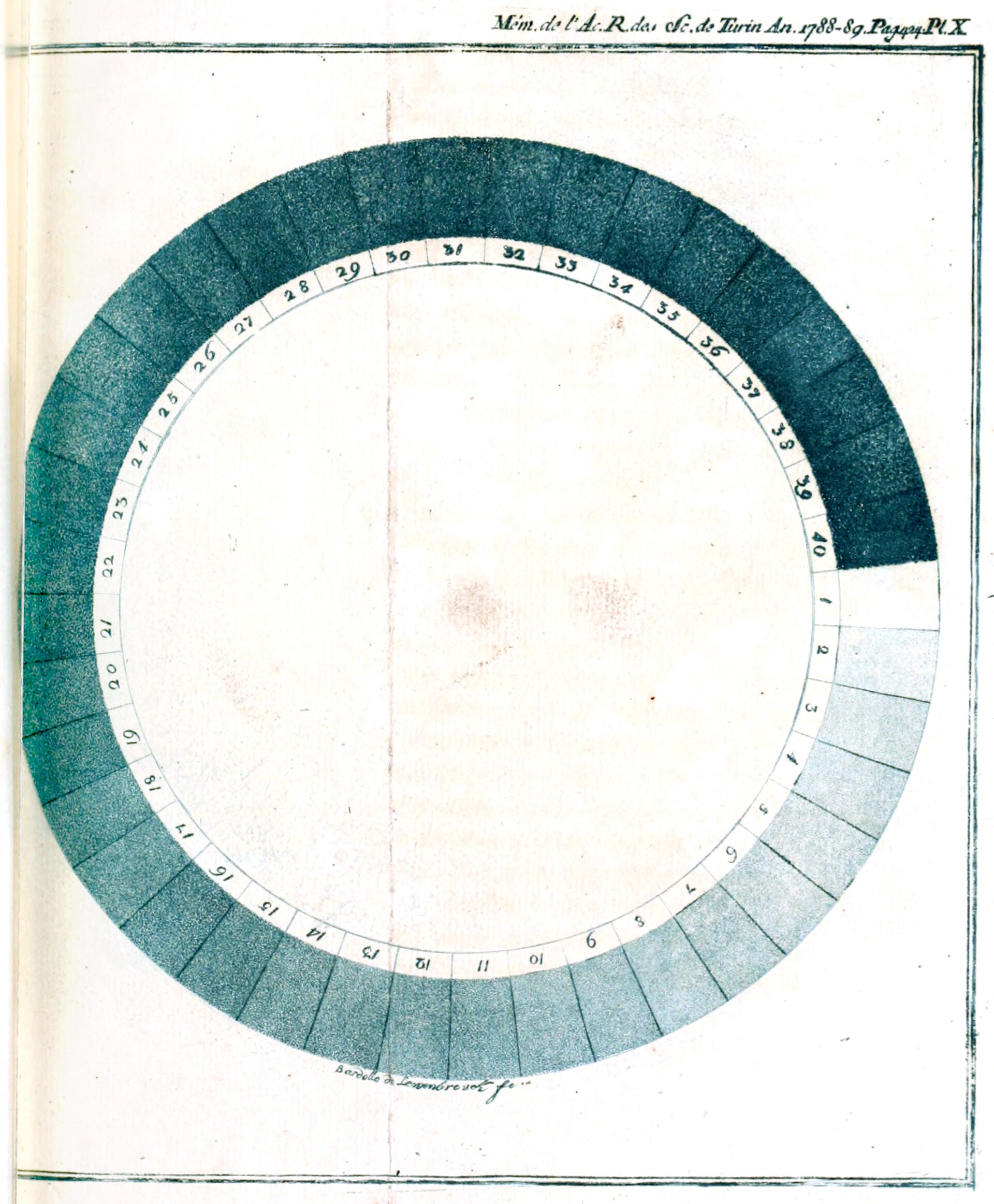
The cyanometer asked a human eye to do a spectrophotometer’s job: hold a numbered blue swatch up against the open sky and say which one matched. Horace-Bénédict de Saussure built the first version in 1787, gluing 16 strips of paper dyed in graduated shades of Prussian blue onto a disc, and carried it up Mont Blanc that August, reading the zenith at the 39th degree on what he’d eventually extend to a 53-stop scale running from white to black. He presented the refined instrument to the Académie Royale des Sciences on 9 May 1790, publishing an illustration of a 40-stop version in that year’s Mémoires. His working theory was that the sky darkened with altitude because there was less water vapor to scatter light back toward the eye — a reasonable guess from a man standing on top of Europe with no way to measure the physics directly, only to compare a swatch to a wheel. Alexander von Humboldt carried a cyanometer across the Atlantic and through the Andes, and on 23 June 1802, climbing Chimborazo in Ecuador, recorded the 46th degree of blue, the darkest sky anyone had matched to the disc — a record that outlasted Saussure’s own by fifteen years and a much taller mountain.
The measurements accumulated for decades and explained nothing. Saussure’s water-vapor theory turned out to be wrong, and no amount of additional readings from additional peaks converted a stack of numbered swatch-matches into a theory of why the sky is blue in the first place. That answer came from physics, not from more paper discs: John Tyndall’s experiments on light scattering by suspended particles, through the 1860s, gave a quantitative account of atmospheric color that made a hand-held color comparison look like exactly what it was — a proxy, not a measurement. The cyanometer got one more life as the Linke–Ostwald blue-scale, a cardboard version numbered 2 to 16 that meteorologists used well into the 20th century to survey atmospheric turbidity, before photoelectric photometers and spectrophotometers took that work over too, recording the wavelength and intensity of scattered skylight directly instead of asking an observer which of sixteen blues looked closest. The physics the cyanometer was built to chase — Rayleigh scattering, now taught in any introductory optics course — is thoroughly understood; the instrument that tried to read it off a paper wheel by eye is a museum curiosity, and Saussure’s 39 and Humboldt’s 46 are numbers on a scale nobody calibrates against anymore.
Worth remembering
- Saussure dyed the paper strips himself by crushing Prussian blue pigment to precise concentrations, then distributed finished cyanometers to friends and fellow naturalists so they could send back readings from their own regions and altitudes.
- Humboldt's 46-degree reading on Chimborazo in 1802 stood as the darkest sky blue ever recorded with the instrument, beating Saussure's own 39-degree reading from the summit of Mont Blanc fifteen years earlier.
Gallery
Sources
- Horace-Bénédict de Saussure, a Swiss physicist, glued 16 strips of paper dyed in graduated shades of Prussian blue onto a disc and used it during his August 1787 ascent of Mont Blanc, measuring the zenith sky at the 39th degree of blue on a scale that was later extended to 53 numbered stops from white to black. ZME Science
- Saussure presented a refined cyanometer to the Académie Royale des Sciences, and an illustration of a 40-stop version appeared in the Académie's Mémoires, presented 9 May 1790 and published that year; the full instrument used in the field ran to 53 graduated stops. Wikimedia Commons
- Alexander von Humboldt carried a cyanometer on his expeditions across the Atlantic and the Andes, and on 23 June 1802, climbing Chimborazo in Ecuador, recorded the 46th degree of blue — the darkest sky blue measured with the instrument, surpassing Saussure's own Mont Blanc reading. Wikipedia
- The color of the sky entered modern meteorology through the Blue-Scale introduced by Franz Linke and Wilhelm Ostwald, a cardboard cyanometer with shades numbered 2 to 16 used to survey atmospheric turbidity well into the 20th century, building on the 1789 instrument of Saussure and Humboldt. ExoDictionary
A graveyard tradition: leave a stone to show you came, and remembered.