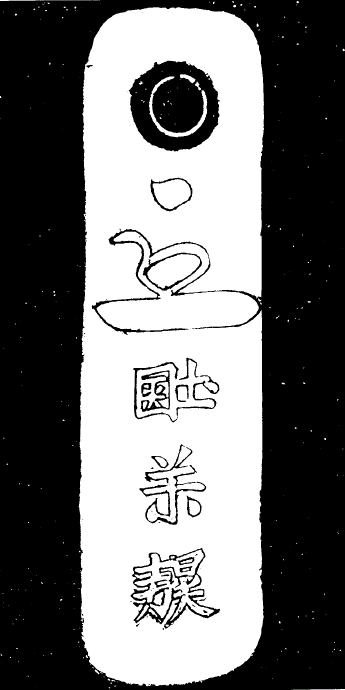
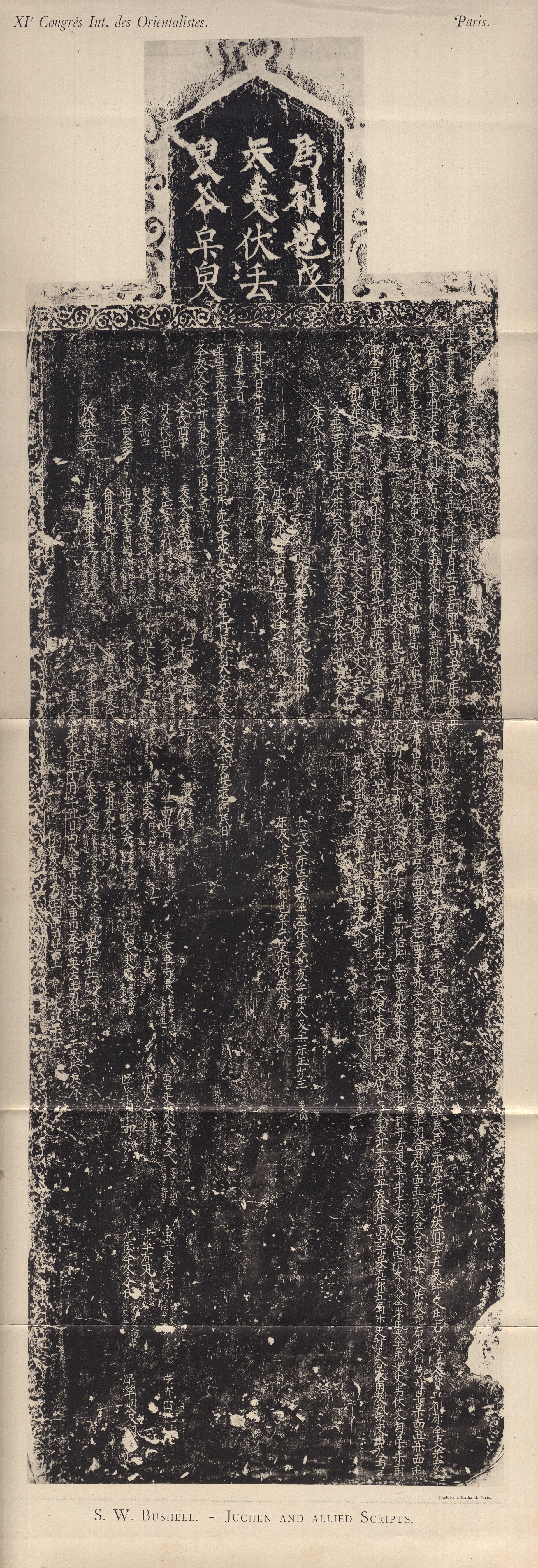
Jurchen was a Tungusic language of the forests and rivers of Manchuria, and for a little over a century it was an imperial tongue. The Jurchen people founded the Jin dynasty in 1115, conquered northern China from the Khitan and the Song, and ruled it until 1234; in 1119 their first emperor, Wanyan Aguda, commissioned a Jurchen script, so that a people newly in command of an empire would write in their own characters rather than their predecessors’. Steles went up across the north in Jurchen, the longest of them more than fifteen hundred characters.
Then the empire fell to the Mongols, and the language receded with its speakers back into the northeastern woods. Over the next three centuries it drifted, ungoverned and largely unwritten — the last dated Jurchen inscription is from 1526 — until a related people, the Manchus, rose in the same region. In 1635 the Manchu ruler Hong Taiji decreed that the old name “Jurchen” be dropped, and the language went on under a new name, as Manchu, which would conquer all of China as the Qing. Jurchen did not so much die as change its name and forget its old one. The irony is doubled: Manchu, the heir that swallowed it, now has only a few dozen fluent speakers of its own.
Worth remembering
- In 1119 the founding Jin emperor had his scholar Wanyan Xiyin devise a Jurchen script from Khitan and Chinese characters — a deliberate act of statecraft, giving a forest people their own writing the moment they began to rule an empire.
- Two centuries after the Jin fell, the Ming dynasty still had to compile bilingual Sino-Jurchen vocabularies at its Bureau of Translators to manage the tribes of the northeast — bureaucratic phrasebooks that are now among the fullest records of a language otherwise nearly lost.
Gallery
Sources
- Jurchen is the oldest attested member of the Manchu-Tungus family; little is known of it because few written examples survive, mainly stele inscriptions in Manchuria and Korea. Encyclopædia Britannica
- Speakers called themselves jušen until the ethnic designation 'Manchu' was adopted by decree in 1635; Jurchen may be regarded as a more or less direct ancestor of Manchu. Kane & Miyake, 'Jurchen', in The Tungusic Languages (Routledge, 2024) / Macquarie University
- The Jurchen 'large script' was created in 1119 by Wanyan Xiyin on the order of the founding Jin emperor Wanyan Aguda, modelled on the Khitan and Chinese scripts; a 'small script' followed in 1138. Berkshire Encyclopedia of China
A graveyard tradition: leave a stone to show you came, and remembered.