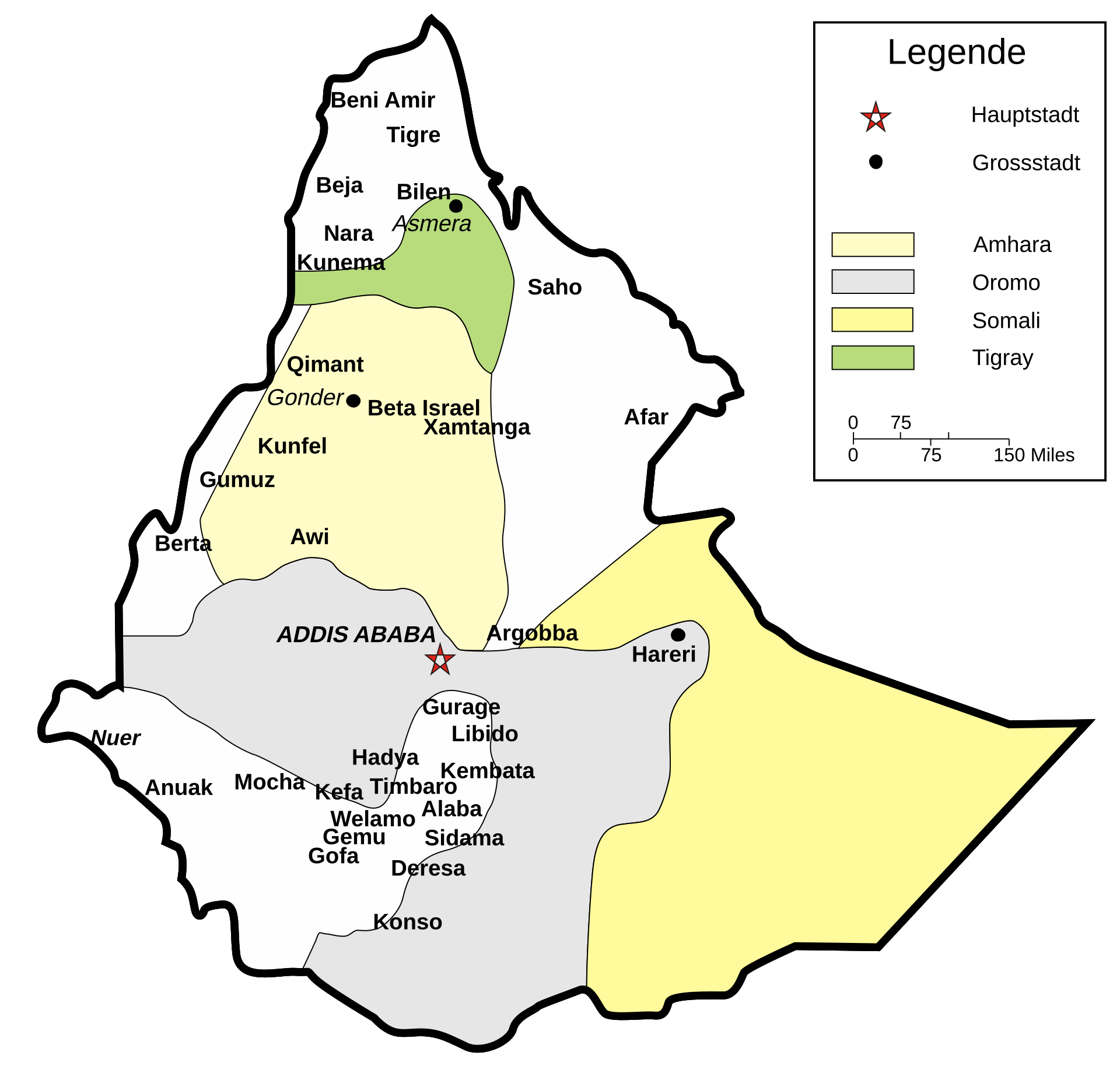
Gafat was a South Ethiopic Semitic language of the Blue Nile country in Gojjam, a distant cousin of Amharic and the Gurage tongues. It had once been ordinary speech for the Gafat people, and was set down in writing at least as early as a manuscript Song of Songs from the seventeenth or eighteenth century. But by the nineteenth, it was already failing: when the traveller Charles Beke tried to collect a Gafat word list in the 1840s, he was told the young no longer knew it.
What killed Gafat was not war but stigma. The dominant Amhara treated the Gafat as outcasts, and the language became a mark of low status — something its own speakers learned to be ashamed of and to use only behind closed doors. When the linguist Wolf Leslau went looking in 1947 to record whatever survived, he found just four elderly speakers after long searching; two were dead within five years. The community completed its shift to Amharic, and Gafat died around mid-century, leaving Leslau’s grammar and the Bodleian manuscript as its headstones. It is the rare grave in this wing that was dug not by an invader but by the speakers themselves, taught to bury their own tongue.
Worth remembering
- By the 1920s Gafat was spoken only in private: the dominant Amhara had branded the Gafat people outcasts, and using the language in public had become a thing to hide — a tongue dying of shame rather than of conquest.
- A seventeenth- or eighteenth-century manuscript translation of the Song of Songs into Gafat survives in the Bodleian Library at Oxford — a written monument to a language that, by the time Leslau published his grammar in 1956, had almost no one left to read it.
Sources
- Gafat is classified as extinct (ISO 639-3 gft; glottocode gafa1240), a South Ethiopic Semitic language of the Afro-Asiatic family. ASJP Database, Max Planck Institute for Evolutionary Anthropology
- Wolf Leslau visited the region in 1947 and, after considerable searching, found a total of four people who could still speak the language; by 1952 two of his four informants had died. Africa (Cambridge University Press), review by Edward Ullendorff, 1958
- By the 1840s the traveller Charles Beke collected a Gafat word list only with difficulty, noting that 'the rising generation seem to be altogether ignorant of it.' Internet Archive — Wolf Leslau, Gafat Documents (American Oriental Society)
A graveyard tradition: leave a stone to show you came, and remembered.