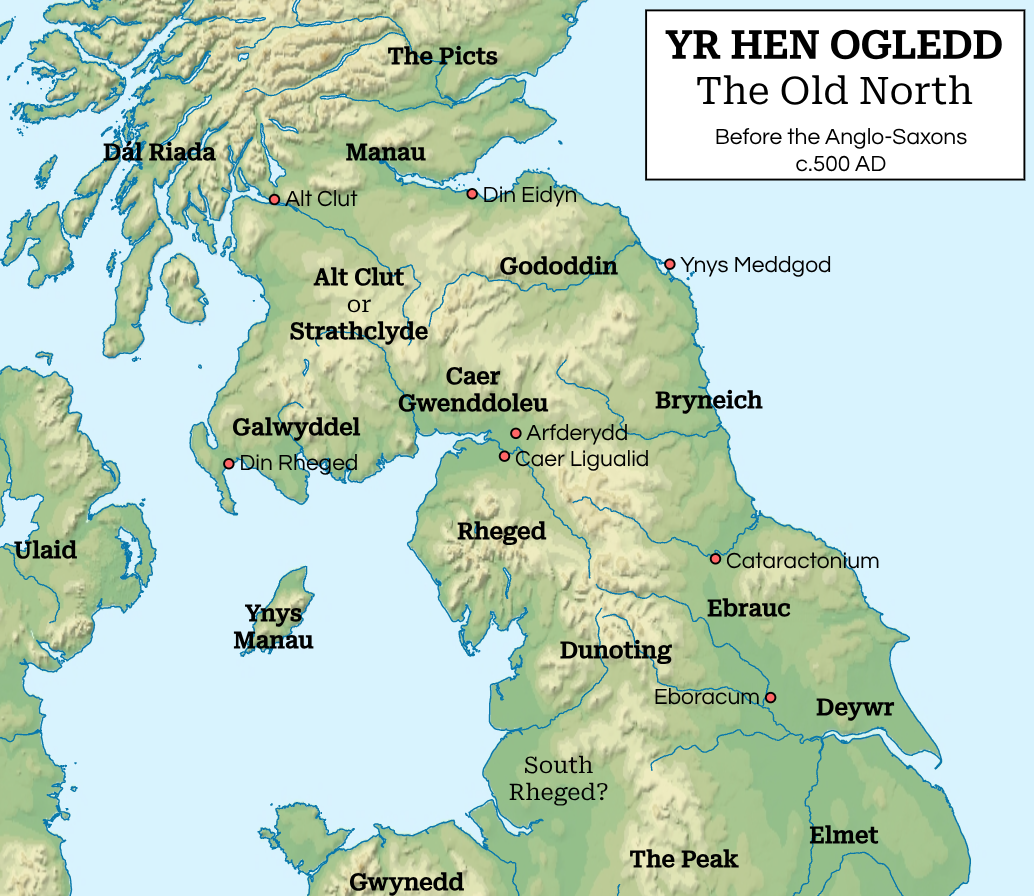
Cumbric was the Brittonic Celtic language of the old north — the Hen Ogledd — the Kingdom of Strathclyde and the country around it, across what is now Cumbria, Lancashire and the southern Scottish Lowlands. A cousin of Welsh and Cornish, it left no text of its own; when Strathclyde was absorbed into Scotland in the eleventh century its speakers shifted to English and Gaelic.
What remains is in the landscape and in counting. Place names carry it — Carlisle, Penrith and Glasgow all hold Brittonic roots — and a base-twenty tally survives as the yan tan tethera numbers shepherds in Cumbria have used to count sheep, nine centuries after anyone last spoke the language they came from. No last speaker was ever recorded; it was gone by around 1150.
Worth remembering
- It used a base-twenty (vigesimal) counting system that survives as the yan tan tethera sheep-scoring numerals still recorded in Cumbrian dialect.
- The language is preserved mainly in place names — Carlisle, Penrith and Glasgow all carry its Brittonic roots.
Gallery
Sources
- Cumbric was a Brittonic Celtic language of north Britain, extinct by the 12th century, surviving in place names and a vigesimal counting system Wikipedia
- Cumbric belonged to the Brittonic branch of Celtic and is known almost entirely from indirect evidence Britannica
- There are no known texts in Cumbric; evidence for the language comes mainly from place names and from personal names recorded in Scottish, Irish and Anglo-Saxon documents. Omniglot
A graveyard tradition: leave a stone to show you came, and remembered.