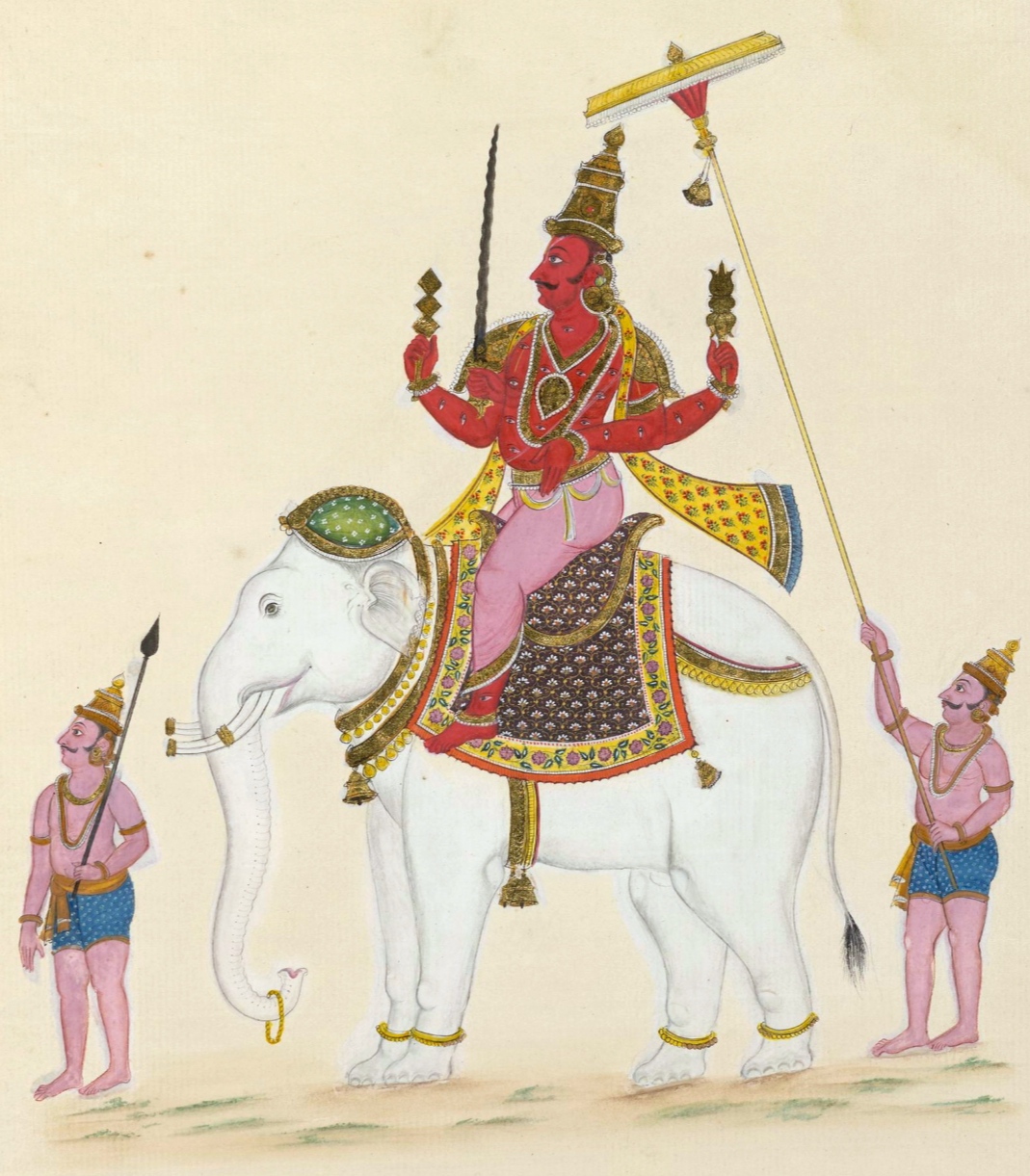
For the Indo-Aryans of the early Rigveda, Indra was the god you called first. More than 250 of the roughly 1,028 hymns of the Rigveda are addressed to him — over a quarter of the entire collection, more than any other deity receives. He was the king of the gods, the storm-borne warrior who wielded the vajra, the thunderbolt, and his central myth was an act of release: he killed the serpent Vritra, who had coiled around the mountains and dammed the waters into drought, split him open while charged on soma, and let the rivers run. He won cattle, broke forts, decided battles. A pastoral, mobile, fighting people facing drought and rival tribes wanted exactly this god — strong, hard-drinking, on their side — and the hymns begged him by name for victory and rain.
Over the 1st millennium BCE the ground shifted under him. As Vedic ritual religion gave way to the devotional cults of the Puranic period, Vishnu and Shiva rose to the head of the pantheon and Indra was relegated to the second tier of gods, a regent of the eastern heavens and of rain rather than the supreme deva. The later myths kept his name while staging his fall: in the Govardhan story Krishna, an avatar of Vishnu, lifts a hill on one finger to shield the cowherds from Indra’s seven-day deluge until the storm-king comes down and bows; in the tale of Ahalya he is caught in adultery and cursed. Where the Rigveda begged him for victory, the Puranas use him as the proud god who has to be humbled. This is not the end of a faith — Hinduism is alive, Indra is still named, still has a heaven and a job. But independent worship of him has effectively vanished; he receives essentially no cult of his own today. The god-king at the centre of the oldest hymns no longer reigns over the religion that first sang them.
Worth remembering
- More than 250 of the Rigveda's roughly 1,028 hymns are addressed to Indra — over a quarter of the whole collection, more than to any other god. He was the warrior king the early Indo-Aryans invoked above all others for victory, cattle and rain.
- His defining deed was killing Vritra, a serpent that had dammed the cosmic waters into drought. Indra, charged on soma, split the dragon with his vajra and let the rivers run, winning the surname Vritrahan, 'slayer of Vritra.'
- The same myths that kept his name later staged his humiliation. In the Govardhan story, Krishna lifts a mountain on one finger to shield the cowherds of Braj from Indra's punishing rain for seven days and nights, until the god of storms comes down and bows — a Vedic sky-king made to kneel to an avatar of Vishnu.
Gallery
Sources
- Indra is celebrated in more than 250 hymns of the Rigveda, the most of any deity, and was the most important god of ancient Vedic Hinduism and the supreme deva of the Rigveda. He wields the vajra (thunderbolt), slew the serpent Vritra to release the waters, and drinks soma; in later tradition he was supplanted at the top of the hierarchy by Vishnu, Shiva and Brahma and relegated to the second level of gods. New World Encyclopedia
- As king of the gods Indra wields a thunderbolt (vajra); he defeated the demon-serpent Vritra, whose death released the waters, earning the surname Vritrahan ('slayer of Vritra'), and he was fond of soma. In later tradition Indra is transformed from a worshipped god into a mythological figure, and gods such as Vishnu and Shiva replace him at the head of the Hindu pantheon. World History Encyclopedia
- More than a quarter of the roughly 1,028 hymns of the Rigveda are addressed to Indra; he is the soma drinker par excellence and king of the gods, and in later Hindu texts Indra loses some of his power as other gods such as Vishnu take his place and his centrality as divine sovereign dwindles in favour of Shiva and Vishnu. Encyclopedia of Religion (Gale), via Encyclopedia.com
A graveyard tradition: leave a stone to show you came, and remembered.